zenpundit.com » cognition

Archive for the ‘cognition’ Category

Reader Recommended Reading

Tuesday, December 15th, 2009

From reader Chris, of the USMC. Ties in well with prior discussions here of the need for cultural-educational-cognitive renovation in American society and the marked inadequacy of the current elite: 

National Affairs -“Keeping America’s Edge” – Jim Manzi

….Reconciling these competing forces is America’s great challenge in the decades ahead, but will be made far more difficult by the growing bifurcation of American society. Of course, this is not a new dilemma: It has actually undergirded most of the key political-economy debates of the past 30 years. But a dysfunctional political dynamic has prevented the nation from addressing it well, and has instead given us the worst of both worlds: a ballooning welfare state that threatens future growth, along with growing socioeconomic disparities.

Both major political parties have internal factions that sit on each side of the divide between innovation and cohesion. But broadly ­speaking, Republicans since Ronald Reagan have been the party of innovation, and Democrats have been the party of cohesion.

Conservatives have correctly viewed the policy agenda of the left as an attempt to undo the economic reforms of the 1980s. They have ­therefore, as a rhetorical and political strategy, downplayed the problems of cohesion – problems like inequality, wage stagnation, worker displacement, and disparities in educational performance – to emphasize the importance of innovation and growth. Liberals, meanwhile, have correctly identified the problem of cohesion, but have generally proposed antediluvian solutions and downplayed the necessity of innovation in a competitive world. They have noted that America’s economy in the immediate wake of World War II was in many ways simultaneously more regulated, more successful, and more equitable than today’s economy, but mistakenly assume that by restoring greater regulation we could re-create both the equity and prosperity of that era.

The conservative view fails to acknowledge the social costs of unrestrained economic innovation – costs that have made themselves ­powerfully apparent in American politics throughout our history. The liberal view, meanwhile, betrays a misunderstanding of the global economic environment.

…. The level of family disruption in America is enormous compared to almost every other country in the developed world. Of course, out-of-wedlock births are as common in many European countries as they are in the United States. But the estimated percentage of 15-year-olds living with both of their biological parents is far lower in the United States than in Western Europe, because unmarried European parents are much more likely to raise children together. It is hard to exaggerate the chaotic conditions under which something like a third of American children are being raised – or to overstate the negative impact this disorder has on their academic achievement, social skills, and character formation. There are certainly heroic exceptions, but the sad fact is that most of these children could not possibly compete with their foreign counterparts.As the lower classes in America experience these alarming regressions, wealthier and better-educated Americans have managed to re-create a great deal of the lifestyle of the old WASP ascendancy – if with different justifications for it. Political correctness serves the same basic function for this cohort that “good manners” did for an earlier elite; environmentalism increasingly stands in for the ethic of controlling impulses so as to live within limits; and an expensive, competitive school culture – from pre-K play groups up through graduate school – socializes the new elite for constructive competition among peers. These Americans have even re-created the old WASP aesthetic preference for the antique, authentic, and pseudo-utilitarian at the expense of vulgar displays of wealth. In many cases, they live in literally the same homes as the previous upper class.

Read the rest here.
Stocking Stuffers……

Saturday, December 12th, 2009

In a burst of raw self-interest – and also a little love for my blogfriends – these books make nifty gifts for any war nerd or deep thinker on your Christmas list:

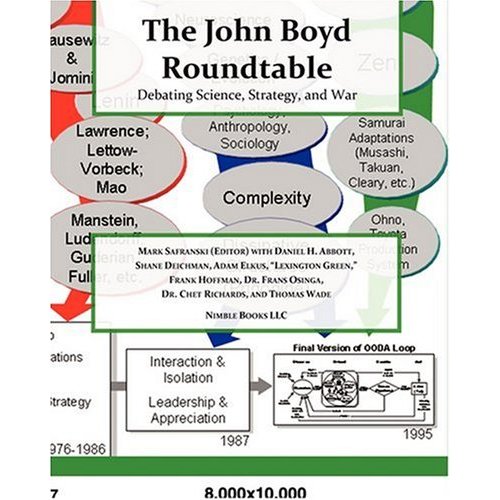
The John Boyd Roundtable: Debating Science, Strategy, and War – Mark Safranski (Ed.)


Threats in the Age of Obama – Michael Tanji (Ed.)

Great Powers: America and the World After Bush – Thomas P.M. Barnett

Brave New War: The Next Stage of Terrorism and the End of Globalization – John Robb

Science, Strategy and War: The Strategic Theory of John Boyd – Frans Osinga


The Genius of the Beast: A Radical Re-Vision of Capitalism  by Howard Bloom

Intelligence and How to Get It: Why Schools and Cultures Count  by Richard Nisbett

Inside Cyber Warfare: Mapping the Cyber Underworld  by Jeffrey Carr

This Is for the Mara Salvatrucha: Inside the MS-13, America’s Most Violent Gang  by Samuel Logan

Full Disclosure:

In copmpliance with new Federal regulations of dubious Constitutional merit, I hearby declare ZP does not accept money for publishing reviews or any paid advertising. Courtesy review copies were extended to me by authors or publishers acting on behalf of Sam Logan, Tom Barnett and Jeff Carr. I edited the first book in this post and was a contributing author to the second one. All of the books, with the exception of Cyber Warfare have been the subject of prior reviews or posts at ZP.

Brief Metacognition

Tuesday, December 1st, 2009

Very, very busy but the following two items struck me as useful advice for sharpening our mental edges.

First, John Robb linked to a series of posts by Eric Drexler of Metamodern. Al of them were good but I particularly liked the following one:

How to Understand Everything (and why)

….Formal education in science and engineering centers on teaching facts and problem-solving skills in a series of narrow topics. It is true that a few topics, although narrow in content, have such broad application that they are themselves integrative: These include (at a bare minimum) substantial chunks of mathematics and the basics of classical mechanics and electromagnetism, with the basics of thermodynamics and quantum mechanics close behind.

….To avoid blunders and absurdities, to recognize cross-disciplinary opportunities, and to make sense of new ideas, requires knowledge of at least the outlines of every field that might be relevant to the topics of interest. By knowing the outlines of a field, I mean knowing the answers, to some reasonable approximation, to questions like these:

What are the physical phenomena?
What are their magnitudes?
What are their preconditions?
How well are they understood?
How well can they be modeled?
What do they make possible?
What do they forbid?

And even more fundamental than these are questions of knowledge about knowledge:

What is known today?
What are the gaps in what I know?
When would I need to know more to solve a problem?
How could I find it?

It takes far less knowledge to recognize a problem than to solve it, yet in key respects, that bit of knowledge is more important: With recognition, a problem may be avoided, or solved, or an idea abandoned. Without recognition, a hidden problem may invalidate the labor of an hour, or a lifetime. Lack of a little knowledge can be a dangerous thing.

Secondly, reading through Richard Nisbett’s Intelligence and How to Get It: Why Schools and Cultures Count ( see this monster, two-partbook review by James McCormick at Chicago Boyz), the intriguing findings of the “Venezuela Project” run by none other than the late Richard Herrnstein of Bell Curve fame. Nisbett writes (74-75):

Herrnstein and his coworkers devised a very advanced set of materials geared to teaching seventh-graders fundamental concepts of problem solving that were not targeted to any particular subject matter. In effect they, they tried to make the children smarter by giving them handy implements for their intellectual tool kits.

What were those non-subject specific, cognitive skills?

  • Basics of Classification
  • Hypothesis Testing
  • Discovery of Properties of Ordered Dimensions
  • Analogies
  • Simple Propositions
  • Principles of Logic
  • Constructing and Evaluating Complex Arguments
  • Weighing opportunity costs vs. probability of success for a goal
  • Evaluating credibility and relevance of data

I would have added metaphors, pattern-recognition and intuitive thinking games but it was a fine set of skills and the results were remarkable, according to Nisbett:

The instruction resulted in big changes in children’s ability to solve problems that the new skills were designed to improve….for language comprehension, .62 SD [ standard deviation]; for learning how to represent ‘”problem spaces,” .46 SD; for decision making, .77 SD; for inventive thinking, .50 SD. In short, general problem solving skills can be taught, and taught moreover in a brief period of time.

In psychometric terms, for a 13 year old, these scores represent phenomenal improvements in cognitive performance and indicate the plasticity of some aspects of measured intelligence. Why have such activities not become commonplace in public schools? Or universities?

Why indeed?

The Internet is Re-Wiring your Brain….in a Good Way

Tuesday, October 20th, 2009

More fodder for the digital vs. dead tree debate:

UCLA Study: The Internet Is Altering Our Brains

….After the initial brain scan, subjects went home and conducted Internet searches for one hour a day for a total of seven days over a two-week period. These practice searches involved using the web to answer questions about various topics by exploring different websites and reading information. Participants then received a second brain scan using the same Internet simulation task, but with different topics.

The first scan of participants with little Internet experience showed brain activity in the regions controlling language, reading, memory and visual abilities. The second brain scan of these participants, conducted after the home practice searches, demonstrated activation of these same regions, but there was also activity in the middle frontal gyrus and inferior frontal gyrus – areas of the brain known to be important in working memory and decision-making.

….The results suggest that searching online may be a simple form of brain exercise that might be employed to enhance cognition in older adults,” Teena D. Moody, the study’s first author and UCLA researcher, said in a statement.

When performing an online search, the ability to hold important information in working memory and to take away the important points from competing graphics and words is essential, Moody noted.

I will be interested in seeing brain scan comparisons between digital natives who were on computers from the time they were toddlers, and the digital immigrants.  My son, for example, learned to read on his own long before pre-school from looking at words on a computer screen ( less “learned” than spontaneously “realized” the symbol-sound-conceptual connection ) while his sister, who had a more traditional exposure to reading, learned later ( more “taught”).

Another difference, while they are both equally skilled at reading, adjusted for an age, she is an avid reader who devours large books (mostly fiction) while her brother reads instrumentally, for knowledge or expository explanations (mostly natural science subjects. Only “Clone Wars” attracted him to read fiction).

The Grand Failure of my Summer Reading List

Saturday, October 10th, 2009

Ancient library

Ah, I am over a month late on a promised follow up post!

Back in early June, I composed a hyper-ambitious Summer Reading list that I wanted to plough through on those hazy, lazy, dog day afternoons. Here was my list:

THE SUMMER READING LIST:

Military History and Strategy

Wired for War: The Robotics Revolution and Conflict in the 21st Century – PW Singer (Finish, currently reading)
The Anabasis of Cyrus (Agora) – Xenophon
The Accidental Guerrilla: Fighting Small Wars in the Midst of a Big One – David Kilcullen
The Scientific Way of Warfare: Order and Chaos on the Battlefields of Modernity
 – Antoine Bousquet
The Culture of WarMartin van Creveld
Certain to WinChet Richards

Science, Futurism, Networks, Economics and Technology

How the Mind Works – Steven Pinker
Fooled by Randomness: The Hidden Role of Chance in Life and in the Markets
 – Nassim Nicholas Taleb
Emergence: The Connected Lives of Ants, Brains, Cities, and Software
 – Steven Johnson
The Singularity Is Near: When Humans Transcend Biology
 – Ray Kurzweil
The Hyperlinked Society: Questioning Connections in the Digital Age (The New Media World)
Lokman Tsui

Biography

Ho Chi Minh: A Life William J. Duiker

Philosophy and Intellectual History

The Open Society and Its Enemies, Vol. 1: The Spell of Plato
The Open Society and Its Enemies, Vol. 2: Hegel and Marx – Karl Popper
The Closing of the Western Mind: The Rise of Faith and the Fall of ReasonCharles Freeman

Fiction

Pattern Recognition – William Gibson
On the Road (Penguin Classics)Jack Kerouac

Pretty impressive, eh? It would be more so if I had actually done it. While I have all of these books on my shelf, I did not get to most of them and was frequently sidetracked by books that were never on the list in the first place. Here’s what I actually read this summer between Memorial Day and Labor Day:

The Books I Really Read Last Summer:

Emergence: The Connected Lives of Ants, Brains, Cities, and Software – Steven Johnson

Wired for War: The Robotics Revolution and Conflict in the 21st Century – PW Singer

The Bloody White Baron: The Extraordinary Story of the Russian Nobleman Who Became the Last Khan of Mongolia by James Palmer

This Is for the Mara Salvatrucha: Inside the MS-13, America’s Most Violent Gang by Samuel Logan

 Horse Soldiers: The Extraordinary Story of a Band of US Soldiers Who Rode to Victory in Afghanistan by Doug Stanton

The War of Art: Break Through the Blocks and Win Your Inner Creative Battles by Steven Pressfield

The Anabasis of Cyrus (Agora) by Xenophon. Translator,  Wayne Ambler

How Rome Fell: Death of a Superpower by Adrian Goldsworthy

The Books I Partially Read Last Summer but Have Yet to Finish:

The Culture of War – Martin van Creveld

 Certain to WinChet Richards

The Conquest of Gaul  by Julius Caesar on Kindle

Why didn’t I stick to my reading list ? Looking back, there’s a number of reasons.

Foremost would be a lack of discipline on my part to put in several hours plugging away, each day, without fail. While I can legitimately say that professional and family commitments were not inconsequential last summer, I’m sure if I counted up the time I frittered away online reading blogs, social media sites, PDFs, etc. it most likely exceeded the clock hours spent reading books.

A second reason was review copies. When a publisher or PR firm sends me a review copy, I feel an obligation to read the book in a timely fashion. The authors count on that during the roll-out phase and most recipients of review copies never bother to write two words. I tend to write reviews only for the books I feel confident recommending to ZP readers; I’m not a professional critic nor do I get paid to blog, so I’m not going to waste my limited blogging time slamming an author or nitpicking unless his views come across as nutty or dangerous. Review copies that are not at a level to merit a positive review ( I probably get sent 3 books for every review that you see posted here, and I refuse to accept books outside my core areas of interest. I also get embargoed drafts still in the writing process but cannot, for legal reasons, blog about them) are read and then are shelved or given away.

The final reason probably comes down to age. It’s much harder now to read four or five hours at a stretch; whether that is because the internet is re-wiring my brain, as Nick Carr argues, or that the hectic pace and noisy environment of my life lacks any such extended blocs of quiet time that I enjoyed at age 20, I’m not sure.  Regardless, for me, books are now read in brief snatches of time these days, with an uninterrupted hour of book reading being uncommon, unless it is done after everyone else in the house is asleep. Over time, that means reading fewer books.

A shame.


Switch to our mobile site