Benedict XVI — a reading between the lines
Friday, September 23rd, 2011[ by Charles Cameron — Benedict XVI, Lutherans, ecumenism, C Peter Wagner’s “new paradigm” of Christianity ]
.
Photo: Pope Benedict XVI and Nikolaus Schneider (R), Chairman of the Council of the Evangelical Church in Germany (EKD) attend the Ecumenical Service of the World in the church of the Augustinian Monastery in Erfurt, September 23, 2011. Credit: Reuters / Norbert Neetz / Pool
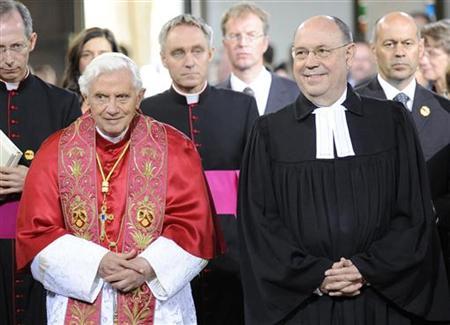
Earlier today, Pope Benedict visited the cloister in Erfurt which once housed Martin Luther, for an ecumenical meeting with leaders of the Evangelical Church in Germany (EKD), a mainline Protestant coalition of Lutheran, Unified and Calvinist churches.
In the course of his presentation, the Pope made clear his admiration for Luther himself:
As the Bishop of Rome, it is deeply moving for me to be meeting representatives of Council of the EKD here in the ancient Augustinian convent in Erfurt. This is where Luther studied theology. This is where he was ordained a priest in 1507. Against his father’s wishes, he did not continue the study of Law, but instead he studied theology and set off on the path towards priesthood in the Order of Saint Augustine. On this path, he was not simply concerned with this or that. What constantly exercised him was the question of God, the deep passion and driving force of his whole life’s journey. “How do I receive the grace of God?”: this question struck him in the heart and lay at the foundation of all his theological searching and inner struggle. For him theology was no mere academic pursuit, but the struggle for oneself, which in turn was a struggle for and with God.
“How do I receive the grace of God?” The fact that this question was the driving force of his whole life never ceases to make an impression on me. For who is actually concerned about this today – even among Christians?
That’s a striking utterance from the holder of the office that Martin Luther so often assailed, writing (for instance):
St. Paul calls Antichrist the man of sin and the son of perdition, because through his precepts and laws he will turn all the world from God and prevent God and the world from coming together; he shall be a master of sin and all iniquity, and yet will retain the name and appearance of Christ and call himself Sanctissimus and Vicarius Dei and Caput Ecclesiae [“most holy one; vicar of God; head of the Church”], and persecute all who will not obey him. It is easy to recognize that the pope more than fits this description.
Things have clearly changed since that time, and the US branch of Lutheran World Ministries has proposed to its member churches:
That they officially declare that the Lutheran commitment to the Confessions does not involve the assertion that the pope or the papacy in our day is the anti-Christ.
It is not, therefore, the Evangelical Churches (ie mainstream Protestants like the Lutheran and Reformed churches) that Benedict is thinking of when he raised an issue that obviously disturbs him, saying:
The geography of Christianity has changed dramatically in recent times, and is in the process of changing further. Faced with a new form of Christianity, which is spreading with overpowering missionary dynamism, sometimes in frightening ways, the mainstream Christian denominations often seem at a loss. This is a form of Christianity with little institutional depth, little rationality and even less dogmatic content, and with little stability.
The matter seems urgent to Benedict, precisely because, as he had just said:
It was the error of the Reformation period that for the most part we could only see what divided us and we failed to grasp existentially what we have in common in terms of the great deposit of sacred Scripture and the early Christian creeds. The great ecumenical step forward of recent decades is that we have become aware of all this common ground and that we acknowledge it as we pray and sing together, as we make our joint commitment to the Christian ethos in our dealings with the world, as we bear common witness to the God of Jesus Christ in this world as our undying foundation.
Catholics and Lutherans may still have their differences – but on “the great deposit of sacred Scripture and the early Christian creeds” they have much in common – and it is of this common ground that Benedict says, “The risk of losing this, sadly, is not unreal” immediately before speaking of the new “form of Christianity with little institutional depth, little rationality and even less dogmatic content, and with little stability”.
The Pope continues:
This worldwide phenomenon poses a question to us all: what is this new form of Christianity saying to us, for better and for worse? In any event, it raises afresh the question about what has enduring validity and what can or must be changed – the question of our fundamental faith choice.
The Pope is a diplomat, and he is expressing his concern as diplomats do, in a carefully worded, highly generalized and eminently tactful way. But can we read between the lines? What does the Pope mean by “this new form of Christianity”?
The “world” of Christianity is changing very rapidly, both demographically and doctrinally, and that’s putting things mildly. I hope to address some of these changes in a series of future posts on ZP — but for now, let me just say we should watch Pope Benedict’s future utterances closely for further signs of exactly what worries and what encourages him.
*
I cannot image, for instance, that Benedict would be altogether comfortable with what C Peter Wagner of the new Apostolic Reformation refers to in his forward to Bishop Bill Hamon‘s book Apostles, Prophets and the Coming Moves of God: End Times Plan for His Church on Planet Earth as
my “paradigm shift” from traditional Christianity to an openness to the person and to the full ministry of the Holy Spirit.
This “full ministry of the Holy Spirit” includes, as the title of Harmon’s book suggests, the idea that Apostles and Prophets will arise in our times, which are the End Times.
In his book Apostles Today: Biblical Government for Biblical Power, Wagner states:
We are now living in the midst of one of the most epochal changes in the structure of the Church that has ever been recorded. I like to call it the “Second Apostolic Age.”
Wagner goes on to say, “The Second Apostolic Age is a phenomenon of the twenty-first century” and then identifies four “notable movements of the Spirit of God” that “have been building the foundation of the Second Apostolic Age for several decades.” These are (pp. 8-9):
- The African Independent Churches
- The Chinese House Churches
- The Latin American Grassroots Churches
- The U.S. Independent Charismatic Movement.
Is any of this beginning to sound like the “new form of Christianity, which is spreading with overpowering missionary dynamism” that Benedict mentioned – a “form of Christianity with little institutional depth, little rationality and even less dogmatic content”?
Let’s turn back to Bishop Bill Harmon for a moment. Hamon himself appears to be clear that he is both an apostle and prophet. In the body of the book which I linked to above – and not on the dust jacket, where over-the-top praise from an author’s friend is commonly found — he quotes one of his supporters, Dr Henry Ramaya of Grace Assembly, Fasan, Malaysia, who writes:
The global recognition and acceptance of bishop Bill Harmon as Father of the Apostolic-Prophetic movement speaks for itself.
and refers to Harmon as “the Apostle Prophet Statesman”.
Dr. Ramaya’s description of the apostolic and prophetic functions, also quoted by Harmon in his book, puts both the missionary and apocalyptic elements of this movement together in a nutshell:
The apostle is God’s vehicle of invasion like light invading darkness, and the prophet is God’s ultimate weapon of warfare. This end-time Apostolic-Prophetic Movement will climax into the apocalypse with a spontaneous outburst of joy because the missionary mandate will be fulfilled.
And one last quote, if I may.
According to notes published on the Elijah List, a listserve that supports the New Apostolic Reformation agenda, Bill Harmon told an “International Gathering of Apostles and Prophets” back in 1999:
We are seeing prophets and apostles coming forth for a strategic reason. … We are about to move from the dispensation of grace to the dispensation of dominion. We are about to see Jesus, not as the suffering lamb that was slain, but the roaring Lion who is King!
If we’d be well-advised to follow Pope Benedict’s further utterances, we should also take note of sources like the Elijah list, and critical considerations of the movement, like those posted on such Evangelical sites as Herescope.
*
Please note that I am not saying that Benedict’s remarks were directed specifically at the New Apostolic Reformation — they were diplomatic and highly generalized for good reason — merely that the NAR is a prominent, if not the preeminent, manifestation of the kind of shift that Benedict is talking about. The second section of this analysis, in other words, is simply one person’s attempt to “read between the lines”…
And did I really just promise to write a series of posts on demographic and doctrinal shifts within Christianity?
Also in the pipeline, a series on the psychological impact of ritual and ceremonial, whether of state, military or religious origin, and a series on the “other wing” of AQ’s jihad, the Ghazwa-e-Hind hadith, Pakistan’s ISI and related matters.