Pew on the prevalence of Mahdism — take heed!

Given the “religious fault line” of mixed conflict and amicable coexistence between Christians and Muslims running across Africa from (so to speak) Nigeria to Somalia, with Boko Haram and Al-Shabaab among the less delightful participants, keeping an eye out for signs of Mahdist “semiotic arousal” would be important here, too.
**
And “semiotic arousal” — that reminds me. Richard Landes, who coined the term, has the definitive, encyclopedic book out about all the many forms of apocalyptic, and why they’re important: Heaven on Earth: The Varieties of the Millennial Experience Essential reading, if you ask me, on a hugely neglected and no less critically important subject.
**
Finally, here’s yet another Pew graphic —
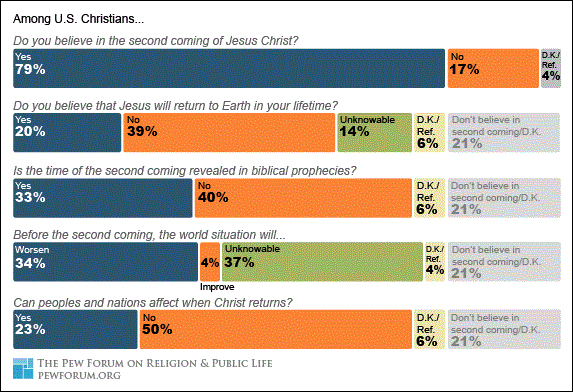
— to be viewed in conjunction with this one, illustrating the ways in which belief in the Second Coming of Christ correlate with opinions about scriptures and the State of Israel:

**
Prophecy has impact, both on public opinion and on believing leaders. Jews with an expectation of the Messianic era, Christians expecting the soon Coming of Christ, and Muslims with Mahdist expectations each have their own apocalyptic scenarios, and in each case those scenarios exert some influence on policies relating to the Middle East and the Israeli-Palestinian situation in particular.
The bottom line?
Scriptural interpretation — and prophetic eschatology in particular — can no longer be assumed to be a quiet backwater topic for rabbinic students, seminarians and future mullahs to study, each in terms of their own tradition. It is now a series of conflicting drivers of current affairs — of war and peace.
Page 3 of 3 | Previous page
Tim Furnish:
August 12th, 2012 at 7:06 pm
Charles,
Excellent analysis. And yes, there’s more to what’s going on in Islamic life, even in Afghanistan, than Mahdism. I was a bit too glib in my take, and I will refine it in a piece I’m writing today for History News Network.
I emailed the Pew folks and asked some questions of whomever had the sense to put in the Mahdism (and Jesus’ return) questions. Let’s see if I hear back.
I would note that regarding the expectations of Jesus’ return among Christians, and the Mahdi’s (and the Islamic Jesus’) coming among Muslims, that historically the former does not usually result in violent holy war, whereas the latter often has.
Tim
larrydunbar:
August 12th, 2012 at 9:02 pm
As the Red States are about to elect the first non-Christian as 1/3 of the government, it is too bad Pew didn’t include non-Christians in the U.S. polls. Perhaps this is the Sign? 🙂
Charles Cameron:
August 12th, 2012 at 9:17 pm
Thanks, Tim.
.
I look forward to your HNN piece — and I’m glad you’ve written to Pew, I was thinking of doing the same. Please keep us updated…
.
WRT the expectations of the Coming / Return / Raj’a), it always strikes me that the big questions include whether the prophetic expectation includes a war either (a) before or (b) at the time of the return, and also whether the arrival can be brought on / hastened by bringing about (c) war, or (d) peace on earth — the “birthpangs of the Messiah / Hotwiring the apocalypse” question with which you’re only too familiar, and on which I often quote you.
.
As to the Christian expectation and violence, material or spiritual — a lot depends (IMO) on how one interprets passages like Ephesians 6.14 (“having your loins girt about with truth, and having on the breastplate of righteousness”) and Revelation 19.21 (“And the remnant were slain with the sword of him that sat upon the horse, which sword proceeded out of his mouth: and all the fowls were filled with their flesh”).
.
There’s an interesting passage in LaHaye and Jenkins’ Glorious Appearing (the last in the Left Behind series) which somehow manages to make a literal (and martial) meaning out of what I take to be a metaphorical (and spiritual) one:
There are (again, IMO) a lot of tripwires and traps in scriptural interpretation…
Charles Cameron:
August 12th, 2012 at 9:41 pm
Hi Larry:
.
I’m off to do some paid work, but I’ll be back…
Tim Furnish:
August 12th, 2012 at 11:10 pm
But Charles, I would submit that there are several light-years of difference between mere violent exegetical rhetoric (as is the norm in Christian circles) and actual violence (as is far too often the norm in Islamic Mahdism.
morgan:
August 13th, 2012 at 12:18 am
Larry, if you assume the current occupant of the White House is a Christian., I have my doubts.
Charles Cameron:
August 13th, 2012 at 4:22 am
Morgan:
.
I don’t have any doubts as to the faith that Obama professes, but I do think Mark Twain had a point — not the only point by any means, but an incisive one, when he said in his Notebook (1898):
Or to put that another way — we’re extremely fortunate when a finite being manages to be reasonably transparent to the infinite. The Imitation of Christ is not an easy matter.
Charles Cameron:
August 13th, 2012 at 4:39 am
Tim:
.
Yes, I agree — but having had a father who fought Hitler and a mentor who battled apartheid, I’m also aware that hatred can at times sweep across whole nations to disastrous and inhuman effect.
.
It’s the potential for hatred — on whatever side — that worries me.
Charles Cameron:
August 13th, 2012 at 4:43 am
BTW, Tim:
.
Joel Richardson now has a piece up about the Pew / Mahdi poll figures, and quotes you:
.
http://www.wnd.com/2012/08/belief-in-mahdi-widespread-in-islamic-world/
.
See also:
.
http://www.wnd.com/2012/08/670-million-muslims-expect-madhi-in-their-lifetime/
morgan:
August 13th, 2012 at 5:36 am
Charles, let’s just say I respectfully disagree
Charles Cameron:
August 13th, 2012 at 4:47 pm
Respectfully agreed.
Tim Furnish:
August 13th, 2012 at 7:53 pm
Gentlemen: I turned the blog into a 2,700 word article: http://hnn.us/articles/mahdism-and-sectarianism-and-superstition-rises-islamic-world
Charles Cameron:
August 13th, 2012 at 8:06 pm
Thanks, Tim.
.
I have a post in the works on Pew’s findings on belief in the jinn — I’m glad to see at a first glance that you’re also exploring that angle.
.
Oops, I almost typed angel — perhaps unconsciously following St Gregory‘s maxim Non Angli, sed angeli, or simply confusing two ranks of supernaturals.
Tim Furnish:
August 14th, 2012 at 5:27 pm
I saw that, Charles, but have yet to read it all. I will, however!
Cristina Caravaggio Giancchini:
February 27th, 2014 at 7:58 pm
Hey Charles,
When I last read about the Mahdi (before our recent conversations) I found it interesting how different the Muslim Eschatology is from the Christian and Jewish ones: for the Mahdi to return violence seems to be a requirement to herald his coming; for Christ to return it is said that one of the requirements is the establishment of Israel; and for the Mashiach to come Jews must be righteous and do good deeds.
It is very interesting.
Marvellous post and yes, we should take heed indeed.
Regards