THE FIRST REBUTTAL: HISTORY AND SPREADING DEMOCRACY
Delayed but not denied, here is the first rebuttal in the Spreading Democracy Debate with Cheryl “CKR” Rofer of Whirledview. CKR’s original post can be found here. Her first rebuttal is here :
I’d like to begin by stating that, speaking as someone trained as a historian, it was a pleasure to read CKR’s first post because she demonstrated an excellent grasp of the field of history. That’s not something I run across every day and it was very nice to see.
CKR drew attention to the methodological core of using history in the formation of solutions for contemporary foreign policy problems:
“As people search for a way to get a handle on large events, historical analogy is not the worst of these tools. The problem with history is that events are never quite the same. It’s essential to look at historical context, but discussion in the US too frequently mixes politics in. The analogies of Vietnam to Iraq frequently display these difficulties. Vietnam was a geographical backwater; Iraq is square in the center of the Middle Eastern oil country. Casualties in Vietnam were much higher than they are in Iraq, and to a conscripted army. Both of those statements have enormous ramifications. Each could be expanded into a book.
Responsible analysis would examine subsets of those ramifications for similarities and differences, then test theory against them. Politicization takes the facts that agree with me and arranges them against the other guy’s argument.”
Jonathan Dresner, a Japan specialist who blogs at Cliopatria, has argued in the past on HNN that historians are well-trained in terms of analytical skills and an appropriately large cognitive base to render judgments about foreign policy. Naturally, I agree with him but forming policy, as opposed to simply critiquing policy, is an action of synthesis which requires a mental shifting of gears by the historian whose habitual cognitive state is analysis. Analysis is a superb tool for deciding how a system works, might work and where it it does not; in other words, for discovering causation and predicting effect. ( Source for Diagram here )

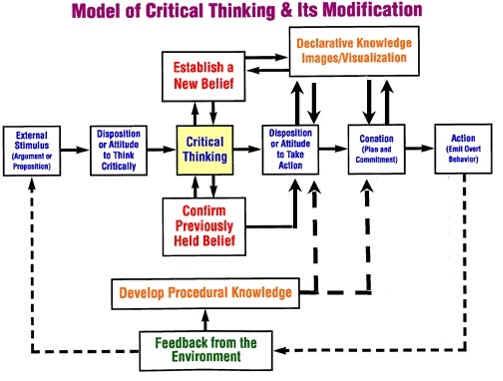
This explains why most historians ( and most policy experts for that matter) are best at figuring all the ways a proposed policy will not work. Analysis is fundamentally a tool of criticism and not creativity. Or in the words of John Boyd, you can get in to a mental cul-de- sac of ” Paralysis by analysis”. Synthesis, by contrast, is a horizontal -thinking act of creativity which is what you need in order to devise solutions to policy problems. ( For a diagram that explains creative insight, go here).
Page 1 of 2 | Next page