YOUR SYSTEM ADMINISTRATION FORCE CANNOT HAVE FEET OF CLAY

Much has been written about the immense difficulties experienced by the U.S military in occupying Iraq and defeating the multifaceted Iraqi insurgency. While tactics, politics and civilian leadership have all come under fire, most critics have zeroed in on having insufficient numbers of troops, blaming in particular Secretary of Defense Donald Rumsfeld and then Deputy Secretary Paul Wolfowitz for overruling Army Chief of Staff General Eric Shinseki’s recommendation for a much larger invasion force. As it turned out, Saddam’s much-feared but ramshackle regime probably could have been toppled by a lower numbers of troops closer to what had been advocated by Wolfowitz but the occupation of Iraq would have been better served by the larger force recommended by Shinseki. Better served but I would argue not well-served. Numbers alone are not the whole story – something critics and supporters of the war alike have missed entirely.
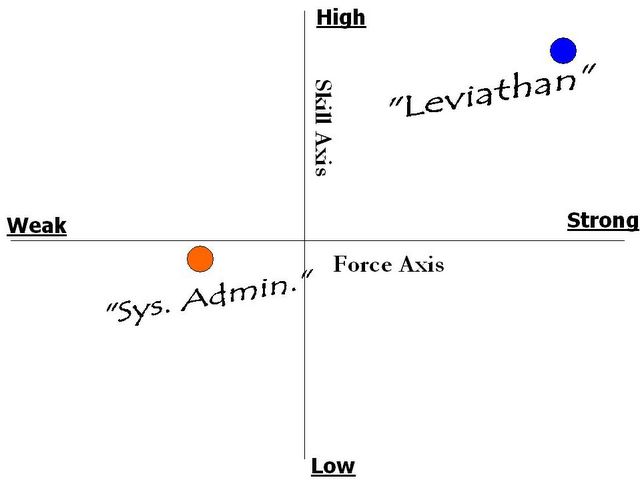
Dr. Barnett in The Pentagon’s New Map illustrated the “Leviathan” – ” System Administration” division of task and structure that the U.S. military is going to need to adapt to in the 21st century. In Blueprint for Action, Barnett expounds on the lessons Iraq has had for that conceptual division. They are numerous and I will leave them for my future review of BFA . I will however, add my two cents to the discussion. The overlooked aspect of this debate has been the critical misallocation of skills in Iraq – something that will continue even if the military is re-orged into Sys Admin and Leviathan forces unless the problem is recognized and taken into account.
Both Sys Admin and Leviathan forces – or any effective military for that matter – require a continuum of skills to function in the field for any extended period of time. Leviathan would have an overall systemic bias toward very high-end and specialized skill-sets but even so it would still need its share of clerks, cooks and humble enlistees to do mundane tasks like delivering the mail, emptying the trash, pulling guard duty and K.P. System Administration, being very human intensive in terms of security and interactivity with locals, requires a far larger number of personnel to perform low-end skill tasks that while not very glamorous, in the aggregate, if left undone, will create mission failure, low morale and numerous situational hazards. Sys Admin has its high-end skill slots to be sure, particularly in engineering and logistics, but the ratios are skewed differently than with Leviathan.
In Iraq the United States has a high-end skill-set military force configured structurally to destroy other great power conventional militaries attempting to do Sys Admin work while simultaneously waging a counterinsurgency war. We are not simply short ” X” number of boots – though more boots would help – we have local commanders cannibalizing their highly skilled experts in a seat-of-the pants manner to do the mundane tasks needed to simply keep the unit functioning as a military force. We are short on the low-end skills and this is creating massive systemic ineffiencies, essentially diseconomies of scale. One contact of mine who served in Iraq doing some rather dangerous field work during the CPA period first as a USG official then as a private contractor, put it this way:
“…The US Army is horrible understaffed,there are 33% of the interrogators in the military as there were 10 years ago and there weren’t enough then. The army is short in nearly every manning position so if a commander happens to have an interrogator there is not guarantee that they will be working in that capacity, they may well be a mail clerk because the unit doesn’t have enough of them either.”
The absence of a robust amount of low end but vital support personnel are part of the problem and one not solved by getting more of the same. Or by hiring a legion of private contractors to to freelance problems as best they can. You don’t use Navy SEALS to do bodyguard duty, you don’t want psychological warfare experts supervising the motor pool. Any economist looking at what the military is doing or is forced to do with it’s people would predict a series of negative outcomes as the effects of inefficiency begin to accumulate.
High-end skill-set personnel will do low-end jobs for a time, to pitch-in and help as it were, but in the end they get sick of being misused and leave the service, taking their valuable skills elsewhere.



September 5th, 2005 at 7:52 pm
I think you mistake the situation. Winning the peace was always about creating an Iraqi society that had the opportunity, and took it, to reform itself into a nation-state that was not doomed to failure, a state that had its own heroes, its own liberty tree nourished with the blood of patriots and tyrants.
Would a Shinseki quantity force have achieved that? I think not. There would have been no need for Iraqis to step up. The US would have done it all for them. Such a state would not have the requisite foundational heroes to weave the national myths necessary for it to survive the long haul. We would have lost the peace. We just would have put off the day we realized we had lost it until later.
The myth and poesy of Gap shrinkage is important but not something that you really can get at in a budget line dominated world. It is, however, vital. The PRC is demonstrating, in slow motion, how you can do so many things right but still fall to pieces without those foundational myths, that national poetry.
Iraq was created by Winston Churchill, not God, it has been said. After they succeed in building their country, they will be able to say that the blood of their patriots, their tyrants mingled and nourished their own tree of liberty. Winston Churchill will no longer be their creator, neither will George W Bush, nor any Sys Admin force.
I would say that not only is it not true that “Your System Administration force cannot have feet of clay” but that it is vital that they have at least a bit of podiatric clay for success. If we are not to truly create an empire, we must fail abroad. It is our allies that must succeed.
September 6th, 2005 at 2:59 am
Hey TM,
Actually, I think we are talking about two different things. Or at least different ends of the spectrum of of the same thing.
I don’t dispute that the U.S. could ” overdo it” in terms of nation-building by not expecting enough initiative to come from the Iraqi side. That was certainly the case with South Vietnam and also the case with the bungling CPA administration.
The ” mythic” idea is interesting. I understand what you are getting at – kind of like Konrad Adenauer stepping up as Chancellor to give Germans a new national identity as part of the liberal West after WWII.
Unfortunately, Iraqis tend to subscribe more to the myths of their internal community – Kurd, Shiite, Sunni Baathist and Sunni Salafist – than a national one. The Shiites in particular have a powerful ideation built around the martyrdom of Ali that is unlikely to be eclipsed. And what current nationalist script they all share is anti-Western. That could have been overcome but many political moments were squandered to no purpose. Hopefully, we won’t squander whay chances remain.
In any event, my point ran more toward the internal/functional aspect of the System Administration force than the external effect it could have on Iraqis. It’s currently dysfunctional in part because personnel resources are not be allocated with any kind of economic sense.
I think you could have a competent and functional Sys Admin force without making the policy choices that would de facto infantilize the Iraqis as wards of America.
September 6th, 2005 at 5:10 pm
Machiavelli v Marx
Dear Zenpundit,
Harvey Mansfield, a teacher at Harvard, said on Cspan 2, (http://www.booktv.org/indepth/index.asp?segID=6076&schedID=375,) that Machiavelli believed that you couldn’t change human nature, while Marx believed you could. Although you quote Machiavelli on your blog’s side bar, it seems your beliefs more closely align with Marx. After all, Stalin had a great system administration that changed many implicit laws for the people of Russian. While I believe Stalin was a madman and your intentions are good, I heard a quote that said: the road to hell is paved with good intentions. How do you keep your system administration from changing how the society works internally without changing how the society feels and acts externally? Welcome to hell my friend.
September 6th, 2005 at 5:47 pm
Hi me me,
Well, it’s not every day I get accused of being a closet Marxist.
I would have to point out that being aware of the aggregate effects of economic incentives no more makes me a Marxist than being aware of Game Theory makes me a mathematician. Behavior and intrinsic nature are two different things, albeit related ones.
Human nature is not particularly mutable but Machiavelli would not have argued that men do not behave differently under different forms of government. Indeed, Machiavelli’s Discourses on Livy is a paean to the virtues cultivated by the Roman Republic and it sheds a different light on Machiavelli’s thinking than you get from simply reading the Prince.
Incidently, I recommend Mansfield’s editon of Discourses.
September 6th, 2005 at 7:09 pm
Hi Mark,
True, but does trying to change the unchanging nature of that which is human make you a madman?
September 6th, 2005 at 8:19 pm
Me me wrote:
“True, but does trying to change the unchanging nature of that which is human make you a madman?”
I gather since you have just compared me to Joseph Stalin and also insinuated that I might be insane, that System Administration is a topic on which you might have a strong feeling or two.
What is less than clear to me is which immutable characteristic of human nature you believe I’m trying to change. Specificity please.
September 6th, 2005 at 8:34 pm
As a mere practioner of business, and a financial sort by training, I find this sea of jargon somewhat tedious.
Let me, however, make some practical observations:
Re the “tm lutas” observations, let me say that the tedious literary recitation seems to boil down to the following: “without enough space for Iraqis to grab the initiative post invasion, the whole endeavor was doomed to be fucked into a cocked hat.”
Well, yes.
But by that standard, it was fucked into a cocked hat from day one insofar as the Ibn Bush Administration rather did not think in these terms and as my personal experience with the morons in the CPA-Iraq taught me, they had zero clue as to the domestic political drivers. All magical thinking.
Regardless, the absence of security from a very early date rather undermined the margin of error and ability to achieve a degree of stability which the “foundation myths” (fabricated to be sure) post an invasion would have been possible to effect. Shinseki’s numbers or some real sense of the importance of security would have been a non-trivial real contribution, regardless of the pointless theoretical whanking American bloggers wish to engage in for their domestic political purposes.
As for me me, a degree of coherence is likely useful for a real response on the part of Mark. He is far to polite to note that your note is bloody incoherent.
September 6th, 2005 at 10:08 pm
“Leviathan would have an overall systemic bias toward very high-end and specialized skill-sets but even so it would still need its share of clerks, cooks and humble enlistees to do mundane tasks like delivering the mail, emptying the trash, pulling guard duty and K.P. System Administration, being very human intensive in terms of security and interactivity with locals, requires a far larger number of personnel to perform low-end skill tasks that while not very glamorous, in the aggregate, if left undone, will create mission failure, low morale and numerous situational hazards.”
This is true. Yes you need people to be office clerks, run the mail room, supply guys, cooks etc. But how do you recruit for these positions? When I was thinking about joining the military and trying to decide what job I would do I was thinking that I wanted to be THE MAN. I wanted to be the guy who was there when shit was happening. The recruiter tried to talk me into being a cook and some other jobs but I was adamant: I wanted to be an infantryman and I wanted to go to airborne school and that’s what I did. The folks who volunteer to be infantrymen, tankers, combat medics and engineers, helicopter pilots, fighter pilots, etc, these people want to be THE MAN. The people who volunteer to be cooks, clerks, mail room folks, etc want to be civil servants. They want a steady job with little danger and no chance of being fired. But working in a mail room in Iraq is dangerous. So how do you recruit for this kind of position? It is not enough to say that we need these kinds of services, of course we need them. But how do you persuade people to volunteer to do these kinds of things? The reality is that in war you never have enough people, so you have to make do with what you have. Combat units deal with this all the time. When someone is killed or wounded they are not replaced immediately. So units are understaffed and yet they still have to perform.
The question we need to answer is how do we fight a war that is different from what we trained for (thus requiring skills we hadn’t prepared for)and one where we don’t have all the resources we would like?
And how do we persuade American citizens who just want to live their lives and pursue their happiness that they should give all that up to perform dangerous or unglamorous duty in far off lands?
The military has a lot of training schools, maybe we should have one called: the Institute of Things We
Hadn’t Prepared For.
September 7th, 2005 at 4:01 am
Ah yes, whanking American bloggers. It sounds like something those American want-a-bes would say. Because we can’t look at American from an inferior country like where ever that saying comes from, I guess all we can do is whank about it.
Mark you are correct. I do think you are trying to change a part of human nature. I do believe human nature could do with some changing; I am just not sure which part you are trying to change. Or I should say, how you are planning to have the system administration change it?
As far as Stalin goes, except for that part about killing millions of his own people, he was a pretty powerful person. As for being mad, I heard that a very fine line separates madness and genius. I would not dare say you have ever crossed that line.
While you have Plato, Machiavelli, Marx, and other giants of thought, I have DL Hughley. To paraphrase DL, we humans are of three faces. One is how people see us, one is how we see ourselves, and one reflects how we really are. The last one I believe is a reflection of our implicit laws that doesn’t change easily or in fact doesn’t change at all. With regards to the other two: how other people see us can’t really be changed by us and for the second one, other people can’t really change how we see ourselves. So when you talk about changing the rule-set of the underclass non-connecting poor, I am just wondering if you are trying to change the person or what makes that person American. We are, after all, Christians and sinners, bikers and mailmen, robbers and saints. If you don’t think a good Christian will stab you in the back for a few pieces of gold or that a biker will give you the shirt off his back in an unlikely show of kindness, then you didn’t grow up in the America that I did. There are good Christians and bad bikers, but they are all Americans. If you go around changing that which makes them Americans you wind up making us just another bunch of Brits or Aussies, and we couldn’t have that now could we.
I watched on Cspan a press conference by three people. One was the head of FEMA, one was the head of Homeland Security, and one was the general in charge of the mess in New Orleans. The two department heads were concerned with saving lives by performing their jobs as the explicit laws called for; the general was for saving lives. He called for all those smart businessmen to get their asses down there and restore some cell phones. The head of Homeland Security said that those coming down can’t go it alone they need to check in and become part of the team. The general said God bless you all but he had to get going. The general seemed to understand that if the Americans going through hell in New Orleans were just given the resources they could survive this crisis. Some would have to be shot, some would have to be arrested, some would die and some would have to be rescued after all their efforts failed, but that is how our country was formed. I just think we forgot how many people had to die to make New Orleans the city that it was.
I apologize for my unclearness of thought. It comes from not being able to write clearly nor see clearly about our future America.
September 7th, 2005 at 4:47 am
Ironically, I thought this was a straightforward post about a Cold War military structure and personnel policy being mismatched to a nation-building mission….
I’ll respond tomorrow at length to you me me. You too Phil. I’d do it now but I’m waaaaaaaay too tired.
September 7th, 2005 at 3:20 pm
Mark
If I read through the dense wood of jargon, you were. Your commentators wish to, it appears to me, go far afield into the woods of metaphysics and morality.
Fine, but only relevant in terms of a reminder that organisational plans can not be successfully laid out on the basis of expecting people to do right (however defined) just because they should. Rather one has to look at what real performance incentives are: e.g. take State Department reform and the question of State – White House – Others relations. Fulminating about what State should do and thinking merely replacing staff solves all is magical thinking, one has to look at real incentives and how to align them.
Talking about morality and the like is empty posturing in large part. Humans are humans and good or bad will be channelled according to the incentive system and expectations created. Only a part of that is abstract morality.
September 7th, 2005 at 5:12 pm
Hi Col-
Yes, they seem to want to go in that direction and I belive there are accusations embedded there of grand utopian scheming on my part to completely re-engineer all society, which, I have to say in all sincerity, is definitely not the case.
It takes a great deal of effort, organization and persistence to task to simply get ( and keep) the few critical fundamentals of any complex system straight. However if you can do that, you will have some genuine margin for error as most entities within the system will run themselves and be self-correcting if they go off track.
As for the jargon, Barnett’s strategic ideas could be expressed without it. The PNMspeak you find tedious developed for two reasons –
a) intellectuals like reinventing the wheel and
b) the new terminology proved politically and professionally useful inside the Pentagon bureaucracy and for agents of that bureaucracy in dealing with outsiders.
It’s also more civilian-friendly jargon than the tonguetwisting, unpronounceable, acronyms like MOOTW that the military usually favors.
September 8th, 2005 at 3:13 am
Hi Phil,
Your points are well-taken. 18-22 year olds do not sign up in the main to cook strained peas for 500 as a life goal.
On the other hand, in previous wars the shortages you make reference to were a result of attrition. I think in American history the period of time during the Battle of the Bulge is a good example – manpower was sudddenly so critical they did emergency drafting of previously exempt categories. The tail end of Vietnam when troop withdrawals and casualties began causing the Amerucan military in GVN territory to break down.
With this war we went into Iraq with critical shortages of manpower. This was in part because in the 1990’s we sliced, fat, then muscle and then bone – ending up with a force that has to win very quickly or runs in to trouble. We really need about 22-24 divisions to comfortably handle all the balls in the air.
October 4th, 2005 at 4:07 am
Horse racing tips for professional lay bettinglayingforprofituk
October 11th, 2005 at 11:23 am
I see you like jargon as well. I hate jargon. Why do we have to tollerate it. I have made a jargon web site that seeks to bust all jargon on the web but we need contributors. So if you feel that you could add a section to our Jargon Buster Directory then please fee free. Keep up the good work with your blog and lets bust the jargon that seeks to keep us all in our place.