SOLDIER-STATESMEN FOR GLOBALIZED ” SMALL WARS”
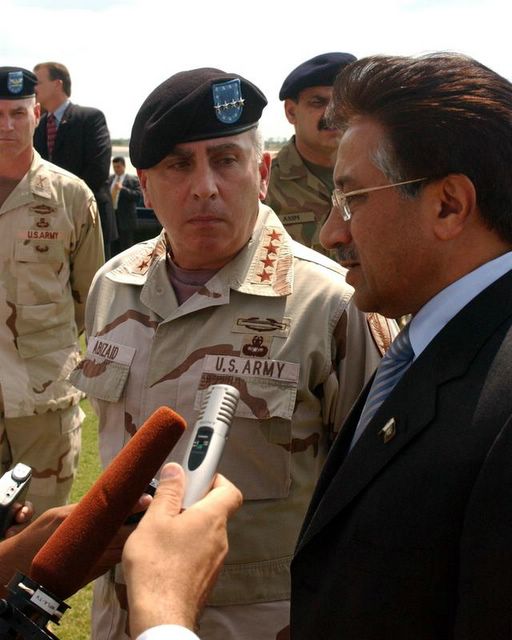
General John Abizaid and Pakistani President Musharraf. Picture courtesy of SPC. Claude Flowers, Public Affairs Office, CENTCOM

Whether you view the War on Terror through the prism of William Lind’s 4GW theory, Dr. Barnett’s PNM taxonomies, John Robb’s ” open-source” warfare or more orthodox perspectives, globalization is making demands upon American military officers more reminiscient of the late 19th century than the 20th. A commander today must be more than a specialist in the military arts and an inspirational leader in the field; increasingly they are dealing with questions of politics and diplomacy once reserved for high civilian appointees. They are required to be adept in economic administration for humanitarian and reconstruction purposes and possess both a media presence and a communications strategy. “Small wars” have gone global and the requirements of fighting them in an interconnected world under the glare of a 24/7 broadband media is producing a new corps of soldier-statesmen from the theater commander right down to the ” strategic corporal“.
The slow evolution of the American soldier-statesman can be seen from the early 20th century. While the comic-opera Spanish-American War saw celebrity soldiers like Teddy Roosevelt cast in a heroic light and wide authority granted to Admiral Dewey and General Wood, that trend was reversed by Woodrow Wilson in WWI. From the outset of the war, the president jealously guarded his prerogatives as Commander-in-Chief from both the Congress and the uniformed services. Wilson dominated the scene to the extent that today only specialists can recall the name of Wilson’s Army Chief of Staff (it was Peyton C. March) and General John ” Blackjack” Pershing, while a revered figure, operated on a narrow delegation of authority designed to help him block Allied desires to feed American doughboys directly into the French and British armies bleeding to death on the Western Front.
The real ” heroes” of the Great War, as historian Jordan Schwarz wrote, were the civilian administrators like William McAdoo and Herbert Hoover – both of whom became leading contenders for appointive office and party nominations for the presidency in the 1920’s. Few soldiers other than Douglas MacArthur gained that kind of public acclaim. The Army and Navy faced genuine public hostility and drastic budget cuts in the aftermath of the spectacular ( and essentially fraudulent) Nye Committee hearings that formented isolationist and pacifist sentiment. Never was the military more a lonely caste apart from American society than during the interwar years.
Page 1 of 3 | Next page