Cross-grain thinking, 2: mapping the jihadist mind & AQ’s #3 spot
Okay, we should definitely add “financial chief” to my list above.
The humorist and the artist in me often lead the more serious analyst in me to insights I’d not otherwise have access to, and since I’m worrying away at the notion that analysis needs to feature both “interior” (mind, heart) and “external” (world) realities, I keep the artistry and humor in my analyses, and hope that makes them more rather than less accessible — so let’s run with the AQ#3 nonsense for a bit.
Mackey’s is a slightly tongue in cheek treatment of a reasonably serious topic. On Twitter the humor gets more incisive, with Andy Borowitz claiming 9,000 AQ#3s have been killed, and AQ#3 in person setting up a twitter account and tweeting merrily away for a while, see the two sample tweets in this SPECS graphic:
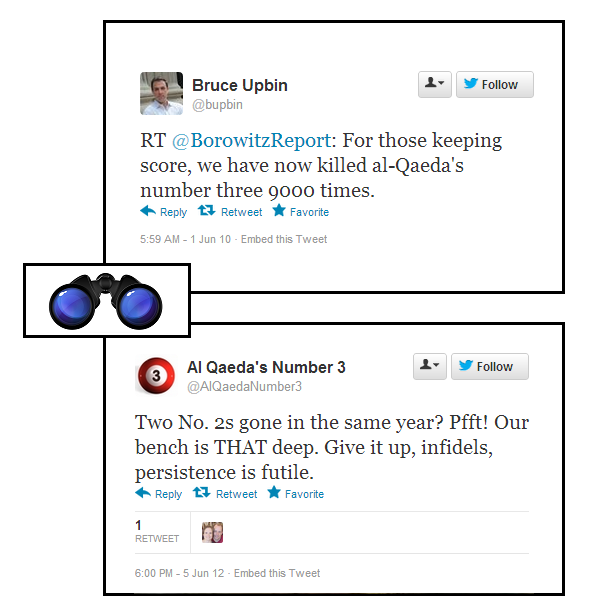
My sources for those two tweets were Bupbin and AlQaedaNumber3.
To be honest, I find the AQ#3 business both irritating — since it shows how little depth our popular understanding of who we’re dealing with really has — and amusing — because it’s so very ripe for satire…
**
I’ve been working at this post so long I’m mentally cross-eyed, so feel free to fill me in or chew me out…
Page 3 of 3 | Previous page
david ronfeldt:
November 12th, 2012 at 12:53 am
Okay, I’ll nibble, but only if I can bring up my favorite way of analyzing mental maps: by dissecting people’s space-time-action orientations — that bundle of cognitions in the mind that lies above our quivering mess of emotion and instinct, but below all the complicated thinking we do in categories about political, economic, etc. matters.
.
Of the three cognitive domains — space, time, and action — the one that often receives the most attention in terrorism analyses I’ve seen is action, notably the belief in violence. Time orientations — as in an apocalyptic intentions — are often second in emphasis. Spatial orientations generally receive the least explicit attention. But my reading of points made by analysts, as well as by terrorists and by people who live in locales that produce terrorists, indicates that spatial disorientations, antipathies, and ambitions figure as strongly and distinctly in terrorist minds as do time and action. It is not simply a loss of hope (a time orientation) that accounts for despair and the turn to terrorism, but more a loss of connection to one’s identity, to one’s people, and to what one values in the surrounding space. The loss of temporal hope derives from the loss of spatial connection.
.
In particular — and this is my theme — terrorists come to acquire a very enlarged sense of social space; and within it, they become keenly resentful about the boundaries and barriers that constrain their own and other people’s lives. They become intent on bursting beyond those boundaries and barriers, and they want none placed on their use of violence. Hiding underground and then exploding outward is, for terrorists, an epitomizing, spatial act. A key aim is to accomplish a vast reconnection among like-minded brethren, while disconnecting the rest of us — in other words, it’s a spatial war as much or more than a temporal war.
.
So, in order to “figure out a rough map of the workings of the “typical” mind of a potential jihadist as it radicalizes,” I’d look into tracking how their space-time-action orientations change over time.
Michael:
November 13th, 2012 at 7:31 pm
I’m guessing #3 is the AQ equivalent of a junior officer in WWI–the first to stick their necks out, providing leadership and guidance to the footsoldiers if they survive and a glorious martyrdom to emulate if they don’t. 😛
Charles Cameron:
November 14th, 2012 at 2:24 am
Michael:
.
I suspect it’s a case of “whatever mole you whack, unless it’s clearly #1 or #2, call it #3″…
.
David:
.
Much food for thought there. I hope you’ll expand on the STA side of things when you can…
.
Thanks as always!
Charles Cameron:
May 1st, 2013 at 5:45 pm
FTR, something new on the AQ #3 spot via Peter Bergen in From Bin Laden to Boston for CNN two days ago:
In this version, the reason so many AQ #3s are reported killed is that they’re really what we used to call before AQ #3.3333 recurring.