Wicked problems, mind mapping, and IBIS
- questions
- ideas
- pros
- cons
An IBIS map starts with one root question (simplified here for posting efficiency):

First step
A question can be responded to with an idea.

Step two
Within IBIS, an idea is:
- a potential answer or solution to a question
- a trigger for further questions
Pros and cons can only respond to ideas.

Step three
Further questions can also respond to ideas, pros, and cons.
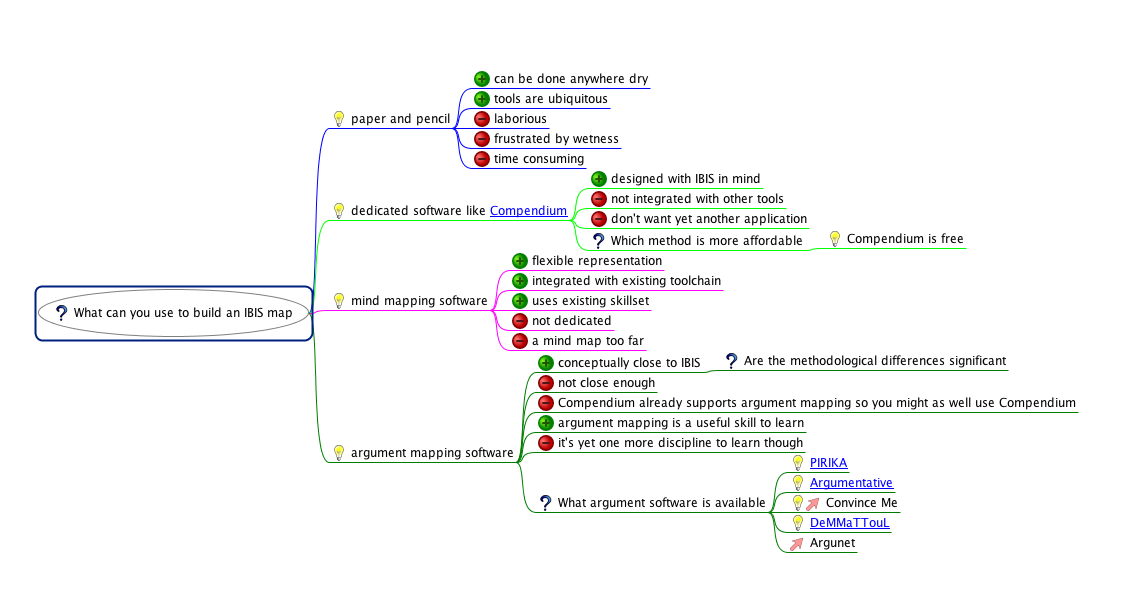
Step four
Following these few rules, Rittel argued that even wicked problems could be mapped. While IBIS can be used for individual visualization of wicked problems. Rittel designed it for a group. Used with other methodologies like dialogue mapping, Rittel figured a shared map could help establish shared understanding, facilitating distributed problem solving.
Rittel may be correct. I don’t know. While other structured analysis approaches exist, many of them suffer from too much representational granularity. Too much fine parsing tends to lead to inevitable ontological crisis.
For my own efforts, IBIS has a nice balance between too little structure and too much. This new Freeplane add-on facilitates use of IBIS within my existing toolchain.
Some ZP readers may find it interesting to experiment with. It requires Freeplane, available as a free download for Windows, MacOS X, and Linux. The initial version of the add-on, FreeIBIS 0.1.0, is available as a free download here. If Freeplane is installed, all you should have to do is double click it to have it install. Commands are accessed under the Tools → freeIBIS menu within Freeplane.
I use the keyboard for mind mapping so I assigned the four IBIS functions to these keyboard shortcut combinations on MacOS X:
- ⌘? for question
- ⌘> for idea
- ⌘= for pro
- ⌘ for con
Page 2 of 3 | Previous page | Next page