Heavy breathing on the line: Uniform disbelief
- Soon after the arrival of the suit I donned it, and put off for Cincinnati on horseback. While I was riding along a street of that city, imagining that every one was looking at me, with a feeling akin to mine when I first saw General Scott, a little urchin, bareheaded, footed, with dirty and ragged pants held up by bare a single gallows—that’s what suspenders were called then—and a shirt that had not seen a wash-tub for weeks, turned to me and cried: “Soldier! will you work? No, sir—ee; I’ll sell my shirt first!!” The horse trade and its dire consequences were recalled to mind
- The other circumstance occurred at home. Opposite our house in Bethel stood the old stage tavern where “man and beast” found accommodation, The stable-man was rather dissipated, but possessed of some humor. On my return I found him parading the streets, and attending in the stable, barefooted, but in a pair of sky-blue nankeen pantaloons—just the color of my uniform trousers—with a strip of white cotton sheeting sewed down the outside seams in imitation of mine. The joke was a huge one in the mind of many of the people, and was much enjoyed by them; but I did not appreciate it so highly.
During an interview on Being American in Europe, 1750-1860, the author is asked what one thing about Europe stuck out to American visitors in 1750-1860. And what was the European sore thumb in American eyes: the routine presence of uniformed men, whether soldiers or policemen, on the streets of European cities.
After all, war, what is it good for?
The initial engagement on July 21, 1861 of what would become the First Battle of Bull Run took place on McLean’s farm, the Yorkshire Plantation, in Manassas, Prince William County, Virginia. Union Army artillery fired at McLean’s house, which was being used as a headquarters for Confederate Brigadier General P. G. T. Beauregard, and a cannonball dropped through the kitchen fireplace. Beauregard wrote after the battle, “A comical effect of this artillery fight was the destruction of the dinner of myself and staff by a Federal shell that fell into the fire-place of my headquarters at the McLean House.”
McLean…made his living during the war as a sugar broker supplying the Confederate States Army. He decided to move because his commercial activities were centered mostly in southern Virginia and the Union army presence in his area of northern Virginia made his work difficult. He undoubtedly was also motivated by a desire to protect his family from a repetition of their combat experience. In the spring of 1863, he and his family moved about 120 miles (200 km) south to Appomattox County, Virginia, near a dusty, crossroads community called Appomattox Court House.
You may not be interested in war, but war is interested in you.
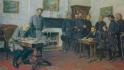
On April 9, 1865, the war revisited Wilmer McClean. Confederate General Robert E. Lee was about to surrender to Lieutenant General Ulysses S. Grant. He sent a messenger to Appomattox Court House to find a place to meet. On April 8, 1865, the messenger knocked on McLean’s door and requested the use of his home, which McLean reluctantly agreed to.
Reluctance was not uniform:
I had known General Lee in the old army, and had served with him in the Mexican War; but did not suppose, owing to the difference in our age and rank, that he would remember me, while I would more naturally remember him distinctly, because he was the chief of staff of General Scott in the Mexican War.
Page 2 of 4 | Previous page | Next page