Heavy breathing on the line: Uniform disbelief
General Lee remarked to me again that their army was organized a little differently from the army of the United States (still maintaining by implication that we were two countries); that in their army the cavalrymen and artillerists owned their own horses; and he asked if he was to understand that the men who so owned their horses were to be permitted to retain them. I told him that as the terms were written they would not; that only the officers were permitted to take their private property. He then, after reading over the terms a second time, remarked that that was clear.
I then said to him that I thought this would be about the last battle of the war—I sincerely hoped so; and I said further I took it that most of the men in the ranks were small farmers. The whole country had been so raided by the two armies that it was doubtful whether they would be able to put in a crop to carry themselves and their families through the next winter without the aid of the horses they were then riding. The United States did not want them and I would, therefore, instruct the officers I left behind to receive the paroles of his troops to let every man of the Confederate army who claimed to own a horse or mule take the animal to his home. Lee remarked again that this would have a happy effect.
Much like helicopters, with malice toward none, with charity for all:
Once the ceremony was over, members of the Army of the Potomac began taking the tables, chairs, and various other furnishings in the house—essentially, anything that was not tied down—as souvenirs. They simply handed the protesting McLean money as they made off with his property.
To the victor goes the tables.
Major General Edward Ord paid $40 for the table Lee had used to sign the surrender document, while Major General Philip Sheridan got the table on which Grant had drafted the document for $20 in gold.
A good enough price for antebellum horseflesh.
Sheridan then asked George Armstrong Custer to carry it away on his horse. The table was presented to Custer’s wife. Little Phil wrote to Libby:
My Dear Madam: I respectfully present to you the small writing-table on which the conditions for the surrender of the Confederate Army of Northern Virginia was written by Lt.-General Grant, and permit me to say, madam, that there is scarcely an individual who has contributed more to bring about this desirable result than your very gallant husband.
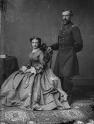
This was not the table’s last stand.
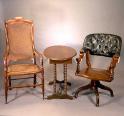
Elizabeth Bacon Custer’s will states:
…the table on which the surrender of General Lee to General Grant was written…are now located in the…War Department Building in Washington, D. C., I give and bequeath to the United States Government…
And then they all lived happily ever after.
After the war, McLean and his family sold their house in 1867, unable to keep up the mortgage payments, and returned to their home in Manassas. They later moved to Alexandria, Virginia. He worked for the Internal Revenue Service from 1873 to 1876.
And that’s why the NSA records (meta)data on all Americans.
Page 4 of 4 | Previous page
T. Greer:
June 30th, 2013 at 3:42 am
You know, I am actually not sure what this one has to do with meta data.
.
It was a good read though.
Critt Jarvus:
June 30th, 2013 at 1:05 pm
Because the link(ages) provide a context which shall not perish.
larrydunbar:
June 30th, 2013 at 6:53 pm
“Because the link(ages) provide a context which shall not perish.”
*
True enough, but isn’t there a simpler way?
*
As the prism decentralizes the light source into different colors, why not just divide between cat owners and dog owners?
*
You can admire the losers and winners in any war. After all, West Point taught the insurgent force how to command an incumbent force against an enemy. At the start of the War the Generals of the South forgot that they were the insurgent Red Team, not the incumbent Blue force. It sounds to me like the Red Team didn’t remember until Sherman went for the guts. By then it was a little too late.
*
I watched a boxing match last night, where a great Pakistani fighter showed us what a liver shot will do, i.e. paralyze the body. On the other hand, as the loser said, “he hit so hard that I had to protect my head, and then he went for my body”.