War on Speed
[ by Mark Safranski a.k.a. “zen”]
“When a man is lying in a shell hole, if he just stays there all day, a Boche will get him eventually. The hell with that. My men don’t dig foxholes. Foxholes only slow up an offensive. Keep moving.”
– General George Patton
“In large-scale strategy, when the enemy starts to collapse, you must pursue him without letting the chance go. If you fail to take advantage of your enemies’ collapse, they may recover.”
“Speed is not part of the true Way of strategy. Speed implies that things seem fast or slow, according to whether or not they are in rhythm. Whatever the Way, the master of strategy does not appear fast”
– Miyamoto Musashi
“Two basic principles . . . underlie all strategic planning. . . .The second principle is: act with the utmost speed”
– Carl von Clausewitz

Soldiers of the 1st Cavalry Division charge [ Photo credit: U.S. Army photo by Sgt. Travis Zielinski]
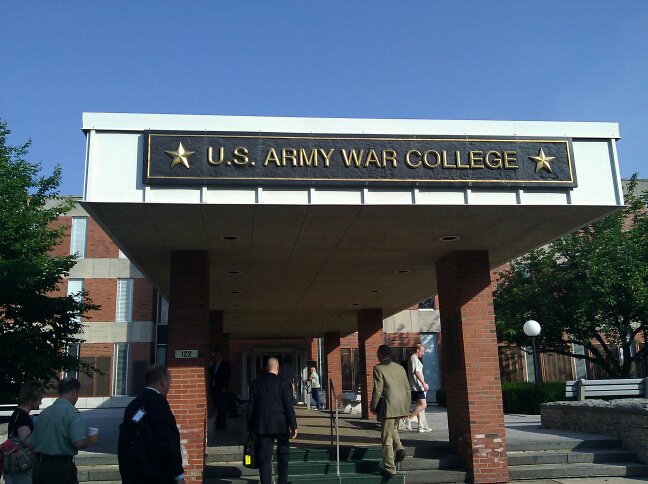
SWJ Blog published a link to 2013-14 Key Strategic Issues List put out by the Strategic Studies Institute to US Army War College students and researchers regarding the critical questions that the Chief of Staff believes need to be answered for the US Army to adapt to changing circumstances. It’s a good institutional practice and an interesting document to peruse. My attention was drawn to the subset entitled “Chief of Staff of the Army Special Interest Topics”. General Odierno’s second topic begins with an appropriately broad question:
“How important is speed—both in terms of maneuver and information?”
We should look at the question first in a general sense and then in the light of the U.S. Army and the circumstances in which it is likely to find itself in the next few decades.
Common sense tells us that in any conflict, the ability of a single combatant, an armed group or an army corps to move and fight with speed is generally an advantage. This applies in other forms of conflict aside from warfare; for example, the boxing legend Muhammed Ali was great in his early career not merely because he was a big man and a gifted boxer but because he was also incredibly fast compared to his opponents, running rings around them in a match, taunting and humiliating them. When age removed the edge of speed, a slower Ali was forced to change his tactics and absorb a great deal of punishment that he had formerly escaped. Slow moving armies are like Muhammed Ali past his prime -they make for good targets.
In the history of warfare, many great fighting forces were also fast moving ones. Stonewall Jackson’s Confederates averaged close to fifteen miles per day in the Shenandoah Valley campaign; Roman legions frequently marched twenty miles in five hours while the armies of Alexander the Great and Napoleon Bonaparte drew closer to thirty a day. The fierce and elusive Apache topped them all, reputedly covering an astonishing seventy miles a day on foot in harsh desert terrain. Nor are the advantages of great speed limited to land armies, speed at sea and in the air is a tremendous equalizer for numerically inferior forces. It is good to move fast. The US Army, or at least parts of it, should be able to move fast, but this comes with a few caveats:
- First, speed is always relative advantage. Being the fastest army in the world is a great thing but it is not quite so great if you are fighting the second fastest army in the world and the difference between the two is marginal.
- .
- Secondly, really optimizing speed for an entire army (vice specific units) is likely to come with trade-offs in terms of force structure and operational costs. Fast is fine, but fast with firepower is better, unless you think Operation Market Garden is the model to emulate.
- .
- Third, distance is often antagonistic to speed (i.e. imposes greater friction costs). The ability to sustain a campaign in Afghanistan from the Western hemisphere does not mean it will be cheap to run your strykers and helicopters on imported fuel. Zipping your panzers across France is not the same as slogging them through the vast and roadless expanse of Russia.
- .
- Fourth, speed and agility are not the same thing. Maneuver in battle depends on other things aside from linear speed; the ability to execute fast transients by rapidly shifting what your force is doing on the fly is unlike simply moving them from point A to point B at a high rate of speed.
- .
- Fifth, moving at one easily predictable speed and operational tempo, even at a high rate, is not as good as purposefully changing up both to throw the enemy off of their game. Sometimes employing a slow or erratic tempo is useful for imposing costs on enemy forces, deceiving them or constraining their freedom of action.
Speed of information is not at all the same as the speed of material things, in part because the qualitative value of the information determines the utility of receiving it faster. An army that could move information and communicate more effectively – by having mastered writing, messenger systems, secret codes, the telegraph, shortwave radio or the internet – usually has a comparative advantage, but only up to a point. Much like medicine, the right dose of information can cure what ails you but too much or the wrong kind at the wrong time can kill you.
Even valuable information – much like Robert E. Lee’s battle plans for Antietam wrapped around some cigars – is simply unconnected data unless it is received by someone (Observation), who unlike General McClellan, is competent to discern the importance, put the information into context (Orientation), plan (Decide)and take appropriate action (Act). Knowledge is contextual and actionable ( or it is a prerequisite for effective action) while information is isolated, raw and could easily be irrelevant trivia or distracting “noise”.
Quantity of information and the velocity with which it circulates through an organization can undermine the comparative advantage of having greater informational speed. Communication often expands to fill the bandwith allotted to the detriment of organizational effectiveness. What is useful intel for a squad leader entering a seemingly abandoned village becomes a drowning sea of minutia for a battalion, brigade or theater commander who can only grasp coup d’oeil by focusing on essential components of operational or strategic problems as they are expressed on the battlefield.
Every transmitted message is a form of transaction requiring time, attention and energy from a commander and his subordinates, taxing their ability to prioritize effectively and inevitably creating “fog” by increasing the ratio of useless, incorrect or irrelevant data to crucial information. Improvement comes both from becoming increasingly effective at distilling knowledge from masses of data and from paring back the traffic in informational garbage and “busywork” and legalistic “CYA” communication. Greater informational speed shows it’s true value when an organization (military, business, political etc) can systematically move critical knowledge to the person who needs it at the moment it is required.
How Should the US Army think about Speed?
The US Army, in my view, faces some probabilities in the next few decades in terms of thinking about speed, force structure, potential conflicts and other questions:
- Barring a resumption of conscription, austerity and domestic politics will mean a smaller active duty peacetime force that will have to formally shed some of the Cold War legacy missions it is no longer capable of executing or willing to fund.
- .
- Any major land conflict the US enters is likely to be expeditionary against a much more numerous opponent ( North Korea, Iran, Pakistan, China or a proxy war – likely in Africa) while our technological edge over near-peer and second to third tier adversaries, while remaining, will be less than in previous decades.
- .
- The US may face more than one “small war” at a time with an allied or friendly state requesting FID/COIN help against an insurgency of some kind.
- .
- The US may face an insurgency at home from Mexican narco-cartels that may begin as a law enforcement matter and be escalated by cartels into a serious paramilitary insurrection and terrorism problem before political authorities are willing to acknowledge the gravity of the threat (i.e. American politicians will behave much like their Mexican counterparts did in the 2000’s. Indeed they are already doing so in regard to massive cartel infiltration of American cities)
- .
- The US will retain sufficient nuclear deterrent, Naval and strategic air capability to make a conventional or nuclear attack on the American homeland extremely unlikely.
The US Army, even in a reduced size, will probably retain the role of “mailed fist” land force with a core of armor, motorized infantry, artillery units along with infantry that could conceivably be scaled up to much larger levels of personnel in a grave crisis. But the reality is the politicians will always try to fight foreign wars with peacetime forces, so to be of real use, the Army must be able to go to war “as is” and win it very quickly. It is unlikely that a serious opponent like Iran, if it’s leaders believe the US intends regime change, will permit America a leisurely 6-12 month build-up of an invading host in a neighboring state the way that Saddam did [ can you imagine PLA generals sitting on their hands as the US Army put, say, 10-15 divisions of American and coalition troops on their border with Vietnam?]
So if the US Army is to be operationally relevant by virtue of speed, there must be a deep all-services investment in the unsexy air and sealift capacity to move a substantial amount of troops and their heavy equipment in days or weeks instead of months ( most likely combined with even greater efforts at pre-positioning ). Speed and maneuver in operations depends on getting there in the first place.
Assuming we have many divisions or brigades (if we stay “modular’) arriving somewhere, increasing operational speed is partly a work of the Army’s leaders spending years changing the organizational culture to give subordinates real room to take initiative within their commander’s intent. This will help improve both physical maneuver as well as information flow by reducing the institutional incentives to create paralysis by micromanagement.
Accepting loose reins may mean more American casualties, far more enemy combatant casualties and consequent civilian collateral damage as field grade and junior officers take greater responsibility and the tempo of operations accelerates. ROE will have to be simpler and hew closer to what is permitted under the Laws of War vice what overly complex guidance prevailed at certain times in Afghanistan. This will require ruffling the feathers of international law professors, lefty NGO activists, anti-American journalists and some members of Congress.
On the other hand, we might start winning wars again.



August 26th, 2013 at 7:00 am
“the Army must be able to go to war “as is” and win it very quickly.” (emphasis added).
.
Zen, help me understand the basis for this comment. I have been reading a lot of TX Hammes’ stuff lately (post in the works), and I am struck by how often he says “we should assume that our next war will be a long one.” Do you think this is a faulty assumption? American history has a lot of wars we thought we’d win quickly…..
August 26th, 2013 at 2:24 pm
If I may interject, T. Greer: Unless the war goes nuclear, I suspect Iraq and Afghanistan are preludes to more long wars. Most of this is related to policy and the 24X7 news cycle. War is hell, but when conveyed via Youtube, policy makers will tend towards timid engagement policies (as we’ve seen in Afghanistan, which has become more like “whack a mole” than a resolved and sustained effort as a matter of policy to win). The news cycle forces policy makers and leaders to act with restraint, which often provides an advantage to the enemy—hence the war drags on without resolution, as the enemy has time to adapt and counterattack on their schedule, not ours. Just a thought.
August 26th, 2013 at 6:10 pm
Mobility and speed were critical elements of the South African’s 26-year long war in South West Africa/Namibia. Many times they were outnumbered by Angolan Army and Cuban forces, along with the South West Africa Peoples Organization’ forces, and prevailed by virtue of speed and mobility. A good read on it is Roland de Vries’ 2013 book, Eye of the Firestorm, which details events in that war from the late 1970’s through the past-apartheid new political dispensation in South Africa. In fact de Vries’ motto is: “Strength lies in mobility.” He is a good writer but the book is lengthy–over 900 pages long–but written in clear, easy-to-understand English.
August 27th, 2013 at 12:37 am
fwiw, i turned to wondering the other day about the term “vector” and, browsing around, learned (re-learned?) that it has long been a key concept of Paul Virilio and related postmodern theorists. i don’t quite get it, but it seems somewhat apropos your post, as in the following passage:
.
“The vector is a key term for Virilio. It describes the aspect of technology which interests him most and also the style of writing he employs to capture that aspect. It is a term from geometry meaning a line of fixed length and direction but no fixed position. Virilio employs it to mean any trajectory along which bodies, information or warheads can potentially pass. Vectors are potential trajectories. The gift of technology to strategy is ever faster, ever longer vectors, with greater and greater acceleration. Unlike Deleuze and Guattari’s ‘line of flight’, escaping from static power, the vector in Virilio is power, a power beyond metaphors of structure, with which writing must find ways to keep pace.”
(see http://www.evolutionzone.com/kulturezone/futurec/mwark/mwark.virilio)
.
and speaking of metaphors, does the above offer food for thought?
.
also, fwiw, it’d be good if we not only got speedier at getting in, but also at getting out. i remain aghast at the phenomenal amounts of expensive stuff we leave behind.
.
August 27th, 2013 at 1:22 am
http://www.youtube.com/watch?v=7YyBtMxZgQs
One of my favorite move clips showing the OODA Loop at work. The swordsman is moving much faster, yet, Indy just pulls out a pistol and shoots him calmly.
August 27th, 2013 at 1:28 am
Another great OODA Loop example, this time with Alan Moore (the comic genius behind The Watchman amongst others):
http://swords-and-veeblefetzers.blogspot.com/2010/11/omega-men-26-brief-lives.html
August 27th, 2013 at 2:36 am
I agree that there will be long wars in the future, especially if the administration is foolish enough to commit us to Syria – overthrowing Assad can be accomplished with speed, but dealing with the factional fighting that will most likely arise afterwards cannot. Speed of information, though, may help – particularly in identifying who the insurgents are. But that’s a whole other subject based on the COIN debate going on now.
August 27th, 2013 at 3:11 am
Old Mexican saying is,
El miedo no anda en burro –
Fear doesn’t ride on a burro
August 27th, 2013 at 4:10 am
Hi Gents,
.
Great comments!
.
T. Greer – I think TX is weighing in against those who assume a long conventional war with another great power or a 2nd tier one can’t happen ( some of this relates to the inside DoD budget/force structure debate). I agree that it could. Blundering in to one though at this juncture would be a strategic disaster. We can’t afford any more of these open-ended “let’s use military force and see what happens” no strategy long wars. Any war of choice for the next ten to twenty years has to be a relatively quick campaign like Panama, Gulf War I etc. for a simple political objective and a swift exit or should just be avoided altogether.. That is all we can manage unless we dramatically change our domestic regime where skimming the economy for a rentier -finance sector is our overriding political economy priority to one that is more balanced.
.
Scott – Agree. Would add political class has no vested interest in winning wars that they begin as losing them does not seem to involve any form of accountability, political or otherwise.
.
Morgan – Did not know that one. Thank you!
.
David – Never heard of Virilio but “vector” makes sense to me as a physics analogy as a direct line of some level of force. That would fit nicely with strategy or a strategist pondering options to use or not use force against something. Agree we are not speedy about getting out and our incentives to waste war material seem to be in the Pentagon DNA
.
Scott – In my view, going into Syria is a lose-lose scenario for the US
August 27th, 2013 at 4:12 am
Ski – re: Indy – we seem to have forgotten how to fight unfairly 😉
.
Gruray – A good saying
August 27th, 2013 at 6:02 am
If any conflict with a serious adversary is going to last over a matter of weeks is not ‘speed’ going to be dependent on the following; control over and the ability to manage the logistical chain, from sourcing raw materials through production (and the ability to finance – one thinks of the discussions and increasing frictions between UK & US in 1916-7 over finance and raw materials markets) and then final delivery to forward areas. Also the need to secure and manage the information flow necessary to maintain such extended and diffuse network – does the US have sufficient semiconductor fabrication plants, supplies of rare earths etc.within its physical control to ensure such have not been comprised at point of manufacture? .
Could I be the only person concerned about US forces reliance on effective monopoly contractors such as Halliburton, KBR etc. for the sourcing and delivery of types of infrastructure and crucial supplies – food & fuel come to mind immediately – whose staffs are I assume not in the end subject to military orders?
August 27th, 2013 at 3:33 pm
“Accepting loose reins may mean more American casualties, far more enemy combatant casualties and consequent civilian collateral damage as field grade and junior officers take greater responsibility and the tempo of operations accelerates. ROE will have to be simpler and hew closer to what is permitted under the Laws of War vice what overly complex guidance prevailed at certain times in Afghanistan. This will require ruffling the feathers of international law professors, lefty NGO activists, anti-American journalists and some members of Congress.
On the other hand, we might start winning wars again.”
You nailed it.