On the history of the selfie
[ by Charles Cameron — on self representation, avatars, and what we may be missing ]
.
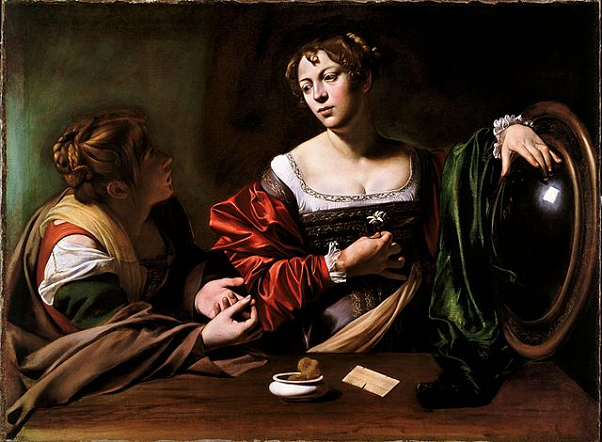
Caravaggio, Martha and Mary Magdalen, aka The Conversion of the Magdalen
Where to begin?
The Washington Post doesn’t like selfies much, according to Galen Guengerich in the Religion, yes, the Religion section — in a post titled ‘Selfie’ culture promotes a degraded worldview he writes:
The 2013 word of the year, according to the Oxford Dictionaries, was “selfie,” which Oxford defines as “a photograph that one has taken of oneself, typically one taken with a smartphone or webcam and uploaded to a social media website.” The first use of the term, according to Oxford, occurred when a young Australian got drunk at a friend’s 21st birthday party and fell down the stairs. He hit lip-first and his front teeth punched a hole in his bottom lip. His response was to take a photo of himself and post it online for his friends to see. “Sorry about the focus,” he wrote, “It was a selfie.”
Okayyyyy…
As usual, the Kierkegaard / Kardashian combo that tweets as @KimKierkegaard manages to straddle the worlds material (in the Madonna sense) and spiritual (in the sense of the Madonna):
What is the operation by which a self relates itself to its own self, transparently? Selfie.
— KimKierkegaardashian (@KimKierkegaard) September 18, 2013
**
I wanted to dig deeper — the WashPost Religion section, Kierkegaard, how could I not? I often want to dig deeper, and today I was driven to do so because today — not or the first time — I ran across a terrorism analyst and blogger named Cristina Caravaggio Giancchini, who uses a detail from her namesake Michelangelo Merisi da Caravaggio‘s Martha and Mary Magdalen (above) as her avatar…
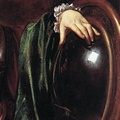
Avatars are a kind of selfie, aren’t they?
In any case, I found myself looking for the particular Caravaggio that contains that detail, discovering it was the Martha and Mary Magdalen, which you see that the top of this post — then kept on digging via Google to learn a little more.
**
Here’s what I found in a blog post titled Fingers and Mirrors: Caravaggio and the Conversion of Mary Magdalene in Renaissance Rome:
The inclusion of the mirror asks viewers to enter into a dynamic conversation about their own delight in the rich textures of the picture; alongside a powder puff and comb, it points us to Mary’s vanity, and her concern with the things of this world. Rather than showing Mary to herself, however, the mirror captures a diamond of light — a visual representation of the divine grace that inspires Mary to look beyond her earthly passions. The flower that Mary clutches to her chest is an orange blossom: symbol of purity.
Page 1 of 2 | Next page