Movie Review: RESTREPO Screening
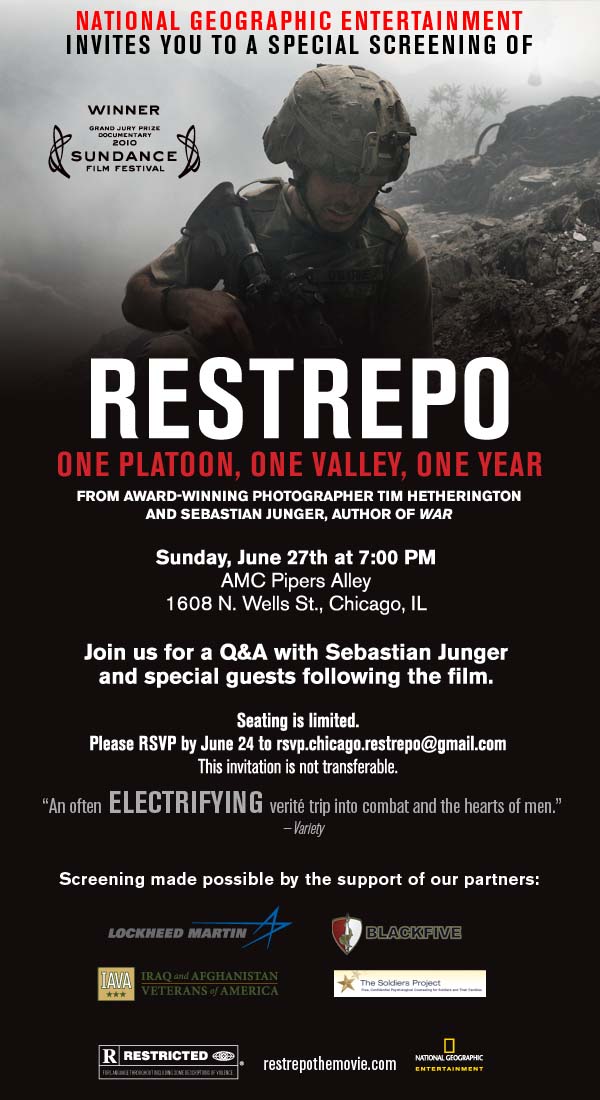
As I mentioned yesterday, I had the good fortune to receive a courtesy invite to a screening of RESTREPO, a documentary of the experience of the second platoon of Battle Company in the Korengal valley of Afghanistan. The film takes its title from a fallen member of the platoon, a medic Pvt. Juan “Doc” Restrepo, in whose honor the platoon’s new outpost in that ferociously disputed valley is named. The film, largely compiled from footage shot by Tim Hetherington, is the companion to the book WAR
First, RESTREPO makes more explicit the harsh terrain in which the war is taking place for the young men of second platoon. If you have ever driven through the mountains of Tennessee or West Virginia, imagine those states as semi-arid, with steeper elevations and go back in time to circa 1900 so that the deeply impoverished residents are struggling to scratch a living out of sand and rocks with little or no comforts of modernity. The valley appears to always be dusty, sunny and very hot. Except up in the hills where it snows – then it looks cloudy and cold. That’s what Korengal looks like.
The Korengalis, it must be said, look like that too. Virtually every Korengali man in the film is hawk-faced gaunt and weathered, fierce faces deeply lined by sun and privation. Korengali elders have the look of determined survivors who built the fortified compounds that cling precariously to the rock wall of the hills, ascending, jerry-built. The village reminded me of what Cabrini-Green might have looked like had it been erected in the 9th century. The warmth of their elders’ feelings toward Americans can be described as “grudging”, well-demonstrated at the shura where the elders asked the Captain for the return of “Yusuf Mohammed” who had been arrested. As it turned out, young “fucking Yusuf Mohammed” had beheaded someone on a jihadi videotape and the clearly disgusted C.O. told the elders that Yusuf would not be coming back.
A second striking difference was that unlike WAR, which is narrated through Sebastian Junger’s perspective, the soldiers are speaking directly themselves, either in candid comments on patrol and in RESTREPO or in de-brief interviews. Junger accurately reflected the views of the soldiers he interviewed but where WAR has one voice, Junger’s, RESTREPO has a multitude of voices with their individual insights, irreverance, agonies, tedium, bitching, regrets and pride. Reading WAR depressed me, but watching RESTREPO, despite scenes of graphic suffering, definitely did not. If you see these young soldiers and do not come away impressed with their mettle and resilience of character, then you have a heart of stone and a head of straw.
Page 1 of 2 | Next page