With Greco: two views of Toledo
Think of Hofstadter‘s Godel Escher Bach. Of Escher himself, and his image of himself holding his own small world in a glass sphere in his hand…
Think of Korzybski, and his dictum: the map is not the territory.
Think of Gregory Bateson, who wrote:
We say the map is different from the territory. But what is the territory? Operationally, somebody went out with a retina or a measuring stick and made representations which were then put on paper. What is on the paper map is a representation of what was in the retinal representation of the man who made the map; and as you push the question back, what you find is an infinite regress, an infinite series of maps. The territory never gets in at all. […] Always, the process of representation will filter it out so that the mental world is only maps of maps, ad infinitum.
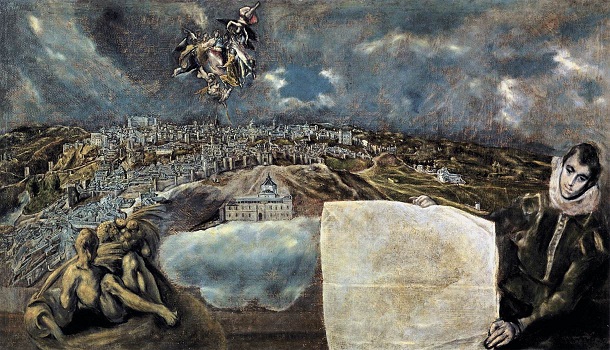
Astoundingly, presciently – prophetically? – El Greco is already alluding to this, around 1610, in his View and Plan of Toledo.
*
El Greco’s Burial of Count Orgaz is in the Church of Santo Tomé in Toledo.
El Greco’s View and Plan of Toledo is in the Museo de El Greco, Toledo.
Here is the complete text of Donne’s sonnet:
At the round earths imagin’d corners, blow
Your trumpets, Angells, and arise, arise
From death, you numberlesse infinities
Of soules, and to your scattred bodies goe,
All whom the flood did, and fire shall o’erthrow,
All whom warre, dearth, age, agues, tyrannies,
Despaire, law, chance, hath slaine, and you whose eyes,
Shall behold God, and never tast deaths woe.
But let them sleepe, Lord, and mee mourne a space,
For, if above all these, my sinnes abound,
‘Tis late to aske abundance of thy grace,
When wee are there; here on this lowly ground,
Teach mee how to repent; for that’s as good
As if thou’hadst seal’d my pardon, with thy blood.
El Greco’s View of Toledo is in the Metropolitan Museum of Art in New York:
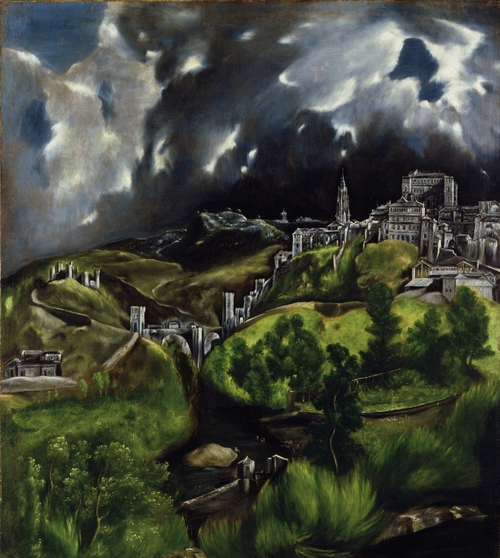
Here we find no blessed Virgin, no angels with their final trumpets — and yet this painting can be viewed as analogous to his Vision of Saint John and the opening of the Fifth Seal — which owes its power to its “otherworldly stormy light” — and thus seen as yet another apocalyptic scene, one which “recalls St. John’s vision of the New Jerusalem in the Book of Revelations … a landscape of unearthly power and drama: a dialogue between heaven and earth conducted appropriately by the cathedral spire…”
Page 2 of 2 | Previous page
Bryan Alexander:
June 6th, 2011 at 12:19 pm
Gorgeous, Charles.
.
Brings to mind:
onparkstreet:
June 11th, 2011 at 10:38 pm
Well, now, you did it again. You made me look at something in a completely different way.
.
I always thought I didn’t like El Greco and now I want to scour the stormy skies for signs, so to speak….
.
– Madhu
onparkstreet:
June 11th, 2011 at 10:39 pm
Er, sorry about the alliteration. It really didn’t work, did it?
.
– Madhu
Charles Cameron:
June 12th, 2011 at 5:22 am
Hi, Madhu:
.
One of the greatest poems by my favorite poet — the Jesuit, Gerard Manley Hopkins, whose life and works "converted" me to poetry — opens with this verse:
So really — if he can write of "kingdom of daylight’s dauphin, dapple-dawn-drawn Falcon" I don’t see why you shouldn’t give me an excuse to quote him by saying "now I want to scour the stormy skies for signs, so to speak"…
.
Scour on!