Rofer on The Fall of Beria and Putin’s Vanishing Act
[by Mark Safranski, a.k.a. “zen“]
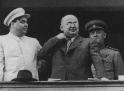
Lavrenty Beria (center)
Russian President and brazen strongman Vladimir Putin reappeared Monday, looking wan and a little uncomfortable for the cameras, but jesting at the mad swirl of internet rumors sparked by his extended absence from public view. One of the rumors, which may have been true, was that Putin was engaged in a power struggle with his own siloviki inner circle unhappy with Western sanctions placed on Russia. Many commentators could not help but recall similar incidents from the Soviet past and friend of ZP, Cheryl Rofer had an excellent post featuring one of the most sinister figures in Russian history, Stalin’s fearsome secret police chief, NKVD boss, Lavrenty Beria:
A Soviet Coup – The Fall of Lavrenty Beria
….As Putin moves toward more authoritarian rule, we can expect to hear rumors whenever he goes out of sight for more than a couple of days. Both wishful thinking and the real possibility that some in his government are unhappy with his actions will continue to mix in the question of a coup. And anyone over 60 years of age is a candidate for sudden death or stroke.
Boris Nemtsov’s death, among other things, may have caused concern among various members of Russia’s elite that they are vulnerable or may have set off a fight between the FSB and Chechen politicians and security services. Nemtsov was one of Boris Yeltsin’s potential successors, along with Putin in the late 1990s. Putin has not been kind to his political rivals, but Nemtsov is the first to be murdered. And it is not clear who murdered him; the FSB and Chechen authorities are seriously arguing about this. Fear of being killed, however, is a powerful motivator toward a coup.
The situation more and more resembles the undertainties of the Soviet Union as Putin consolidates power. Succession in the Soviet Union was a vexed question, but is nominally by popular election in post-Soviet Russia, not yet fully normalized. Putin has played fast and loose with elections, first as Yeltsin’s handpicked successor and later with his tradeoff with Dmitry Medvedev as Prime Minister and President.
If Putin were seriously ill or dead, or if a coup seized power, we would not hear about it immediately. Nobody in the Russian government takes stability for granted – instability is one of Putin’s great fears – so those in power would want to project continuity, that nothing is wrong, until the change can be introduced smoothly.
In today’s world of social media and a somewhat more open Russia, suppressing that kind of news will be more difficult to do than after Stalin’s stroke, but, given all that we do not know about the Kremlin’s current activities, suppressing that information for at least a week or two seems entirely possible.
Stalin succeeded Lenin, with some question as to Lenin’s intentions, in the 1920s. He then set about consolidating his power and eliminating rivals. Stalin died of a stroke in March 1953. What happened next got complicated. This description is condensed from Mark Kramer’s “Leadership Succession and Political Violence in the USSR Following Stalin’s Death,”Chapter 4 in Political Violence: Belief, Behavior and Legitimation, Paul Hollander, ed., New York: Palgrave Macmillan, 2008.
Page 1 of 4 | Next page