Twitter combat, al-Shabaab, black banners, Tahrir and more
If he made an innocent error, he should apologize and set the record straight.
If not, let him stand before the Mercy Seat of Ha-Shem and explain why he violated the commandment given to Moses: “You shall not bear false witness against your neighbour.”
*
The thing is — getting back to our black banners with Shahada and distinctive seal of Muhammad — there were in fact demonstrations in Tahrir Square just a week earlier, at which those pesky black flags were in evidence:
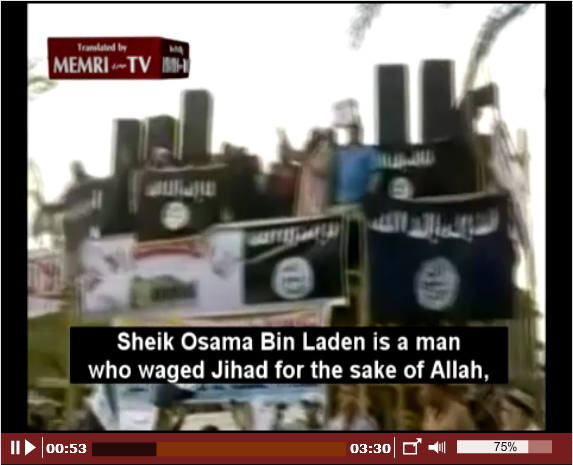
MEMRI brought us the video of which that is a screen-capture, and provided a transcript of Sheikh Tawfiq al-Afni‘s address to the crowd, of which this is an excerpt:
Tawfiq Al-Afni (On stage): ”Sheikh Osama bin Laden is a man who waged Jihad for the sake of Allah, and we pray that Allah will unite us with him and the martyrs in Paradise. My brothers, in Islam, we say with great pride that we adhere to the Jihad for the sake of Allah…”
Crowd: “Allah Akbar.”
Tawfiq Al-Afni: “We are not waging Jihad for worldly benefits or for positions. By Allah, we have only come to pledge our allegiance to Islam. We wage Jihad for the sake of Allah and the Koran. […]
“We respond to Your call. Please turn our skulls into a ladder for your glory.”
Crowd: “We respond to Your call. Please turn our skulls into a ladder for your glory.”
Black banner, Shahada, seal of Muhammad, Tahrir Square.
*
So it’s important that we should know these things (oh, and much more besides):
- The black banners are in Tahrir and Somalia, as they have been in Mahdist movements stretching back to the Abbasids.
- Black banners featuring the seal of Muhammad appear to have a connection with AQ, often indicative of sympathetic support, if not active participation.
- That such voices exist in Egypt should not make us think that they represent a majority, nor indeed that they are the voice of the Muslim Brotherhood, but rather that they are among the voices raised in a tumultous situation.
- There are many secular voices raised in Tahrir, and also Islamist voices with a willingness to take the path of politics and compromise.
- We should remember that there are voices in Tahrir of both terror and reconciliation. We should not forget the voices of those Muslims who protected Coptic churches, nor of the Copts who protected Muslims while they bowed their heads in prayer…
- And no-one, no-one left or right should forget that the Egyptian army, too, has a voice, and a megaphone, and much more besides.
Page 3 of 3 | Previous page
Charles Cameron:
December 9th, 2011 at 2:02 am
Okay:
.
For more on al-Shabaab’s venture onto Twitter, read Chris Anzalone and Michelle Shephard.