Justice Scalia, St Hubert, and the Stag
Let the Jägermeister herbal liquor label bring us to our conclusion — and to the third saint associated with a vision of stag and crucifix:
The label on Jägermeister bottles features a glowing Christian cross seen between the antlers of a stag.

This image is a reference to the two Christian patron saints of hunters, Saint Hubertus and Saint Eustace, both of whom converted to Christianity after experiencing a vision in which they saw a Christian cross between the antlers of a stag.
**
St Eustace, then, is the third saint to whom the same vision is attributed. — and the one whose vision has been most gloriously celebrated in art.
Albert Durer‘s engraving of St Eustace in the Metropolitan Museum, New York:
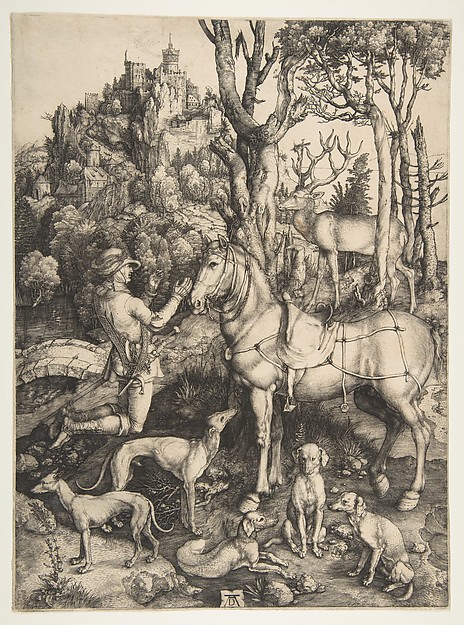
Pisanello‘s St Eustace in the National Gallery, London:

Page 2 of 2 | Previous page
Charles Cameron:
February 25th, 2016 at 3:46 am
Looking back, I see I posted about some of the literary references to St Eustace in Hoban’s Riddley Walker and in the work of John Fowles at ChicagoBoyz a while back —
.
http://chicagoboyz.net/archives/15921.html
.
Some very interesting conversation ensueed..
Cheryl Rofer:
February 25th, 2016 at 4:13 am
Oh my, Charles, I quoted John Fowles today too. But in a different key, so I’ll leave that for another time.
.
Placing a glowing cross between the antlers of a stag is one of the many Christian appropriations of a pagan symbol. Stags figure in many pagan stories as messengers or warnings. Interesting that they had to do it twice – probably didn’t take the first time. I checked his dates – late 600s/early 700s.
Charles Cameron:
February 25th, 2016 at 4:18 am
I am very much taken with the tale of Acteon and Artemis..
.
Oh, and Norman O Brown!
jim:
February 26th, 2016 at 9:18 pm
Eustathius was named Placidas before his Baptism. They are the same person. You are no journalist, just a cut and paste idiot, and your “article” has nothing at all in common with Zen!
larrydunbar:
February 27th, 2016 at 1:08 am
Whoa, Jim! What have you got against cut and paste idiots?
Grurray:
February 27th, 2016 at 3:03 am
Jim, calm down, take a breath, and walk towards the stag… walk towards the stag…
Charles Cameron:
February 27th, 2016 at 3:35 am
It’s true, some versions of the tale begin with Placidus who takes the baptismal name Eustathius — I’m not sure that’s always the case, but figures like this get confused at times. I’ve seen the Durer image of St Eustace described as of St Hubert, for instance.
.
Great advice, Grurray — walk towards the stag!
Joe:
February 27th, 2016 at 4:09 am
Great discussion folks. Yes Eustace/Eustathius/Placidus are the same. But there are other sources of this biography too.
.
Here is my recent article on this subject (based partially on a peer reviewed essay I published in 2009):
.
http://religiondispatches.org/decoding-scalias-secret-hunting-society-from-jagermeister-to-medieval-heresy-to-buddhist-legend/
Charles Cameron:
February 27th, 2016 at 7:16 am
Much appreciated, Joe — thanks.
.
I was aware of the Bodhisattva / Ioasaph / Josaphat transformation, since the Buddha as St Josaphat was at least until recently celebrated in the Roman Martyrology on November 27, my birthday. As I recall, the life of Barlaam and Josaphat is found in the Loeb library in a version by St John Damascene.
.
I had no idea the same sort of conversion had taken place with Eustace.
Joe:
February 29th, 2016 at 3:44 pm
Yes indeed. It seems the likely Buddhist narratives may form a cluster of tales which traveled together. The precise mechanism is murky, but St. Christopher too may have a Buddhist original in the cannibal ogre Kalmasapada who was converted by prince Sutasoma, boddhisatva-as-child. In that case, it is iconography, rather than text which is implicated in the transmission, since both buddhist and christian icons show the child savior on the back of an Animalistic giant (Christopher/Kalmasapada) who stands at the water’s edge. The texts of the two stories diverge slightly, but the child redeemer reforming the giant’s cannibalistic tendencies and making him a champion of the faith is a common theme in both.
Grurray:
February 29th, 2016 at 4:24 pm
I just became aware of Hesychasm, which was basically Orthodox transcendental meditation.
The monks would say a simple prayer to Jesus. Some would say it all day, and when they got skilled enough with it they would just chant ‘Jesus’ like a mantra. Combined with certain postures and deep breathing techniques referred to as forcing the mind to descend into the heart, they believed it resulted in what was called theosis, a union with God.
Depending on how far they took it, the practice had a tendency to be variously praised for its tranquility and clarity or condemned as a heresy.
Joe:
February 29th, 2016 at 5:59 pm
Very cool, Grurray! Clement of Alexandria was aware of the Buddhists and there was some positive interaction early on, and parallels in monastic culture are very striking. Later isolation between these two venerable faiths was largely a result of geopolitical barriers that arose subsequently, rather than merely geographic distance alone.
Charles Cameron:
February 29th, 2016 at 6:47 pm
I’ve been wanting to discuss Buddhist monasticism with Rod Dreher vis-a-vis his Benedict Option, Joe.
.
I was mentored from the age of 11 or 12 by Fr Trevor Huddleston, Anglican monk, after requesting to join his monastery at age 10, used to take my vacations from quasi-military school Wellington College at the Benedictine Abbey of Solesmes at age 17 or so, visited Taize, had a brief correspondence with Thomas Merton age 20, met and befriended Trungpa Rinpoche at Oxford at about that time, and took him to visit the Benedictines of Prinknash Abbey, after which he established the first Tibetan Buddhist monastery in the west at Samye Ling — and more recently have been deeply involved in Hermann Hesse’s Glass Bead Game, with a side order of interest in his concept for a secular monasticism..
.
On my shelf, besides Leonard Doyle’s translation of St Benedict’s Rule is Benedict’s Dharma: Buddhists Reflect on the Rule of Saint Benedict.
.
All this by way of saying I’d be very interested in reading your writings on this topic of Christian-Buddhist convergence, and maybe corresponding in some further detail. I’d also like to invite you to guest-post here on that topic, should you wish to do so.
Charles Cameron:
February 29th, 2016 at 6:56 pm
On Hesychasm, it’s my understanding that the Jesus Prayer eventually loses all verbal formulation and rests in the heart — somewhat akin, perhaps to Ursula Le Guin’s formulation of the Great Name:
Three interesting quotes about Name / Word:
Grurray:
February 29th, 2016 at 10:25 pm
Joe, I’m sure you know much more about the subject than I do, but, from what I’ve gathered, the School of Alexandria ‘Christianized’ Neoplatonic philosophy. One of the early founders of Neoplatonism, Ammonius, was also from Alexandria. He may have lived in India at some point where he also may have picked up some Buddhist ideas. There seems to be a lot of overlap between the two philosophies.
Origen, a student of Clement, believed in reincarnation and that the true nature of God was pure thought or word or logos – take your pick on the translation.
Charles Cameron:
March 1st, 2016 at 7:18 am
[aside]
.
I’ve somewhere run across the idea that Ammonius Saccas, revised to read Saccas Ammonius, sounds suspiciously like Sakya Muni..
.
[/aside]
Grurray:
March 1st, 2016 at 2:18 pm
Wow, Charles, that would be something if they were one and the same.
Origen was really one of the main guys, if not the guy, who brought Christianity out of the back rooms and shadows and gave it an intellectual foundation. If that foundation was crypto-Buddhism, we might have to rethink some things.
He was also condemned as a heretic at one point, but I think he’s making a comeback among our conservative theologians.
Charles Cameron:
March 1st, 2016 at 8:33 pm
I’d take it with salted popcorn —
.
More promising, I think, is the idea of the Indian guru Kirpal Singh, that St John’s opening verse might be a reminiscence of two Vedic verses, which he transcribes thus:
which translates to:
To the best of my memory, he doesn’t say they are two verses but puts them together in the epigraph to his book, Naam, but I asked a Sanskritologist friend and was told they were found separately in the Veda.
.
CH Dodd has chapters in his Interpretation of the fourth Gospel on Early Christianity, the Hermetic Tradition, Hellenistic Judaism. Rabbinic Judaism, Gnosticism and Mandaism, but dos not go as far afield as the Vedas, where the doctrine of Vac (both Milk and Word) is found — see for an example of the overlapping concepts this quote from Som Raj Gupta, The Word Speak’s to the Faustian Man: Chandogya Upanisad:
Grurray:
March 2nd, 2016 at 3:23 am
Quite a bit of common ground. Clement also used the imagery of the word as mother’s milk
http://www.copticchurch.net/topics/patrology/schoolofalex/IV-StClement/chapter5.html
.
“One is the Father of all, one also the Logos of all, and the Holy Spirit is one and the same everywhere and there in only one Virgin Mother…and calling her children to her she nurses them with holy milk, the Logos for the children.”
Charles Cameron:
March 4th, 2016 at 1:23 am
Excellent, thanks.