Indistinguishable from magic?
[ by Charles Cameron — a primer on some undercurrents in mind ]
.
I’ve been thinking about Clarke’s Third Law:
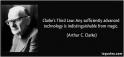
This may hold true if you mean by it that someone in possession of sufficiently advanced tech can generally persuade less “sophisticated” folk that the use of that tech amounts to “magic”, but no student or practitioner of an authentic magical tradition will easily credit such an idea — where’s the contagion? where’s the sympathy? — where’s the true name?
**
Concerning the nature of magic:
Sir JG Frazer, The Golden Bough:
Thus far we have been considering chiefly that branch of sympathetic magic which may be called homoeopathic or imitative. Its leading principle, as we have seen, is that like produces like, or, in other words, that an effect resembles its cause. The other great branch of sympathetic magic, which I have called Contagious Magic, proceeds upon the notion that things which have once been conjoined must remain ever afterwards, even when quite dissevered from each other, in such a sympathetic relation that whatever is done to the one must similarly affect the other.
Ursula LeGuin, A Wizard of Earthsea:
He saw that in this dusty and fathomless matter of learning the true name of every place, thing, and being, the power he wanted lay like a jewel at the bottom of a dry well. For magic consists in this, the true naming of a thing.
and furthermore:
Years and distances, stars and candles, water and wind and wizardry, the craft in a man’s hand and the wisdom in a tree’s root: they all arise together. My name, and yours, and the true name of the sun, or a spring of water, or an unborn child, all are syllables of the great word that is very slowly spoken by the shining of the stars. There is no other power. No other name.
**
A contemporary example, and an historical antecedent:
Magic and Medicine from the Ozarks, 272: Nails:
Nails have been used in Ozark folk healing and magic in a variety of ways. There’s a belief among Hillfolk that the object that hurt the individual was just as important to the healing process as the medicine put onto the wound. Knife blades, bullets, and nails were often treated with healing salves and plants alongside the puncture or cut itself. Rusty nails were added to tonics to prevent tetanus or to treat illnesses like tuberculosis. Water made from soaking new nails was seen as a sure treatment for anemia and iron deficiencies, and sometimes the sickness itself could be taken off the patient and nailed to a tree. Nails were driven into footprints to deal lethal blows to foes and witches alike. Coffin and gallows nails were carried by Hillfolk as an amulet to ward of certain venereal diseases.
The Works of Francis Bacon, Lord Chancellor of England, Vol. 2, ed. Montague:
Page 1 of 2 | Next page