Forget religion, it’s all politics!
All is not well in Orthodoxy currently, with a split linked to Russia’s war in Ukraine causing a schism and dark talk of violence among the various Orthodox churches. Bartholomew of Constantinople, known as the ecumenical patriarch and the “first among equals” of the Orthodox patriarchs, agreed in October to give autocephaly to the Ukrainian Orthodox church, essentially making it an independent church. Patriarch Kirill of the Russian church, which regards Ukraine as its domain, responded furiously and announced a split from the ecumenical patriarch.
and:
Kirill has banned Russians from taking holy communion in the churches of Athos, calling any priests who bless the ecumenical patriarch schismatics, leading to a dilemma for those Russians who want to visit.
Schism is about as bad as it gets within Christianity. The Pope and the Patriarch are currently trying, with some little success, to heal a schism between Catholics and Orthodox which began as a dispute over a clause in the major credal statement — the filioque clause in the Nicene Creed — which broke the two major branches of the Church, east and west, apart in 1054. That’s more than a millennium of strife between brothers whose savior prayed at the end of his life [John 17.22-23]:
And the glory which thou gavest me I have given them; that they may be one, even as we are one: I in them, and thou in me, that they may be made perfect in one; and that the world may know that thou hast sent me, and hast loved them, as thou hast loved me.
**
Okay, kudos to Guardian writer Shaun Walker for knowing the importance of religious reporting of issues that also have economic, strategic, political aspects!
And let’s conclude with a link to this related Orthodox prayer page:
:Concerning the Orthodox Prayers for the Union of All and the Prayer in St. John 17
Excerpts from Ecumenism: A Movement for Union or a Syncretistic Heresy?
by Bishop Angelos of Avlona
Page 2 of 2 | Previous page
Grurray:
December 17th, 2018 at 1:32 am
“I answer the questions that have to do with God and with life and with death, this is what I think is my task, but I am not a businessman. How am I supposed to answer questions about business?”
.
Charles, I’ve read business books with methods and tips from Zen Buddhism, Confucianism, Aristotelianism, Stoicism, Anglo-Saxon ethics… I’m sure there has got to be a way to parse the Philokalia for a few other enterprising insights.
.
It is somewhat disconcerting to see Mt. Athos politicized, but actually, despite the ostensible ascetics seemingly opposed to worldly matters, Christian monasticism has always hovered not far from political matters. I think usually when something is breaking down or an old order is blowing up, it’s the monks who we turn to. Maybe it’s some moral certitude that we crave. Maybe it’s some constancy and faithfulness as an antidote to cynical peevishness.
.
I don’t know about traveling to Greece or Mt. Athos, but I do know that Taleb once provided his opinion on Twitter about the best way to visit there and the region
https://twitter.com/nntaleb/status/1039876201932840961
“Athos for one hour or 45 minutes.
Italy for longer visits.
Levant for even longer ones.”
Cheryl Rofer:
December 17th, 2018 at 3:59 am
Of course, many factors play a part, but the Russian Orthodox Church has long been close politically to the Kremlin. Sometimes too close. So there are splits when one or another of the churches associated with Russian Orthodoxy feels that the stress is too much. Estonia split a number of years ago. Now, with the military side of the Kremlin attacking Ukraine, it’s not surprising that the Ukrainian Church wants independence.
.
To take another of the paradoxes you love so much, sometimes too much force separates rather than brings together.
Charles Cameron:
December 17th, 2018 at 6:46 pm
Terrific if unexplained Taleb tweet, Grurray. As to monasticism and otherworldliness, I’d say the Abbot was supposed to be somewhat worldly, and the Steward or Bursar very much so, but their efforts would shelter the rest of the monks from such concerns. If individual monks had courtly influence, wrote books &c, they could be personally worldly under the Abbot’s supervision. Those monks who ran a business for the abbey — bee-keeping and honey, for instance — they’d need to know that tiny sliver of the world..
IMO, YMMV, I should probably dig out the Rules of Benedict and who, Basil? for the Orthodox.
Charles Cameron:
December 17th, 2018 at 7:00 pm
.

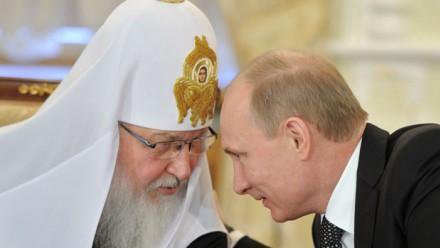
Cheryl:
.
Indeed..
.
.
.
I’ve seen others where Putin’s face has been superimposed on that of the Patriarch .. and yet others where Putin is the face on an icon..
Charles Cameron:
December 17th, 2018 at 8:01 pm
Hey, from something I’m working on..
In the west at least, they have such possessions as hairbrushes — and no doubt tablets these days — %i(ad usum), ie as borrowed goods, “for use” but not “for keeps”.
Grurray:
December 17th, 2018 at 10:14 pm
“IMO, YMMV, I should probably dig out the Rules of Benedict and who, Basil? for the Orthodox.”
.
I always go back to spiritual combat. St. Anthony the Great, St. Gregory of Nyssa, and Dom Lorenzo Scupoli all wrote about overcoming Nietzschean struggles of the faith. One of St. Anthony’s saying is, ‘Whoever has not experienced temptation can not enter into the Kingdom of Heaven. Without temptations no one can be saved.’
I don’t know if that would be very popular on the Square Mile or at Davos, but it makes good sense to me.
Charles Cameron:
December 18th, 2018 at 5:16 pm
Nyssa I think of, knowing little, as one of the three great apophatics — the Cappadocians, Nyssa, Nazianza, Basil.
.
Seems to me apophasis will be a more and more significant position as the years wear on — not in the classic sense, but as a matter of general emphasis, words and human minds being naturally incapable of grasping god, as basic equations have a hard time handling “infinity”. I suspect Karen Armstrong has a similar sense, though I haven’t read her on the subject.
.
The Neoplatonists fit in here, too, no? I had the great good fortune to live as a kid in the same village as TS Eliot’s tutor in mysticism, Herbert Warner Allen, and Dean Inge, the Plotinus scholar, who would have been (I can only imagine) his friend.
.
The Warner Allen (& little me) story is a great story IMO — I told it in a comment on ZP.