It’s snowing metaphoric chyrons, ignore unless interested 7
In reality, both the pages and the accounts were created and operated by researchers at NATO’s Strategic Communications Center of Excellence, a research group that’s affiliated with NATO. They were acting as a “red team” on behalf of the military to test just how much they could influence soldiers’ real-world actions through social media manipulation.
The results indicated that soldiers did indeed tend to leak information that “bad actors” might appreciate and use against them, or against NATO forces more generally:
By the end of the exercise, the researchers identified 150 soldiers, found the locations of several battalions, tracked troop movements, and compelled service members to engage in “undesirable behavior,” including leaving their positions against orders.
And guess what? The Russians are aware of the same possibility, and have banned the use of smartphones and similar devices by their troops as a consequence:

That combo of articles comes to us via Michael Robinson, to whom I must once again offer my grateful thanks.
And one thing more: the NATO group issued a report, and its title intrigued me:

Cognitive security was another term that’s new to me — IBM / Watson defines it thus:
Cognitive security combines the strengths of artificial intelligence and human intelligence. Cognitive AI learns with each interaction to proactively detect and analyze threats, providing actionable insights to security analysts for making informed decisions – with speed and accuracy.
That’s as much a sales pitch as a definition, but still gives us a sense of where these terms are trending.. and there’s reading to be done:
That’s our mini-essay for the day, and maybe the week!
**
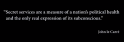
Now think on this:
**
Game on!
Let’s end today’s snow-sweep with a game metaphor applied to physics, or maybe I should say the philosophy and practice of physics: it’s a game in which the rules — in this case, mathematical languages — change from move to move — from Natalie Wolchover‘s A Different Kind of Theory of Everything:
It happens again and again that, when there are many possible descriptions of a physical situation—all making equivalent predictions, yet all wildly different in premise—one will turn out to be preferable, because it extends to an underlying reality, seeming to account for more of the universe at once. And yet this new description might, in turn, have multiple formulations—and one of those alternatives may apply even more broadly. It’s as though physicists are playing a modified telephone game in which, with each whisper, the message is translated into a different language. The languages describe different scales or domains of the same reality but aren’t always related etymologically. In this modified game, the objective isn’t—or isn’t only—to seek a bedrock equation governing reality’s smallest bits. The existence of this branching, interconnected web of mathematical languages, each with its own associated picture of the world, is what needs to be understood.
That’s it!
Page 2 of 2 | Previous page