Relics, sports memorabilia and other collectibles
Michael also drew my attention to this account of Rabbi Menachem Youlus [depicted above], “a self-described ‘Jewish Indiana Jones'” according to the New York Times – Indiana lookalikes seem to be cropping up all over! – who for years “told stories of traveling to Eastern Europe and beyond to search for historic Torahs that were lost or hidden during the Holocaust” but recently admitted he had lied (NYT, Rabbi Admits Torah Tales Were a Fraud, February 2):
“Between 2004 and 2010, I falsely represented that I had personally obtained vintage Torah scrolls — in particular ways, in particular locations — in Europe and Israel,” he told Judge Colleen McMahon of Federal District Court. “I know what I did was wrong, and I deeply regret my conduct.”
4.
Finally, from the world of Islamic art, Michael brings us another tale of collectors and their sometimes disreputable practices — this time from The Economist and having to do with the 16th-century illuminated version of Ferdowsi‘s epic Shahnameh, with its “lyrical calligraphy on gold-spattered pages” and “258 painted miniatures”, purchased at auction and “broken up” [as also depicted] – to the horror of collectors and bibliophiles – by Arthur Houghton :
In 1976 Houghton auctioned seven of its paintings at Christie’s for £863,500 ($1.6m): nearly four times more than the $450,000 he had paid for the whole book. He gave 78 pages to the Metropolitan where he was chairman of the trustees. When he died in 1990, 120 pages remained in the manuscript. These went back to Iran in 1994 in a swap for “Woman III” by Willem de Kooning, an abstract expressionist painter. Each side of the swap was valued at $20m.
5.
Hypothesis: all collectibles are talismans, all talismans are sacred.
****
Further addendum:
I’d intended to post this as a comment, but the comment function seems to be off — will try to fix that — but Michael’s most recent post to me included a pointer to a still current offer of a highly-collectible Americana twosome:
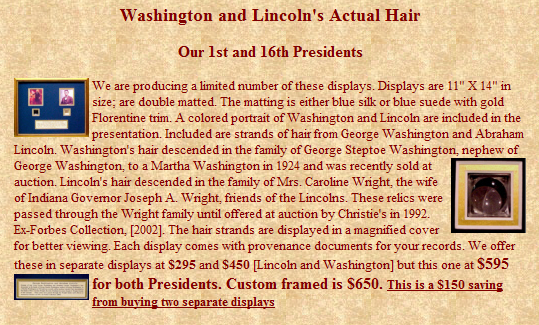
Available for order today from The Historical Shop, Metairie, LA
ADDENDUM:
Zen here – dealing with an internal server error as it relates to comments and pings on Charles’ post. Unable to turn comments back on at the present time – only this post seems to be encountering problems. Trying to fix.
ADDENDUM to the ADDENDUM:
Comments are now open.
Page 2 of 2 | Previous page
Michael Robinson:
March 13th, 2012 at 5:27 pm
Secular relics can be every bit as lugubrious as the sacred. For example there are death masks of which Princeton has an extensive collection, appropriately a bequest, which has a full index and pictorial guide.
.
In 1837, when George Washington’s body was removed from its original coffin and re-interred in a marble sarcophagus, fragments and fittings were removed. Mount Vernon has a post including a slideshow of the various ways of George Washington’s coffin fragments have been mounted and displayed. Fragments of the coffin do appear for public sale on occasion and, on May 21st. 2011, a group of these shards could have been yours for $1,553.50.
.
Not least there is the infamous Jeremy Bentham auto-icon, his clothed skeleton and mummified head on display in University College London. In accordance with his happiness principle Bentham believed the dead should be useful to the living; in his will Bentham requested first a public dissection, as part of an anatomy lecture, before the preservation and display, an account of the history, initial preparation and modern conservation of the piece.
Ski:
March 16th, 2012 at 10:22 pm
Umberto Eco’s novel “Baudolino” is an excellent tale and highlights the Medieval trade of fake religious relics to the unsuspecting public. Suckers have existed for a long time it seems.