Countering Violent Extremism: variants on a theme
[ by Charles Cameron — modeling / scoring CVE as a flow of ideas, with related matter from Hesse, Melville, Tufte, Rushdie and John Seely Brown ]
.
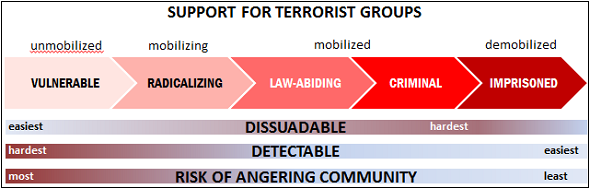
[ graphic: McCants / Berger, see below ]
.
I am interested in thoughts: in the way thoughts connect to one another, differ from one another, lead to one another, parallel or echo one another, and oppose one another…
That’s my interest, that’s me.
1.
So when Will McCants of Jihadica posts the first two parts of his three-part series on Countering Violent Extremism (CVE), two points in particular strike me:
McCants proposes his own definition for CVE – “Reducing the number of terrorist group supporters through non-coercive means” – in part 1 of his presentation, indicating what in his view it should and shouldn’t involve, and in supporting this definition, he notes (recommendation #3):
The focus is not on reducing support for ideas, which is difficult to judge, but rather support for specific organizations that embody those ideas and seek their realization, which is easier to document and more closely related to criminal behavior.
In part 2, he mentions “thought police” twice, the second time saying:
But if counter terrorism is to involve more than just locking people up, it should not stray too far from stopping bomb throwers into social engineering and thought policing.
I’m definitely not into thought police either — but while I’d agree that ideas are by nature difficult to track or assess, that’s nonetheless where my own curiosity and creativity finds its level.
2.
Just how CVE should operate in general is outside my scope — but since I do tend to focus in on ideas, I have the sense that paralleling McCant’s diagram of the approximate stages of support for terrorist groups:

or the version JM Berger reworked with McCants and posted on Intelwire, which I’ve placed at the top of this post — there could in theory be a diagram of the evolution of thought that accompanies those stages, and that such a diagram, intricate though it would undoubtedly be, might still be of some use.
3.
It seems to me that two main streams off thought – some might say “narrative” — would tend to flow together towards the eventual outcome of full radicalization and active jihad.
- One stream would begin with dissatisfaction and wend its way through a general sense of injustice in the world to the idea that Islamic nations and groups in particular are being targeted for military interventions by America and its allies, perhaps with a detour though the issues associated with “underdog” Palestinians, and thence towards a sympathy for jihadists, some level of identification with the Ummah, formal acceptance at some point of Islam (ie the taking of the Shahada), to an acceptance that jihad is an individual obligation for able Muslims under present circumstances…
- The other stream would arise from religious seeking and theological speculation, finding in Islam a simple and clear-cut answer to the seeker’s questions, via further discussion and the taking of Shahada — and then move along roughly the same trajectory that Daveed Gartenstein-Ross meticulously chronicled in his first, less widely known book, My Year Inside Radical Islam: A Memoir, with an emphasis on an increasingly “puritanical” salafi / wahhabi / deobandi interpretation of the religion, which can then lead in turn to a sense of potential political ramifications, again that the West is involved not merely in wars that happen to be in Muslim countries but in wars against the Ummah, and thence again to the acceptance of jihad as individual obligation.
That individual obligation (fard ‘ayn) being, I suspect, the likely “bottleneck” where any and all such streams would converge.
4.
For those interested in how this ties in with wider currents in contemporary thought, and with the bead game in particular:
I said above that I am interested in thoughts. I mean by this that my natural focus is more on thoughts than on people. Not that this is better or worse than some other focus…
In Hermann Hesse terms, I’m more interested in the great game of juxtaposed cultural contents played by the Castalians in his book Magister Ludi:
All the insights, noble thoughts, and works of art that the human race has produced in its creative eras, all that subsequent periods of scholarly study have reduced to concepts and converted into intellectual values the Glass Bead Game player plays like the organist on an organ. And this organ has attained an almost unimaginable perfection; its manuals and pedals range over the entire intellectual cosmos; its stops are almost beyond number.
than I am in the game that Hesse tells us he played in reverie while raking and burning leaves in his garden — visualizing the great men of all times walking and talking together across the centuries – a game which quite a few great minds seem to have stumbled upon, and which Hermann Melville describes in his novel, Mardi:
In me, many worthies recline, and converse. I list to St. Paul who argues the doubts of Montaigne; Julian the Apostate cross- questions Augustine: and Thomas-a-Kempis unrolls his old black letters for all to decipher. Zeno murmurs maxims beneath the hoarse shout of Democritus; and though Democritus laugh loud and long, and the sneer of Pyrrho be seen; yet, divine Plato, and Proclus, and Verulam are of my counsel; and Zoroaster whispered me before I was born… My memory is a life beyond birth; my memory, my library of the Vatican, its alcoves all endless perspectives, eve-tinted by cross-lights from Middle-Age oriels…
Both modes are valuable, I’d suggest, both are worth pursuing.
5.

Edward Tufte has the above diagram in Visual Explanations, one of his several beautiful and profound books. That diagram in turn is based on Salman Rushdie‘s description of the Indian epid Kathasaritsagara or Ocean of the Streams of Story in his book Haroun and the Sea of Stories:
…the Water Genie told Haroun about the Ocean of the Streams of Story, and even though he was full of a sense of hopelessness and failure the magic of the Ocean began to have an effect on Haroun. He looked into the water and saw that it was made up of a thousand thousand thousand and one different currents, each one a different color, weaving in and out of one another like a liquid tapestry of breathtaking complexity; and [the Water Genie] explained that these were the Streams of Story, that each colored strand represented and contained a single tale. Different parts of the Ocean contained different sorts of stories, and as all stories that had ever been told and many that were still in the process of being invented could be found here, the Ocean of the Streams of Story was in fact the biggest library in the universe. And because the stories were held here in fluid form, they retained the ability to change, to become new versions of themselves, to join up with other stories and so become yet other stories…
That diagram offers a quick approximation to the idea that I’d like to be able to model / diagram / score the ideas in play in CVE.
6.
If an idea is timely, it will find its kin — that’s one way to check that you’re not hopelessly out to lunch — and I certainly feel kinship with Tufte, Rushdie and Hesse here.
This, from John Seely Brown‘s opening keynote [video] at the 2012 Digital Media and Learning Conference, also strikes a kindred note for me:
How do you participate on the ever-moving flows of activities, knowledge and so on and so forth; how do you move from being like a steamship that sets course and keeps going for a long time to what you might call whitewater-kayaking, that you have to be in the flow, and you have to be able to pick things up on the moment, you gotta feel it with your body, you gotta be a part of that, you’ve gotta be in it, not just above it and learning about it. … In this new world of flows, participating in these knowledge flows is an active sport. And the whole catch is, how do you participate in these flows…?
7.
Ideas as flows, radicalization processes as flows — it’s mapping, modeling, and scoring them that really catches my own interest. It is still early days as yet…



March 20th, 2012 at 2:02 pm
I am interested in thoughts: in the way thoughts connect to one another, differ from one another, lead to one another, parallel or echo one another, and oppose one another…
.
“Indeed, everybody in the Rue Fossette held a superstition that “Meess Lucie” was learned, with the notable exception of M. Emanuel, who, by means peculiar to himself, and quite inscrutable to me, had obtained a not inaccurate inkling of my real qualifications, and used to take quiet opportunities of chuckling in my ear his malign glee over their scant measure. For my part, I never troubled myself about this penury, I dearly like to think my own thoughts; I had great pleasure in reading a few books, but not many—preferring always those on whose style or sentiment the writer’s individual nature was plainly stamped—flagging inevitably over characterless books, however clever and meritorious, perceiving well that, as far as my own mind was concerned, God had limited its powers and its action—thankful, I trust, for the gift bestowed, but unambitious of higher endowments, not restlessly eager after higher culture.” – “Villette,” Charlotte Bronte.
.
http://en.wikisource.org/wiki/Page:Villette.djvu/244
.
I, too, love to think my own thoughts, one thought flowing into the next. I have a series of quotes on this topic and will add to this thread later. All my old favorites! Those late twentieth-century women writers, mostly English, some Irish, some American, the Brookners and O’Briens and Barkers and Murdochs and Carters and Livelys and all that a certain type of contemporary–and often male–writer loves to make fun of because, well, I don’t know why. I guess not Carter, but the more domestic types. But who writes better than Elizabeth Taylor (the author, and one of her passages goes here, too.)
March 20th, 2012 at 2:06 pm
I can’t resist, I’ll add the quote later but E Taylor writes in one of her novels that all of human life may be distilled down to perhaps one memory, that one touchstone of the vivid. The Vivid. What a perfect idea to explore in a novel or short story! The setting is an elderly character, unwell, in bed, and thinking dreamy thoughts of childhood remembrance that ill characters think in novels. And yet, a hospital is like that, Charles. Hospitals always make you think certain things, and doctors and nurses and medical students brush the thoughts away. Life needs to be vivid because, otherwise, it will be terrible. In this, the hereafter types and the herenow types are entirely the same. Something must be contemplated to dispell the terrible.
.
Ah those dreamy victorians. They always get me thinking. Always.
March 20th, 2012 at 7:09 pm
Thanks, Madhu:
.
I’m wondering if, perhaps, your second comment was triggered by reading my post Which world is more vivid? This, or the next? — “vivid” being the operative word im both — where for some unknown reason the comments shut themselves off?
.
I’d be happy to copy it across there, if that were the case… though I’d leave it here too, for continuity.
.
Looking forward to your further quotes — does Doris Lessing feature in your list of authors?
.
< aside>
.
One of these days I’d like to do a rich analysis of her Shikasta series — not great science fiction, but philosophically amazing and provocative on strategy in ways that I think might interest ZP readers! Heh. And I’d like to do the same for Herbert‘s original Dune series — no less brilliant, but in other ways.
.
< / aside >
March 21st, 2012 at 2:48 pm
I had not intended to refer to your “Vivid” post but it came up, as if bubbling up from some underground spring, as soon as I started typing. Interestingly, if I write in long form I cannot move from idea-to-idea with fluidity. And it has to be typing, keyboard of typewriter (which I don’t have) or computer. Texting or short-hand won’t do.
.
I can’t locate the Elizabeth Taylor quote. I think it is from “A View of the Harbor.” On O’Brien, a young commentator at Huffington post called O’Brien dated, which surprised me because her writing seemed so fresh and exciting during my 80s teenagehood, even though she made her “splash” in the 60s and 70s. But I get the point. Time moves on. ?Does it ever, Charles.
.
“Outside it is blustery. In the occasional lull I think I hear an owl. Of course I always hear the cars, their dorne in the distance, cars going too fast at night. There could be an owl since we are on the outskirts of a city and there are trees to roost in. They, too, are creaking and groaning. I am counding sheep but they are tumbling into one another and I see nothing but rumps of graying feece, ruddled at that, and as for the ploy of counting apples, it is too playful, too strenouos. Still, one has to pass the time, the leisure hours, the resting hours, knit up the raveled sleeve of care.” – “Night,” Edna O’Brien.
.
I could quote the whole thing, one sentence at a time.
.
“And those noises, and those sighs, and those murmurs, and those innuendoes, and those emanations, and those come-hithers, and those coo-coos issue from me faithfuly, like buntings.”
.
“I say seven and think it means something. The figure slides across the page or the blackboard or the sweet sky or the sawdust floor, and though it tells me something, like the cost of the joyride, or what filly to back, or how long more the journey, the immediate journey, that is, it does not tell me what I need to know.”
.
You see how it all fits in with your posts? We need the vivid, or we feel empty.
.
And yes to Lessing. I’d love to read that post about strategy….
March 21st, 2012 at 2:53 pm
What emptiness are some who are drawn to radicalism filling? Is sociopathic lack of conscience an emptiness that the damaged “sense,” but cannnot feel, only act out on, just as the lack of empathy may lead to killing?
March 21st, 2012 at 3:01 pm
On Brookner,
.
“It is easy to see why this should be the case. She does not shy away from difficult subjects: disappointment and regret; the ways in which people try to come to terms with their shortcomings. Her sense, from Freud, that the templates for our lives are set in childhood, our relationship with our parents acting as a model for all later human interaction, inevitably produces claustrophobic results. As Sturgis says ominously in Strangers, “No one escapes their past.” ”
.
http://www.telegraph.co.uk/culture/books/bookreviews/4838324/Queen-of-the-lonely-hearts-club.html
.
This is why I believe her novels are sometimes hated (okay, I get the criticism. If you prefer narrative over introspection, you will not like them. Which is fine. We all don’t have to like the same things.) They are disliked because nothing could be more anti-modern than to say we carry burdens and we may not be able to overcome the. The gods of Oprah and self-help and a certain type of modern medicine and marketing allow any personal examination, save one: you may try your best, and still lose.
April 20th, 2012 at 9:11 pm
[…] If you haven’t read Charles Cameron’s ruminations on the matter, you […]
April 27th, 2012 at 11:40 pm
I question if all this is really about one vivid memory. How does the model account for those that did not experience that vivid memory yet are just as convicted in principle? In my mind i am also thinking the radicalism and extremeism displayed in social media and in hacking and identity theft. It is none the less violent and intended to inflict serious terror. I personally see this model as being easily adaptable to the modern nuances of the so-called Arab Spring and Occupy like movements.
Dr. Terry Tucker, Yorktown Systems Group, Senior Analyst
April 28th, 2012 at 9:11 pm
Hi Terry:
.
It was Madhu, a physician and long-time friend of this blog, who introduced the idea of “vivid memory” in commenting on this post, and she was talking about fictional narratives rather than modeling CVE — this post was about the flow of ideas within a (generalized, jihadist) radicalization process, suggesting that there may be key ideas in that process that are like hubs in international travel — “therefore at this point jihad is obligatory” being roughly equivalent to “then take connecting flight ## to destination”.
.
And yet I also think there’s a “vivid” quality to “those that did not experience that vivid memory yet are just as convicted in principle” — it’ll probably take another post for me to figure that one out in any detail, though.
.
Thanks for your comment