Reactions to the Reactionary – The New Scholarship on Fascism, 2
[ Emlyn Cameron reviews Timothy Snyder‘s The Road to Unfreedom — second in a series [first here], and introducing a “Yale Theory of Fascism” — Emlyn Cameron holds a Masters from the Columbia School of Journalism ]
.
.
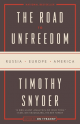
Timothy Snyder, The Road to Unfreedom
Timothy Duggan Books (2019)
Trade paperback, 368 pages
$ 17.00 (Amazon $10.39)
ISBN 0525574476
.
Because he and a few around him fear the death of the revolution,
China must be made to convulse.
Robert Jay Lifton, Revolutionary Immortality
.
“It’s always something!”
This phrase punctuated every illness, automotive break down, or household repair of my childhood. I am sure it is a typical of many homes where ends are made to meet, but only just.
Depending on the moment, it could be a wry observation – the good-natured sigh under pressure that enabled my mother to collect herself before addressing the latest unexpected fee – or it could be a hiss, lashing at a world that found a way to negate every surplus dollar she managed to save away. It is the cry of a person whose world cannot be improved, only maintained, and with great difficulty.
It is a bitter hiss of this kind, warped and magnified by demagogues, to which Timothy Snyder has addressed himself in his book The Road to Unfreedom. As a political atmosphere he calls it the politics of eternity – as in Orwell’s a boot stamping on a human face forever rather than the [spiritual] life everlasting – a sense that beyond the small and guttering campfire flame of one’s culture there are always strange others waiting to move in and destroy you. In this frame of mind, all political action is an act of self-defense or a preemptive strike against an eternal coalition of enemies.
In 283 pages, with 60 pages of footnotes which follow, Snyder makes the case that Russia’s history from the collapse of the Soviet Union through 2016 is the story of a nation suffering the effects of eternity politics. This moral rot, he goes on to argue, is something the Russian Federation would transmit to the United States, and to which America is currently acutely vulnerable.
Snyder gives special attention to the years 2011-2016, each year meant to exemplify a choice between a political virtue and an aspect of eternity politics. In each case, it seems, Russia has abandoned the virtue and thereby taken a step towards authoritarianism and eternity: sacrificing individualism for totalitarianism; succession for institutional failure; global integration for imperial ambitions; novelty for eternity; truth for lies; and equality for oligarchy.
While this thematic structure is suggested in the prologue, the events are too complex and Snyder too honest a scholar (and engaging a storyteller) to confine any chapter entirely to its explicit theme. The story of Russia’s transformation into a one-party state, the invasion of Ukraine, and subsequent Russian enthusiasm for Donald Trump’s presidential campaign is relayed in primarily chronological order with brief asides for historical context, and it is better for it. The result, in Snyder’s occasionally mordant voice, is a presentation that at times reads like a thriller with an ensemble cast of ne’er-do-wells and nationalists.
The compelling story only suffers in passages where the author too fully adheres to his thematic structure, as when he gives a history of Ukrainian and Russian statehood which stretches back over a thousand years to the 980s. The information is useful and telling but coming, as it does, in the fourth chapter (and just under a third of the way through the book as a whole), it jars a reader and may test patience as the narrative winds its way to recent events again.
Page 1 of 5 | Next page