Coronavirus meets religion #5 – the arts and pestilence
[ by Charles Cameron — — what novelist, poet, painter, composer or film maker will create the great works of our present plague? — with two quotes on pestilence ]
.
I owe much to the Guardian for Jonathan Jones‘ article Plague visionaries: how Rembrandt, Titian and Caravaggio tackled pestilence, which provided me with the classic western exemplars here — and then there are those two quotes. But read on —
**
Pilgrims, penitents, flagellants, corpse-bearers, gargoyles, vultures — the whole ghastly crew populate the first chapter of Carlos Fuentes‘ great novel Terra Nostra. It is a time of plague, and the river Seine is boiling.
Great artists not infrequently tackle subjects of death, decay and destruction, the antechambers of hell, as they do works of beauty, mercy and grace, the antechamber of paradise. Today’s edition of “Coronavirus meets religion” features a small cluster of the greatest works of European art, painted in time of plague — to ward it off, to beg God for his mercy, to instruct the faithful in the path of heaven, to petition God on behalf of oneself or one’s family..
**
Titian: Pieta
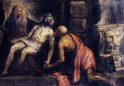
This detail of a painting by the great color master Titian shows from left to right the virgin Mary holding her son Jesus, who has just been brought down from the cross, dead, his hand held by a an old and weathered figure half-clothed in rad, believed by art historians to be a self-portrait by Titian, and representing St Jerome. and bottom right, an image of himself and his son as they’d be represented in a peasant’s ex voto or prayer plaque.
Jonathan Jones notes:
Titian painted this twilit image when Venice was being ravaged by plague. He portrays himself half-naked, prostrated before the image of Mary cradling the dead Christ. To make his message clear, he includes a picture within this picture: a crudely daubed popular ex-voto panel you might see in a church, depicting him and his son Orazio in prayer. This most sophisticated of artists is offering this great ashen canvas in the same simple spirit as an offering any peasant might make. It didn’t work. Titian and Orazio both died in the 1576 plague.
**
Mary Shelley:
Want a shiver down the spine? Mary Shelley gave us Frankenstein – here she is on pestilence, from this month’s Back Matter on Lapham’s:
Have any of you, my readers, observed the ruins of an anthill immediately after its destruction? At first it appears entirely deserted of its former inhabitants; in a little time you see an ant struggling through the upturned mold; they reappear by twos and threes, running hither and thither in search of their lost companions. Such were we upon the earth, wondering aghast at the effects of pestilence. Our empty habitations remained, but the dwellers were gathered to the shades of the tomb.
**
Caravaggio: The Seven Works of Mercy
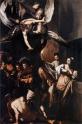
St Matthew‘s gospel gives the standard set of “works of bodily mercy” (Matt. 25: 35-36:
I was an hungred, and ye gave me meat: I was thirsty, and ye gave me drink: I was a stranger, and ye took me in: Naked, and ye clothed me: I was sick, and ye visited me: I was in prison, and ye came unto me
Page 1 of 3 | Next page