Coronavirus meets religion #5 – the arts and pestilence
Various artists have depicted what are now known as the Works of Corporal Mercy, Bruegel the Elder painted them in pen and ink, Bruegel the Younger painted them in color, but nobody had brought all seven together combined in such a single image as Caravaggio‘s. From Caravaggio.ogr:

He set the Acts described in Matthew 25 : 35-36 in a little piazza, perhaps in front of the same Taverna del Cerriglio where three years later he was attacked. It is night, and the padrone is directing three men to his inn (“I was a stranger, and you welcomed me”). One is hardly visible. The second is recognizable as a pilgrim by his staff, Saint James Major’s shell, and Saint Peter’s crossed keys on his hat; perhaps he can be identified as Saint Roch but more likely, following the Gospel, he is Christ in disguise. The third, a young bravo, is Saint Martin c utting his cloak to share it with the naked beggar in the foreground (“I was naked, and you clothed me”). In the shadow behind the blade is a youth whose legs seem to be twisted (“I was sick, and you visited me”). The group of loiterers is completed by a husky man, Samson, in the desert of Lechi (Judges 15 : 19), pouring water into his mouth from the jawbone of an ass (“I was thirsty, and you gave me drink”). Opposite this group, on the right, is Pero breast-feeding her aged father, Ci-mon, through the bars of his prison (“I was hungry, and you gave me food” and “I was in prison, and you came to me”). And in the background, a vested priest holds a torch to illuminate the hasty transport of a corpse, perhaps recalling the plagues that periodically decimated the city’s population (burial of the dead, the seventh Act, not mentioned in the Gospel). Above the scene hover the Madonna and Child with two angels, as if to warrant divine acknowledgment of human charity, particularly of the protagonists in the painting, who may portray members of the confraternity.
**
Susan Sontag:
Sontag on pestilence, in Disease as Political Metaphor — courtesy the New York Review of Books:
From pestilence (bubonic plague) came “pestilent,” whose figurative meaning, according to the Oxford English Dictionary, is “injurious to religion, morals, or public peace—1513”; and “pestilential,” meaning “morally baneful or pernicious—1531.”
**
Albrecht Dürer: The Four Horsemen of the Apocalypse:
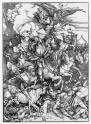
Most beloved of the most famous set of illustrations of the Book of Revelation is this work by Albrecht Durer. The Met explains:
Page 2 of 3 | Previous page | Next page