Simultaneity II: the pictorial eye
Here is Gayford’s concluding paragraph, tying Hockney’s work into the larger context of our need for multiple frames of reference:
“Don’t we need people who can see things from different points of view?” Hockney asks. “Lots of artists, and all kinds of artists. They look at life from another angle.” Certainly, that is precisely what David Hockney is doing, and has always done. And yes, we do need it.
*
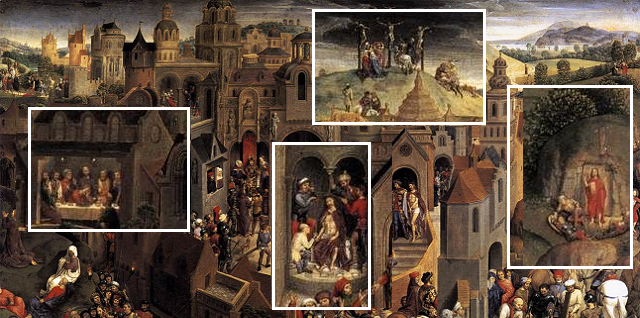
Memling again — and here I have enlarged and “framed” four of the 23 scenes from the passion of Christ which he has incorporated in the one painting: the Last Supper, the Crowning with Thorns, the Crucifixion, the Resurrection — Thursday evening through Sunday, and from life to death and back again.
*
It was Holy Week for Christians just last week, so perhaps you will forgive my having been preoccupied with images of the passion during the season set aside for such meditations — but what I want to point out to you is timeless, and indeed brings the transcendent into the everyday. Let’s take a look at a Hitchcock film next, then, and see how a contemporary videographer Jeff Desom has remixed the already Hockney-like Rear Window [link to IMDb] to create his own time-lapse telling of the tale [link to Vimeo], from which I took this screen-grab:

*
Time-lapse — simultaneity? The philosopher Alfred North Whitehead once wrote:
The communion of saints is a great and inspiring assemblage, but it has only one possible hall of meeting, and that is the present; and the mere lapse of time through which any particular group of saints must travel to reach that meeting-place, makes very little difference.
And so it is with this other Memling painting — and many others like it, by artists old and new:
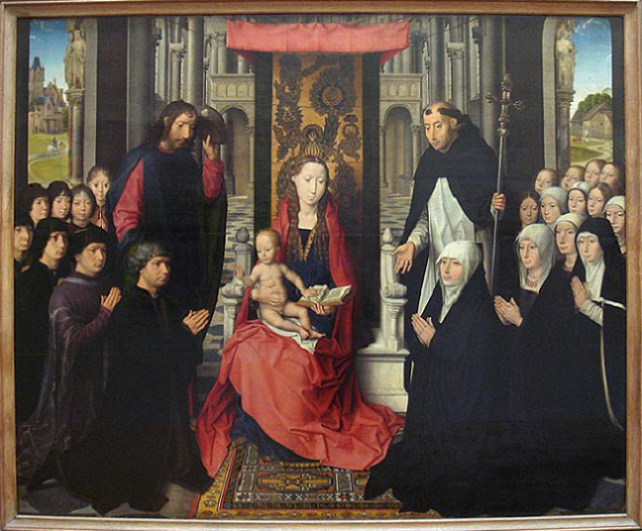
Here we see the Virgin Mary and Christ child with Saints Dominic and James — there’s an eleven centuries gap right there, St Dominic lived from 1170 – 1221, more than a millennium after Christ — and Memling has St Dominic presenting his patron, the spice trader Jacques Floreins with his family to Christ, circa 1490. With everyone dressed in late 15th-century fashions…
Whitehead — co-author with Bertie Russell of Principia Mathematica — see how amazing this is? — could have been thinking of Memling: “the mere lapse of time through which any particular group of saints must travel to reach that meeting-place, makes very little difference”.
*
Coming up next: how this affects our understanding of story.
____________________________________________________________________________
Page 2 of 3 | Previous page | Next page