Form is insight: a musical experiment
[ by Charles Cameron — here’s a musical experiment from the book / project i seem to be writing, which offers a grand slam intro to contemplative and artistic approaches to creative thinking, and hence a fresh angle on intelligence ]
.
It looks very much as though I’ve been beginning to write parts of let’s call it “a book” for a while here on Zenpundit. I laid out the overall topic and approach as I see it in my previous post, but here I would like to launch into it mid-stream, with a musical experiment to explore the mind’s capabilities. I’ll explain why, later.
**
.
**
Okay, here’s the experiment.
I invite you to listen to a short piece by JS Bach on YouTube. This will take roughly three and a half minutes of your time, the piece of music itself is one of the glories of the classical tradition, I’ve chosen the video because of the terrific graphics that accompany and illuminate the music, there will be some rock and ragtime to follow for those whose tastes go those ways — and I must ask you to pay very special attention while watching and listening to the video.
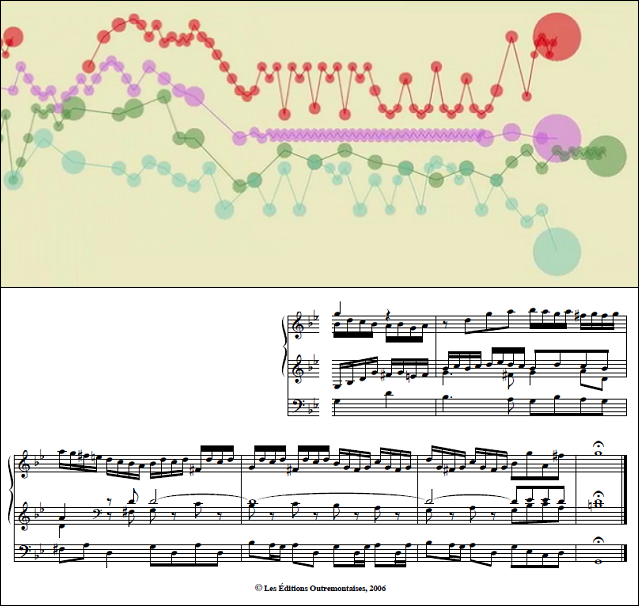
Before you do that, however, I’d like you to take a look at the image at the top of this post, which shows you the ending of the piece both as the video graphics present it, and in the musical notation or “score” an organist would read. The graphics are terrific because they allow the untrained eye to follow the threads of the different melodies or “voices” as Bach braids them together. The work is his “Little Fugue” in G minor, which you can find indexed in his collected works as “BWV 578”.
Here’s how I’d like you to pay attention during the piece:
As you listen to the performance on video, I’d like you to follow the colored lines of the melodies as they move along in the video graphic, and listen carefully to hear how many of the lines of sound you can actually follow distinctly in your mind. At the beginning there’s only one “voice” – only one line of melody – so your task is easy. If you are used to listening to music of one sort or another, you’ll almost certainly be able to track, more or less, some kind of thumping bass line and some kind of melody rising above it – two voices.
Can you manage three? four or more?
If you’re a musician you may still find the graphics — and the exercise – illuminating, but you might prefer to make the same experiment with a version of the piece played by Robert Köbler on a Silbemann organ, accompanied on video by the score..
Here’s the video — see how many voices you can hear and track:
**
How did you do? How many voices could you follow at one time?
And why am I bothering to as you to do this, and then talking so much about it? After all, you may already know everything I’m saying and more, or you may simply not care that much about such things.
Here’s why: the project is about creativity and intelligence.
It’s about how to apply forms of creativity that are generally found in the arts and humanities — and in the world’s contemplative traditions — to the questions that arise for every bright human as we face the exhilarating challenging and terrifyingly complex world around us.
It’s about understanding complexity, in the way the Intelligence Community needs to understand complexity, and business leadership, and our scientists and technicians, and the congregants at our synagogues, churches, mosques and temples, and, well, all the bright people everywhere — disillusioned, or fresh and rarin’ to go.
**
Complex problems often require some sort of recognition and resolution of several or many distinct and sometimes conflicting voices, points of view, concerns or vectors.. which may shift in intensity and direction as the situation evolves.
In musical terminology, any music that includes two or more distinct melodic lines or “voices” playing together simultaneously is polyphonic — from the Greek for “many voices”. Counterpoint — from the Latin for a point that counters another point — is the artful way in which composers can “work” two or more melodic lines together, so they clash at times, resolve, and harmonize.
The fugue — the particular contrapuntal form Bach uses in the piece you just heard — imposes even tighter constraints on the composer, and can elicit even greater creative inspiration as a result — as many of Bach’s, Mozart‘s, Beethoven‘s and others’ greatest works testify..
**
I imagine you can see that the many voices of polyphony — voices in counterpoint, that at times clash and are in need of resolution and harmony — have their equivalents in the complex multi-stakeholder problems, clashing points of view and need for constructive resolutions that creative artists, intelligence analysts, strategy, policy and decision makers, and anyone who wants to keep aware of the shifting currents of our strange and complicated times all need to take into account.
So polyphonic, and specifically contrapuntal, thinking, can be extended way beyond the realm of music — as Hermann Hesse suggested in his greatest novel, Glenn Gould tried to demonstrate in his “contrapuntal radio” pieces, and Edward Said understood when he characterized the Israeli-Palestinian issue in these words:
When you think about it, when you think about Jew and Palestinian not separately, but as part of a symphony, there is something magnificently imposing about it. A very rich, also very tragic, also in many ways desperate history of extremes — opposites in the Hegelian sense — that is yet to receive its due. So what you are faced with is a kind of sublime grandeur of a series of tragedies, of losses, of sacrifices, of pain that would take the brain of a Bach to figure out.
The “book” may turn out to be a DVD, or a workshop, at this point who knows? Whatever format it winds up it takes, it will teach contrapuntal thinking — using examples drawn from world culture and contemporary geopolitics — as a radical alternative methodology, complementary to but very different from our current analytic methods. It will be a text in the cross-disciplinary, associative, lateral or horizontal equivalent of the kind of disciplinary, siloed, linear or vertical thinking that our increasingly specialized culture has trained us in —
and which we need to supplement, if we are to have the mental flexibility to see and make the creative leaps our times require of us.
For more on this, see also my Feb 2011 post (at least I’m reasonably consistent over time) A HipBone approach to analysis VI: from Cairo to Bach.
**
God only knows how many voices there are in Bob Dylan‘s song Sad Eyed Lady of the Lowlands, or Eric Clapton‘s Have you ever loved a woman from the 2004 Crossroads Guitar Festival – the principle’s the same, but we don’t (yet) have the graphics to allow your eye to follow what the musicians are doing — and there are solos, and sidemen.
Each musician has at least one voice, its melodies and its silences, to present – and sometimes several, as we saw with the Bach organ piece. And together the individual musicians add up to an ensemble, each with an awareness of the others’ voices and a concentration on their own.
And for an insight into the varieties of organ mastery, compare Billy Preston‘s amazing solo starting at 9’33” on the Clapton piece, Al Kooper‘s organ work on Dylan’s Sad Eyed Lady, and Ton Koopman‘s rendering of the same Little Fugue BWV 578 we started with – where at times you can watch Koopman’s fingers on the keys or feet on the pedals, for yet another way of visualizing the intricate interweavings of this glorious music.
**
Glenn Gould had an amazing mind: for your enjoyment, here’s a version of his own fugue, aptly entitled So You Want To Write a Fugue? — with a similar graphical display to help you follow along with the interweaving lines of melody…
It’s serious, and it’s hilarious too! Or maybe you’d prefer Scott Joplin? Either way, enjoy:
Glenn Gould:
Scott Joplin, Euphonic Sounds, a Syncopated Novelty:


