Crucifixion and Resurrection, ancient and modern
[ by Charles Cameron — religious resonances of the Tupac video, from the Drachenloch cave bears to today ]
.
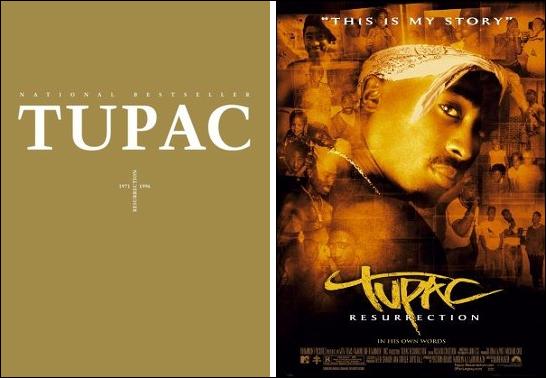
1.
As the 2006 book and DVD covers above suggest, the themes of crucifixion and resurrection have been associated with Tupac Shakur for a while.
R.N. Bradley blogs at Red Clay Scholar and is a doctoral candidate in African American Literature and Culture at Florida State University. She makes the same connection clear in a post titled Smilin’ Serpent: the Violent Passion of Tupac Shakur on September 13, 2010:
Projects revealed Shakur’s pseudo-schizophrenic obsession with death and resurrection. These tropes manifested in videos like “I Ain’t Mad Atcha” or the collabo featuring Scarface “Smile,” and the coverart of The Don Illuminati: the 7 Day Theory(1996).
2.
Death comes before resurrection: Tupac Shakur died of gunshot wounds in 1996, after completing his final album, Makaveli — which was posthumously released:

3.
What may be more surprising is that he was brought back to something approximating life — in a holographic performance that included a duet with a decidedly non-holographic Snoop Dogg— just this week…

4.
But then, that’s religion.
Time-bound, mortal and frankly disintegrating as we are, we’d like there to be more to the story after death, and that yearning is something that religion addresses.
Perhaps to get the point across in an interesting way you’ll allow me to quote from a move in a game I played some years back:
Exploring the Drachenloch cave in Switzerland, Emil Bachler found cave bear skulls arranged in wall niches in one part of the cave, and stone tombs in another chamber containing cave bear skulls and bones. Ursus spelaeus, the cave bear, has now been extinct 10,000 years, while the Neanderthal inhabitants of the caves appear to have ceased as a species themselves about 40,000 years ago.
In Shepard and Sanders’ book, The Sacred Paw, which deals with both the natural history of the bear and its appearances in myth and ritual, Bachler surmises that his finds provide “the first evidence in man of an already awakened higher spiritual life.”
But why the bear in particular? What could we learn from the bear that we couldn’t learn anywhere else? Shepard and Sanders’ answer is that the bear seemed able to teach us how to survive bodily death. Hibernation isn’t just a “natural” phenomenon — it’s also a “spiritual” revelation… I’ll let them explain in their own words:
Page 1 of 3 | Next page