Between the warrior and the monk (ii): Fr Trevor Huddleston
The young boy never quite recovered from this encounter. We know him now as the Nobel Peace laureate, Archbishop Desmond Tutu.
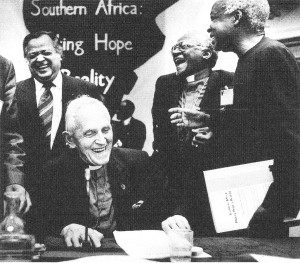
Here’s a photo of four old friends — Huddleston, Tutu, Julius Nyerere of Tanzania, and former Commonwealth Secretary General Shridath Ramphal.
.
From individuals to the world:
These are two simple stories of how Fr Trevor simply and straightforwardly loved whomever was before him, regardless of the enormous pressure at the time to discriminate between “real” and “insignificant” people — a love which made an indelible mark on those whose lives it touched.
And when Father Trevor touched you, as Lord Buckley might say, you stayed touched.
Thus far I’ve been focusing on individuals that Trevor touched. I do not think he in fact saw more than one person at a time, and his responses to situations were geared directly to the service of his love.
It was because of this that while he was in South Africa, Trevor repeatedly and quite literally put his life on the line in defence of the very simple proposition that the color of a person’s skin was immaterial in view of the love that was possible between any two people — so perhaps here’s where I should mention some of that history and some of the honors it brought him. After all, Trevor did pretty much take on the government of the South Africa he so loved, and lived to see it change.
.
Bishop Trevor of Sophiatown
Trevor Huddleston was a founding member of the African National Congress, the author of the first non-fiction work (Naught for Your Comfort, more on that later) to critique his beloved South Africa’s apartheid policy, reviled publically for meddling in politics by an Archbishop of Canterbury who later declared he had been in error and that Fr Trevor was about as close to a saint as one could find.
In 1955, Father Trevor, along with Yusuf Dadoo and Chief Albert Luthuli, was awarded the Isitwalandwe, the highest award given by the African National Congress. He was awarded the United Nations Gold Medal in recognition of his contribution to the international campaign against apartheid, the highest awards from both Zambia and Nigeria, the Dag Hammerskjold Award for Peace, the Indira Gandhi Memorial Prize, and ten honorary doctorates, including that of his alma mater, Oxford.
Archbishop Huddleston initiated the “International Declaration for the Release of Nelson Mandela and all Political Prisoners” in 1982, took part in the televised “International Tribute for a Free South Africa” held at Wembley Stadium, London in 1990 during which he introduced the address by Nelson Mandela (see below), entered South Africa House, Trafalgar Square, London in 1994 to vote in the first South African democratic election, and was a guest at President Mandela’s inauguration in Pretoria that year.
He received the KCMG (Knight Commander of the Order of St. Michael and St. George) in the 1998 New Year Honours list, for “Services to UK-South African Relations”, and attended an Investiture at Buckingham Palace on March 24th, 1998, to receive this honour from HM the Queen.
He chose the designation, “Bishop Trevor of Sophiatown”.
.
Nelson Mandela:
But let’s go back to individuals, and to Nelson Mandela in particular.
Mandela and Trevor were comrades in the fight against apartheid from the beginning — and the richness of their friendship is visible in the photo of Mandela with his arms on Trevor’s shoulders in the right hand panel at the top of this page.
Page 2 of 3 | Previous page | Next page