Guest Post: Cameron on “A Difficulty in Translation”
Tuesday, April 8th, 2008Blogfriend and an expert on comparative religious studies, Charles Cameron has graciously offered a paper on comprehending the worldview of radical Islamist terrorists, which I have posted below in it’s entirety. Cameron is formerly the Principal Researcher for the Center for Millenial Studies and is currently writing a book on religious and apocalyptic violence:
A Difficulty in Translation
By Charles Cameron
It is not easy to get behind the veil that a natural hatred for those who attack and maim us draws across our ability to see OBL clearly, nor to understand what kinds of influence might lean some undecided Muslims, perhaps already prone to dislike American influence in world affairs, to move closer to a mindset that’s amenable to jihad.
Yet this in turn is something we have great need of, as Thomas Hegghammer made clear in an article on Jihadi Studies: the obstacles to understanding radical Islam and the opportunities to know it better, published in the Times Literary Supplement on April 2.
Hegghammer asks, rhetorically, “More than six years after 9/11, the study of jihadism is still in its infancy. Why has it taken so long to develop?” and answers himself, “the most important reason is no doubt that the emotional outrage at al-Qaeda’s violence has prevented us from seeing clearly.”
Understanding how the jihadist mindset works is not easily accomplished at a visceral level, without calling on some of our own most treasured memories and associations — as Michael Scheuer, ex-chief of the bin Laden desk at CIA, did in his book, Through Our Enemies’ Eyes: Osama bin Laden, Radical Islam, and the Future of America, Revised Edition
The decision of bin Laden and his colleagues, I believe, deserves no less thoughtful consideration than that of the American revolutionaries we revere as heroes. Unfortunately, the West today hears the statements of bin Laden and his colleagues with precisely the same sort of ear with which the British Crown listened to the Americans … This is not to say bin Laden and his al Qaeda colleagues were correct or deserve sympathy; as I said, America will have to use military force to confront, battle, and defeat bin Laden, al Qaeda, and their allies. It is to say, however, that bin Laden has been a worthy enemy … and that those in the United States should to able to have some appreciation for his movement by reflecting on the origins of their own country.
That’s an astonishing “move” — linking bin Laden associatively with the heroes of the American Revolution — but it has the merit, if we will allow it, of helping us view bin Laden through other eyes than those of our own instinctual response to attack. I would like to attempt a similar maneuver here, correlating bon Laden’s visit to the Tora Bora caves with Martin Luther King’s final speech given some 40 years ago on April 3, 1968 in Memphis, Tennessee. In making this linkage, I feel it necessary to express my strong appreciation for Martin Luther King’s life, which in some respects played a similar role to that of my own mentor, Trevor Huddleston.
I quote King in this context because an insight into his self-identified following in the footsteps of Moses may be transferable into an understanding of bin Laden’s stay in the Tora Bora caves, viewed as an act of piety through pious Muslim eyes. King said
We’ve got some difficult days ahead. But it doesn’t matter with me now. Because I’ve been to the mountaintop. And I don’t mind. Like anybody, I would like to live a long life. Longevity has its place. But I’m not concerned about that now. I just want to do God’s will. And He’s allowed me to go up to the mountain. And I’ve looked over. And I’ve seen the promised land. I may not get there with you. But I want you to know tonight, that we, as a people will get to the promised land. And I’m happy, tonight. I’m not worried about anything. I’m not fearing any man. Mine eyes have seen the glory of the coming of the Lord.
King is consciously aligning himself here with Moses, presenting his own story as the story of Moses receiving the commandments of God, descending from the mountain, and dying within sight of the promised land. It is a powerful rhetorical device, and one whose power we can easily understand when Dr King uses it.
It is also a rhetorical device used, mutatis mutandis, by Osama bin Laden — and our understanding of Martin Luther King’s use of it may allows us to glimpse its force when drawn on within an Islamic context by bin Laden — in words, but even more in deeds. In a post recently at hipbone out loud, I wrote
… this level of insight then allows us to see al-Qaida to some extent as pious Muslims may see it. For though the means bin Laden uses may be critiqued from an Islamic and even a strict Wahhabi point of view – as the recent publication of a devastating book length attack by one of al-Q’s earliest major theological supporters, Sheikh Sayyed Imam Al-Sharif, shows – it is still the case that his actions can have different resonance when “read” through Islamic eyes.
When bin Laden, at the lowest point of his jihadist efforts, leaves the Yemen for Afghanistan and betakes himself to the Tora Bora caves, he will inevitably remind some Muslims of the Prophet himself, who at the lowest point of his prophetic vocation left Mecca for Medina and sought sanctuary in a cave — where by the grace of his God, a spider’s web covered the entrance in such a way that his enemies could not see him.
Our natural tendency in the west is to see Tora Bora in terms of military topography, as a highly defensible, almost impregnable warren of caves deep within some of the world’s most difficult mountain territory. What we miss may be precisely what Muslim piety will in some cases see — that bin Laden’s retreat there is symbolically aligned with the “sunna” or life of the Prophet, and thus with the life of Islam itself — in much the same way that Christians, in the words of Thomas a Kempis, may practice “the Imitation of Christ”.
Gratitude where gratitude is due: Lawrence Wright makes this very point eloquently in his book, The Looming Tower. But Wright is rare in the attention he pays to religious markers of this sort, and I am also grateful that we have such scholars as Scott Atran and Michael Vlahos to inform us. Wright’s broader point about bin Laden’s “imitation” of Mohammed fits in with Vlahos’ observations as to the coalescing of contemporary jihadist narratives with those of the sunna, the life of Mohammed and his companions, in his Terror’s Mask: Insurgency within Islam:
Corbin describes the essential interpretive principle or hermeneutic of Islam: “Recite the Quran as if it had been revealed to you alone.” The Arabs and Persians created Hikayat — a “mystical epic genre” — to join “real” History – and one’s own actions within it — to a metaphysically prefigured History promised by Muhammad.
And this is precisely the meat of the discussion which the unnamed sheikh has with bin Laden and al-Zawahiri shortly after 9-11, the videotape of which was released by the Pentagon on December 13, 2001. The sheikh tells bin Laden
And the day will come when the symbols of Islam will rise up and it will be similar to the early days of Al-Mujahadeen and Al-Ansar [lit., the helpers, referring to Muhammed’s immediate followers]. And victory to those who follow Allah. Finally said, if it is the same, like the old days, such as Abu Bakr and Othman and Ali and others [three of the first four successors to Muhammad, called “the Four Righteous or Right-Minded Caliphs“]. In these days, in our times, that it will be the greatest jihad in the history of Islam and the resistance of the wicked people.
Perhaps we can grasp, finally, that it is his walking in the footsteps of his Prophet, as Dr King walked in Moses’ footsteps, which has given bin Laden’s much of the potency of his appeal.
And it is not in munitions and troop movements that the jihadists’ morale is to be found, but in subtle cultural and yes, spiritual details such as these.
 some and intimidating to others. New Media collapses traditional concepts of time and space as information moves around the world in an instant. Unlike traditional media,
 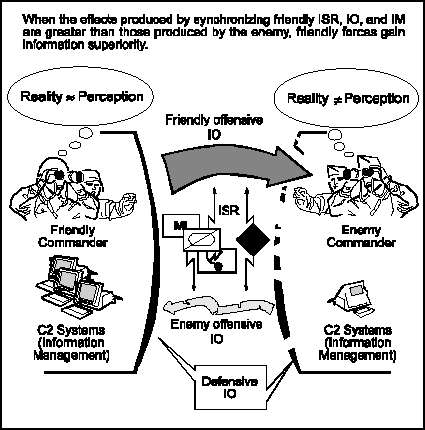 public diplomat, and persuader. Our adversaries understand and exploit this reality. Writing to
  successes in the short run but having the global audience grdugingly concede that “the Americans speak the truth” adds momentum of every word, every idea and every action we undertake. It will not bring us love because oftentimes, our pursuing national interests will come at the expense of others but truth-telling will yield something more valuable, respect. No one cares to be treated as if they were a fool and most of the transparently self-serving gibberish official spokesmen offer up pays dividends only in contempt being added to the anger foreigners already feel at some of our policies. Credibility is to the war of ideas what COIN is to guerilla warfare and it is a valuable and exceedingly rare quality because once your credibility is lost, it is lost.
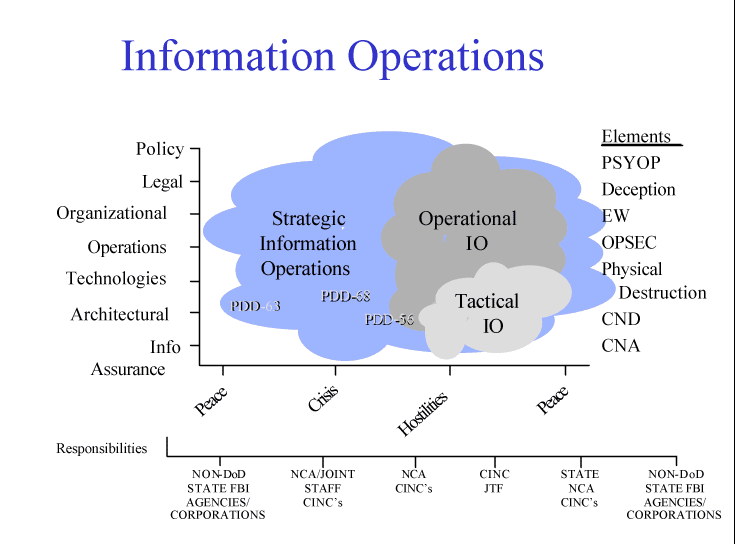 programs, plausibly deniable third parties and used sparingly and with subtlety. The increasingly “radically transparent” world ensures that too many sophisticated eyes with all sorts of agendas will be analyzing our official spokesmen 24/7. The best will can hope to accomplish is effectively framing our public message to be truthful and compelling. Any meme that is verifiably false, if we believe we must put it out into the global media environment, cannot have a return address.

