[ by Charles Cameron — with application to paras from JM Berger & WIll McCants ]
.
Two from Florida, both yesterday!
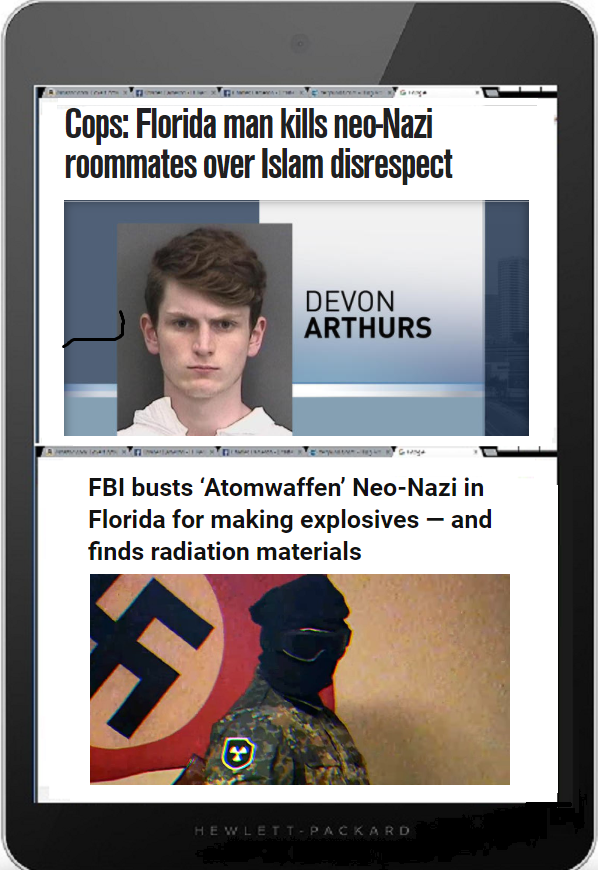
Really!
**
The kid who converts from Neo-Nazi to Islam and then kills his disrespectful roomies makes for a brilliant & provocative case study, becaause it so confounds our usual expectations.
Consider. We are used to the idea of otherwise unexceptional people joining extremist groups, religious or political — we term the process “radicalization”. And under the banner of “countering violent extremism” we encourage people to leave violent extremist groups and fade back into the normal fabric of society — some become anti-extremist messengers, Kerry Noble and Maajid Nawaz being well known examples. And both coming and going, there’s the little matter of messaging — messaging for radicaliziation, messaging for deradicalization.
But converting from a far-right political ideology to militant Islam? What kind of process us that, and what kind of messaging is involved, or called for?
I want to focus in on this poor dumb kid Devon Arthurs because he offers an almost too-good-to-be-true instance of two significant ideas from two of our finest analysts.
**
Let’s take Will McCants first.
McCants’ point is that every jihadist (and every extremist, by extension) is subject to a wide mix of drives, some more potent than others, but none of which should be viewed as the exclusive “explanation” for radicalization. As he writes in a gobbit that is now pinned to the top of his twitter-feed:
The disappoint stems from the desire to attribute the jihadist phenomenon to a single cause rather than to several causes that work in tandem to produce it. To my mind, the most salient are these: a religious heritage that lauds fighting abroad to establish states and to protect one’s fellow Muslims; ultraconservative religious ideas and networks exploited by militant recruiters; peer pressure (if you know someone involved, you’re more likely to get involved); fear of religious persecution; poor governance (not type of government); youth unemployment or underemployment in large cities; and civil war. All of these factors are more at play in the Arab world now than at any other time in recent memory, which is fueling a jihadist resurgence around the world.
If anyone elevates one of those factors above the others to diagnose the problem, you can be certain the resulting prescription will not work. It may even backfire, leading to more jihadist recruitment, not less.
That’s the general case: but you could hardly have a better instance of how sui generis the process is than our case of the young Neo-Nazi turned Muslim.
**
Things get even more interesting, however, when we see how this case fits with a point JM Berger has been at pains to meke recently. In Extremist Construction of Identity: How Escalating Demands for Legitimacy Shape and Define In-Group and Out-Group Dynamics, JM expresses his growing sense that extremism should be studied as a category unto itself — that we should not limit our studies to such brands as “Islamic extremism” or “Right Wing extremism”. He writes:
More broadly, this paper is a first step in developing and testing the hypothesis that extremist group radicalisation represents an identifiable process that can be understood as distinct from the contents of a movement’s ideology. That is not to say that the content of an ideology is meaningless or unimportant. Rather, this research seeks to explore whether universal processes of radicalisation provide a more useful window into why identity-based extremist movements form in the first place and how they evolve toward violence.
In the case of Devon Arthurs we have someone who doesn’t only espouse one extremism, but two, in rapid succession. And thus it is plausible to say that it is not Nazism, nor violent extremist Islam, that attracts him, but extremism as such.
Thinking through our ideas about narratives in radicalization and derad with Arthurs as our instance, raises all sorts of questions: what messaging if any do the Neo-Nazis and Jihadists have in common? What message allows someone to slip from one camp in to the other? And what messaging would be an effectove counterbalance not to one ideology or the other, but to the general propensity for extremism?
All in all, this kid makes for a fabulous case study in the ease with which our assumptions can deceive us.
**
Sources:
CBS News, Cops: Florida man kills neo-Nazi roommates over Islam disrespect
RawStory, FBI busts ‘Atomwaffen’ Neo-Nazi in Florida for making explosives