zenpundit.com » poetry

Archive for the ‘poetry’ Category

The possible unexpected consequences of intervention

Thursday, January 24th, 2013

[ by Charles Cameron — wondering whether it can ever be possible to expect the unexpected, and if so, what exactly that might mean? Libya & Mali ]
.

.

Alex Thurston at Sahel Blog: Covering Politics and Religion in the Sahel and the Horn of Africa posted Libya and Mali, Part I today. The topic is one I am not qualified to comment on, although I’m trying to learn from those (such as AT) who are — but this sentence caught my eye and got me writing:

A failure to soberly consider the possible unexpected consequences of intervention and transition has helped chaos to develop in post-Qadhafi Libya.

I wonder if that’s a koan?

**

Is it ever possible to “soberly consider the possible unexpected consequences” of anything? Consider Donald Rumsfeld‘s remark:

There are known knowns. These are things we know that we know. There are known unknowns. That is to say, there are things that we know we don’t know. But there are also unknown unknowns. There are things we don’t know we don’t know.

Throw in the missing fourth category, supplied by somebody for Wikipedia:

Moreover, one may criticize Rumsfeld statement for omitting the most dangerous type of unknown: the “unknown known”. That is, as Mark Twain famously expressed it, “It ain’t what you don’t know that gets you into trouble. It’s what you think you know that just ain’t so”. Indeed, Rumsfeld was really discussing an “unknown known” which provided faulty justification for the war — members of the Bush administration claimed that the Iraqi government possessed weapons of mass destruction (see Rationale_for_the_Iraq_War), but it just wasn’t so.

**

Now allow for what you might call informed guess-work, what CS Peirce called abduction — I’m just now introducing my elder son to Eco & Sebeok‘s magnificent book, The Sign of Three: Dupin, Holmes, Peirce — and “non-predictive” attempts to lay out a spread of possible outcomes by means of scenario-planning, as Tom Barnett wrote in his Year 2000 International Security Dimension Project Final Report:

By “decision scenario approach,” we mean using credible scenarios to create awareness among relevant decision-makers regarding the sort of strategic issues and choices they are likely to face if the more stressing pathways envisioned come to pass.

and:

Again, none of our material here is meant to be predictive in the sense of providing a step-by-step “cookbook” approach to Y2K and Millennial Date Change crisis management. Our fundamental goal in collecting and synthesizing this analysis is to avoid any situation where US military decision makers and/or operational commanders would find themselves in seemingly uncharted territory and declare, “I had no idea . . ..”

We (myself at times included) seem to be busily employed making non-predictive predictions.

**

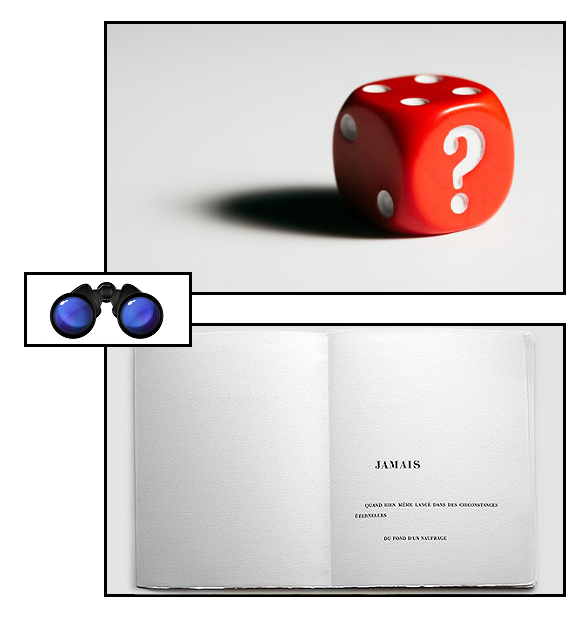
Black swansNassim Nicholas Taleb may have been the one who most recently crept up behind us and clapped loudly to alert us to the unexpected, but Stéphane Mallarmé was there first in 1897 with the great graphical poem Un coup de dés jamais n’abolira le hasard, featured in the lower image of the pair at the top of this post.

My own “zen telegram” version, for those who neither know the poem nor read French:

A ROLL OF THE DICE

NEVER

not even when tossed sub specie aeternitatis from the depth of a shipwreck

WILL NEVER EVER ABOLISH

CHANCE

— now there’s a koan for our times — and always.

**

Listen to the poets…

Hear the voice of the Bard!
Who Present, Past, & Future, sees;
Whose ears have heard
The Holy Word
That walk’d among the ancient trees…

**

Sources and links:

  • Un Coup de Dés Jamais N’Abolira Le Hasard from Wikipedia
  • le début de la typographie moderne by Étienne Mineur with page images
  • Un coup de dés, French original and English translation, by AS Kline
  • See that voice of the Bard, William Blake
  • Unequal equations

    Friday, January 18th, 2013

    [ by Charles Cameron — math, modeling and mapping, in that strange zone where beauty meets understanding ]
    .

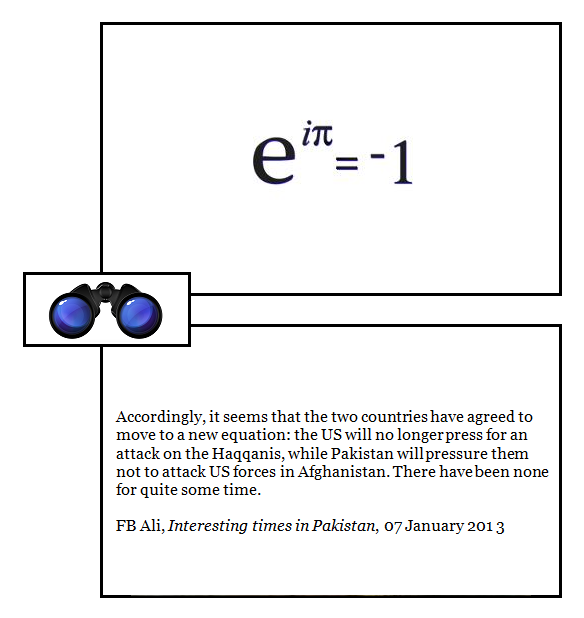
    The upper equation — Euler‘s — gets as tight and definitional as one can get, yet is profound in the way the greatest haiku are… while the metaphorical “equation” mentioned in the lower panel is a very rough model indeed of the intricate and constantly shifting forces at work in and on Pakistan.

    **

    I’m interested in mapping these sorts of influences at a level of detail that the human mind can assimilate and comprehend — and the graphical news-map in the video below will give you an idea of what one approach to such a mapping would look like.

    This particular example is drawn from a mapping of web-based news items related to President Obama over the course of 2009, but it should give you some idea of the constant flux of tensions and motion of “nodes” involved in tracking political issues, at home or abroad — the beginning is a bit slow, but from about the 23 second mark on is just amazing:

    Now is that art, or technology — or a beginning of something fascinating that by its very nature melds both?

    **

    Sources:

  • FB Ali, Interesting times in Pakistan on Sic Semper Tyrannis
  • Recorded Future Index video
  • Infinite in faculty, quintessence of dust

    Saturday, January 12th, 2013

    [ by Charles Cameron — on the cutting off of hands, the eternal life of martyrs, and the vast and petty nature of we poor amazing humans ]
    .

    As you know, I love apposite juxtapositions between religious texts – if you’re into cognition, it’s called pattern recognition, in Jung or Plato it would be familiarizing oneself with the archetypes, and in terms of creativity it’s “one swell foop” of analysis and synthesis, an oak in an acorn, insight in a nutshell.

    At times, as here, the comparison presents a significant similarity that “sees things” from a very different vantage point from our everyday selves – a refreshing and salutary reminder, perhaps, from high altitude, even if it’s not the street-level view we require to navigate life’s many smaller obstacles and minor goals.

    **

    Here are two such comparisons that have served a somewhat different purpose for me –- showing me that aspects of another religion’s practice that I find shocking have echoes in my own tradition. I do not claim these correspondences to be exact — but if we allow them to be, I believe we may find them illuminating:

    and:

    My hope is that such examples can help us to approach the “other” with greater respect and understanding — where we agree, and even where we strongly disagree.

    In the way of peace. For it is written in the Injil, in the Gospel (Matthew 5:9):

    Blessed are the peacemakers: for they shall be called the children of God.

    **

    But to return us to the high altitude view from which we began, I’ll give Shakespeare the final word:

       HAMLET: I have of late–but
    wherefore I know not–lost all my mirth, forgone all
    custom of exercises; and indeed it goes so heavily
    with my disposition that this goodly frame, the
    earth, seems to me a sterile promontory, this most
    excellent canopy, the air, look you, this brave
    o’erhanging firmament, this majestical roof fretted
    with golden fire, why, it appears no other thing to
    me than a foul and pestilent congregation of vapours.
    What a piece of work is a man! how noble in reason!
    how infinite in faculty! in form and moving how
    express and admirable! in action how like an angel!
    in apprehension how like a god! the beauty of the
    world! the paragon of animals! And yet, to me,
    what is this quintessence of dust?

    They are being sincere, even if they are not being accurate

    Saturday, January 12th, 2013

    [ by Charles Cameron — disentangling religion / politics braids in Pakistan and elsewhere ]
    .

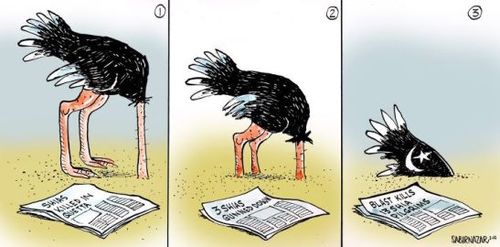
    image credit: Pakistani cartoonist and artist Sabir Nazar

    .

    Blog-friend Omar Ali writes:

    The state will make a genuine effort to stop this madness. Shias are still not seen as outsiders by most educated Pakistani Sunnis. When middle class Pakistanis say “this cannot be the work of a Muslim” they are being sincere, even if they are not being accurate.

    The “madness” he’s discussing is the extensive killing of Shia Muslims by Sunni Muslims in Pakistan, and I’d recommend both his own article on 3 Quarks Daily and Bahukutumbi Raman‘s on Raman’s strategic analysis as offering detailed background for a topic I addressed from a different angle in Ashura: the Passion of Husayn.

    **

    It’s Dr. Ali’s final sentence in the quote above that interests me, though, as you’ve probably deduced already from the title of this post:

    When middle class Pakistanis say “this cannot be the work of a Muslim” they are being sincere, even if they are not being accurate.

    I haven’t quite known how to say this succinctly before, but I think Dr Ali hits a whole array of nails on the head.

    Religions are mostly preached to whoever listens — and those who listen can be a pretty diverse lot, particularly across continents and centuries. The upshot is that religions generally wind up being interpreted in a variety of ways to suit the wide variety of human temperaments and situations.

    Et voilà! Members of a religion who see it as a force for peace will tend to say of those who dismay them by using it as a cover for violence, “this cannot be the work of a member of my faith” — and they are being sincere, their understanding of their own religion is as peaceable as they say it is.

    They are being sincere — even if they are not being accurate, and their religion as a “big tent” across cultures, classes, continents and centuries, also includes sincere people whose views are radically and violently opposed to theirs.

    **

    If Walt Whitman can say it, you’d better believe it can be said of religions with a billion or more adherents:

    Do I contradict myself? Very well, then I contradict myself, I am large, I contain multitudes.

    Bouleversé by forgiveness

    Tuesday, January 8th, 2013

    [ by Charles Cameron — not just “thinking outside the box” — how about upending the whole thing and seeing what shakes out? ]
    .

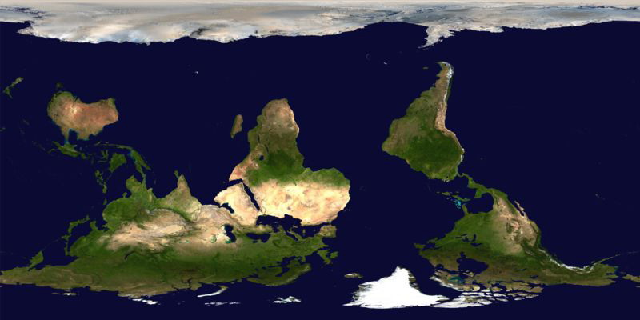
    FWIW, this isn't the world, nor is it upside down -- it's just a rather different map, eh?

    .

    A celebrated stanza by the Indian poet-saint Kabir — beloved of both Hindus and Muslims — asks:

    Is there any guru in the world wise enough
    to understand the upside-down Veda?

    There’s a style of poetry used by Kabir and others to describe experience of the divine called “ulatbamsi” or the “upside down language” — and Linda Hess, Kabir’s great translator, writes of it as a language “of paradoxes and enigmas” — not too dissimilar, perhaps, to the koans or meditation paradoxes often encountered in zen training.

    **

    Boom! The French have the word “bouleversé” to cover the way we feel when suddenly our whole world seems turned upside down.

    Maybe it’s a modern idea? Bob Dylan, I’m delighted to say, no longer belongs to Robert Zimmerman except for purposes of copyright — his songs have entered the cultural bloodstream. Here’s his version:

    The battle outside ragin’
    Will soon shake your windows
    And rattle your walls
    For the times they are a-changin’

    The world often seems upside down, our values are often quite the reverse of what they might be if we had the kind of clarity that is implied in Samuel Johnson‘s celebrated quote:

    Depend upon it, sir, when a man knows he is to be hanged in a fortnight, it concentrates his mind wonderfully.

    And then there are those great ones for whom our world is manifestly unjust, manifestly topsy-turvy — or “through the looking-glass”, if you prefer.

    I mean, what else can being “in the world, but not of it” be all about, if it’s not about a major shift in perspective?

    **

    I’m writing about this at such length because I just read one of those paragraphs that turns my own world upside down. It came in the middle of a long piece on “restorative justice” and it focuses on the power of forgiveness.

    This particular paragraph describes how an Indian-American woman, Sujatha Baliga, came to see the unexpected power of forgiveness, and for her it occurred in a Buddhist context — but the power itself is beyond the boundaries of specific religions:

    Baliga had been in therapy in New York, but while in India she had what she calls “a total breakdown.” She remembers thinking, Oh, my God, I’ve got to fix myself before I start law school. She decided to take a train to Dharamsala, the Himalayan city that is home to a large Tibetan exile community. There she heard Tibetans recount “horrific stories of losing their loved ones as they were trying to escape the invading Chinese Army,” she told me. “Women getting raped, children made to kill their parents — unbelievably awful stuff. And I would ask them, ‘How are you even standing, let alone smiling?’ And everybody would say, ‘Forgiveness.’ And they’re like, ‘What are you so angry about?’ And I told them, and they’d say, ‘That’s actually pretty crazy.’ ”

    **

    I like the dark blue “sky” and the “clouds” at the top of the map I began this post with — but then, I’m a mostly vertical human who seldom stands on his head, so it looks “natural” to me. But that’s simply a matter of my point of view.

    I imagine maps like that one must please our friends “down under”.

    **

    A hat-tip to Hadar Aviram, whose California Corrections blog first pointed me to the article about Sujatha Baliga.


    Switch to our mobile site