zenpundit.com » poetry

Archive for the ‘poetry’ Category

Of ID cards and innermost mysteries

Thursday, November 29th, 2012

[ by Charles Cameron — just another angle on personal identity and ID, nudged on by two news pieces I saw today, and written to set the thought juices flowing ]
.

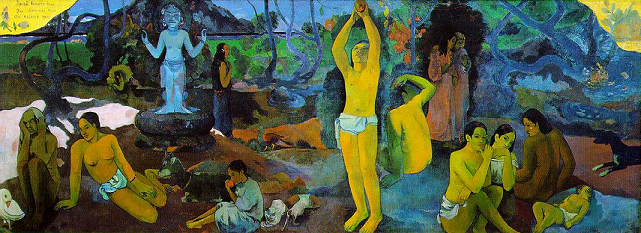
Life’s four deep questions are often listed thus: Who am I? Where did I come from? Why am I here? and Where will I go? We humans can spend a lifetime in search of the answers, and Paul Gauguin made three of them them the title of what some consider his greatest painting:

Paul Gauguin: D'où je viens, qui je suis, où je vais?

**

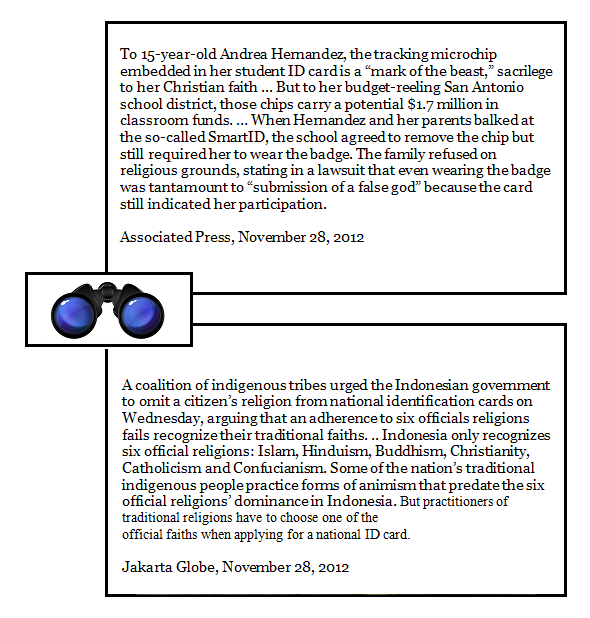
These are deeply personal questions — and now governments and bureaucracies everywhere would like to know the answers to them, too:

**

The poet Hopkins, in his tightly compressed way, teaches us that we are not our driving licenses, we are not files in a desk drawer or on a computer, we are not our photos, we are not numbers, we are not even our names, we are… that which is most natural to us, that which is most essential about us, what you might call our “true natures”:

Each mortal thing does one thing and the same:
Deals out that being indoors each one dwells;
Selves — goes itself; myself it speaks and spells,
Crying Whát I do is me: for that I came.

We selve, we go ourselves — most precisely, we deal out that being which dwells within us.

And to learn what that being is, that mystery which most richly propels us, is our life task.

**

In our desire to identify, classify, count and track everybody and everything, our governments and bureaucracies keep losing track (!) of the simple fact that a person’s person is that person’s innermost mystery.

Don’t you mess with my mother the moon

Tuesday, November 27th, 2012

[ by Charles Cameron — a poor, low-res copy of the greatest photo, a poem of mine, and a recent report of a scenario involving nuking the moon, apparently considered and, I am happy to say, rejected by the military ]
.

First, the greatest photo:
.

Photo: Ansel Adams, Moonrise, Hernandez, New Mexico, 1941

**

Next, the poem:

Don’t you mess with my mother the moon!
.

i

Don’t you mess with my mother the moon!
Pearl.
Superb in the night sky.
Which you treat as a junkyard.

ii

I am serious. I was never
more serious. This, which you thinking
life to be composed of things consider
real estate, rock,
subtly balances that other,

portending at the eye
that same angle — and that other, too
you would colonize,
strip, slash, mine, burn,
rape had you the chance, were it not
so magisterial a furnace.

Gold, which figures the sun
with silver the moon,
you have tapped for coinage,
despoiling hills for greed,
valleys for your convenience:
nor is your idiocy limited in reach
by anything but your idiocy.

Sun and moon are married
in a wedding you cannot conceive,
to which you lack invitation
though it was offered you.
The simple light of the night sky
escapes you, neither glimpse
nor sonata troubles your soul with its ripples,

for you lack, altogether,
reflection.

**

I wrote that poem quite a few years ago, and intended it as an appeal from the side of joyous poetic appreciation against the prevalent idea that the moon is a chunk of rock to be mined and otherwise exploited like any other. I didn’t suppose then that my voice would be heard against the amplified voices of technology, commerce, and human hubris—but voices will be voices, even in the wilderness.

The Japanese have a tradition of “moon-viewing” festivals — Tsukimi – a superb idea, appropriately reflective of the culture that produced the zen poet Ryokan, who celebrated a thief’s visit to pillage his mountain hermitage with the words:

The thief left it behind:
the moon
at my window.

The thief couldn’t steal it — but boyo, we still might be able to figure out a way to mess it up…

**

I for one don’t ever want to look at the moon and know that someone is using it as a projection screen for advertisements, let alone that its face is disfigured by robotic factories producing cheap running shoes – bad enough that we’ve left our trash there already!

Credit: NASA / Orbiter shows trash, tracks at Apollo moon landing sites

Look, my techno-leaning human friends — mine the asteroid belt if you must, I suppose Disney will eventually get the rights to Saturn, and make a ride of it – but leave the moon, leave the moon alone.

**

Then, the scenario:

I mean, how myopic can we get? According to Forbes yeaterday:

There’s a couple of preposterous reports out today alleging that the United States considered blowing up the moon in order to freak out the Soviets during the Cold War. Apparently something called “A Study of Lunar Research Flights” seriously pondered a moon bombing, and scientists as notable as Carl Sagan were even involved in planning the lunar attack, which was to take place in 1959 — before cooler heads prevailed.

Yup. There was a scenario — not a plan but a scenario — that was being explored: A STUDY OF LUNAR RESEARCH FLIGHTS:

Nuclear detonations in the vicinity of the moon are considered in this report along with scientific information which might be obtained from such explosions. The military aspect is aided by investigation of space environment, detection of nuclear device testing, and capability of weapons in space. A study was conducted of various theories of the moon’s structure and origin, and a description of the probable nature of the lunar surface is given. The areas discussed in some detail are optical lunar studies, seismic observations, lunar surface and magnetic fields, plasma and magnetic field effects, and organic matter on the moon.

I’ve corrected a spelling error, but otherwise that’s the abstract, as found within the .mil domain. I haven’t seen the document itself, but the abstract speaks for itself.

And no, as far as I can tell, the scenario didn’t involve “blowing up” the moon, which would have been pretty difficult as the Forbes article indicates. Apparently, though, some part of the military-industrial machine explored, discussed, and finally rejected the idea of hitting the moon with a single nuke — enough to switch a light-bulb on, it was hoped, above the Soviet military-industrial head.

**

And finally:

I’ve dragged this poem out of retirement, and hereby give you permission to reproduce it in toto, with or without the rest of this post — and indeed encourage you do to so. Tweet and RT the URL for this post, repost the poem, agree with me, disagree —

This latest revelation makes me feel it’s time for a conversation about convenience, commerce and science vs beauty, reverence and awe — about what the moon is worth to us.

It’s my birthday, do me a favor — spread the word: Don’t you mess with my mother the moon!

DoubleQuoting Rubio and Obama

Friday, November 23rd, 2012

[ by Charles Cameron — one fault-line in current American political tectonics runs through the age of the planet ]
.

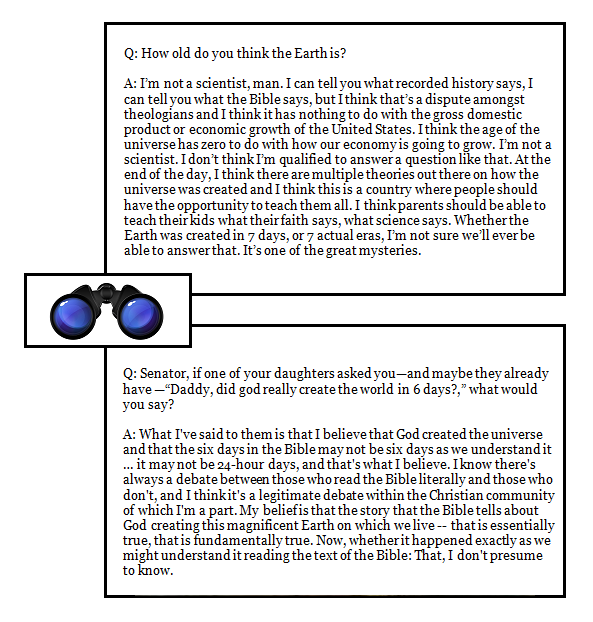
I thought Daniel Engber‘s piece in Slate doublequoted Rubio and Obama very nicely the other day:

The top quote is from Sen. Rubio, the second from then-Sen. Obama, and indeed, they both hedge their bets, as Engber goes on to suggest:

1) Both senators refuse to give an honest answer to the question. Neither deigns to mention that the Earth is 4.54 billion years old.

2) They both go so far as to disqualify themselves from even pronouncing an opinion. I’m not a scientist, says Rubio. I don’t presume to know, says Obama.

3) That’s because they both agree that the question is a tough one, and subject to vigorous debate. I think there are multiple theories out there on how this universe was created, says Rubio. I think it’s a legitimate debate within the Christian community of which I’m a part, says Obama.

4) Finally they both profess confusion over whether the Bible should be taken literally. Maybe the “days” in Genesis were actual eras, says Rubio. They might not have been standard 24-hour days, says Obama.

In light of these concordances, to call Rubio a liar or a fool would be to call our nation’s president the same …

**

I don’t however think Engber is right in saying of Sen. Rubio — and by implication of Pres. Obama too:

By arguing that every viewpoint has a claim to truth — that the geologists and theologians are each entitled to their own opinions — the senator gave up on dealing with reality at all.

This runs deeper than the “age of the earth” question, it seems to me, and the two sides currently facing off on a whole slate of issues seem to articulate, respectively, these two questions

  • Doesn’t anyone recognize the truth of Revelation when they see it?
  • Doesn’t anyone recognize the truth of Science when they see it?
  • My own question — which I think has the capacity to reconcile the two — would be along the lines of:

  • Doesn’t anyone recognize the truth of Poetry when they see it?
  • **

    An afterthought:

    Current American political tectonics: an issue of homeland security?

    A Meditation In Time of War: security

    Thursday, November 22nd, 2012

    [ by Charles Cameron — divine protection in Israel and Kentucky ]
    .


    .

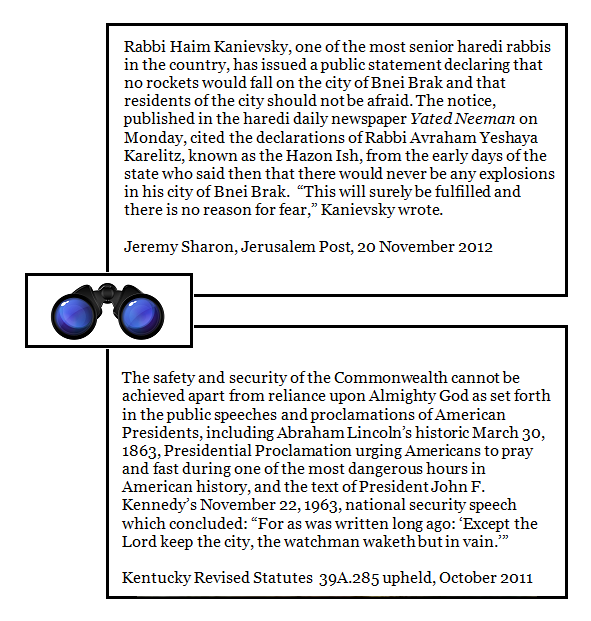
    So who needs an Iron Dome, or Star Wars?

    I really don’t have access to the Rabbi’s full and detailed views on the matter, but based on what the Jerusalem Post reports, he appears to be advocating that divine intervention is both a necessary and sufficient form of defense against Hamas missiles.

    The Kentucky legislature’s position is somewhat different. The two paragraphs immediately preceding the one I’ve quoted here read:

    No government by itself can guarantee perfect security from acts of war or terrorism.

    and:

    The security and well-being of the public depend not just on government, but rest in large
    measure upon individual citizens of the Commonwealth and their level of understanding, preparation, and vigilance.

    So Kentucky suggests an admixture of government security measures, public vigilance and divine protection.

    **

    Let’s skip around a bit. I’m reminded of Abraham‘s discussion of divine judgment and protection in Genesis 18, which begins —

    And Abraham drew near, and said, Wilt thou also destroy the righteous with the wicked Peradventure there be fifty righteous within the city: wilt thou also destroy and not spare the place for the fifty righteous that are therein? That be far from thee to do after this manner, to slay the righteous with the wicked: and that the righteous should be as the wicked, that be far from thee: Shall not the Judge of all the earth do right? And the Lord said, If I find in Sodom fifty righteous within the city, then I will spare all the place for their sakes.

    Abraham then quizzes God with incrementally lowering figures until God says:

    I will not destroy it for ten’s sake.

    Scriptures tend to describe acts of God as, well, acts of God – and that’s a category which can include the fall of sparrows, let alone a rain of missiles, a parting of waves, or a pillar of cloud.

    Modernity tends to regard missiles, inbound, as acts of human agency, and likewise with missiles sent up to intercept them.

    **

    Kurt Vonnegut pretty much opens his book, Cat’s Cradle, with the statement:

    No names have been changed to protect the innocent, since God Almighty protects the innocent as a matter of Heavenly routine.

    I’m sure he meant it with a wink and a nod, but I take some comfort from it all the same. You see, I live in a world of both human and mysterious agency — a world of grace and science, science and grace.

    Call me confused, tell me I contradict myself. I can only say with Walt Whitman:

    Do I contradict myself? Very well, then I contradict myself, I am large, I contain multitudes.

    Oh — and in fact it’s more complex, more nuanced than that.

    Cross-grain thinking, 3: ASP’s Report on Climate Security

    Wednesday, November 21st, 2012

    [ by Charles Cameron — as Dylan sang, a change in the weather is known to be extreme ]
    .

    People sit at a flooded table in Piazza San Marco, Venice -- photo: Luigi Costantini / AP

    .
    Right at the top of Part I of the recent three-part Report on Climate Security from the American Security Project, we read this paragraph:

    Climate change is real: we see its impacts every day, around the world. A melting Arctic, unprecedented droughts across the world, extreme examples of flooding, and uncontrollable wildfires are all examples of the changing climate.

    That’s right, that’s right and important, that’s right, important and timely.

    But you know, at heart I’m a poet. And although I’m concerned about the issues the report addresses, I can’t help thinking of climate and weather, atmosphere and wind, in a manner that crisscrosses the “interior” vs “exterior” divide.

    If you lean to the scientific more than the poetic, you might want to consider what I’m talking about as an instatiation of the insight Gregory Bateson expressed in the title of his seminal book, Mind and Nature: A Necessary Unity.

    **

    Let me lean to the poetry-side for a paragraph or so, then we’ll come back to security issues the report raises.

    I probably caught this particular “weather and weather” disease from Dylan Thomas’ great and celebrated poem, A Process in the Weather of the Heart:

    A process in the weather of the heart
    Turns damp to dry; the golden shot
    Storms in the freezing tomb.
    A weather in the quarter of the veins
    Turns night to day; blood in their suns
    Lights up the living worm.

    Writing about this poem in his Reader’s Guide to Dylan Thomas, William York Tindall notes “Thomas’ obsessive concern with the natural process that, linking man and world, inner and outer, turns upon the axis of life and death” and specifies that “applying ‘weather,’ a word for outer climate, to inner climate joins two worlds.”

    Thomas is concerned in that extraordinary poem to join, likewise, life with death, night with day, womb with tomb, seeing eye with blind bone and more – or not so much to join them as to see them as inseparable, as parts of the single unfolding that is the world.

    There is much more to the poem than the central obsessive theme of the “process in the weather of the heart” with which the poem opens and the “process in the weather of the world” with which it closes. It is their conjunction, their inseparability which interests me here – the poet’s perception that there is no inner without the outer, no outer without the inner – that in each there is weather, which Tyndall also calls climate, that weather is in both…

    **

    Back to meteorology and national security..

    Look, I’m not exactly an enemy of thinking about climate change and national — or global — security. I admire ASP for today’s piece by Catherine Foley, Climate Change: The Missing Link in Tackling the Mali Crisis. We need more considerations of that kind, they’re rare and extremely valuable.

    Mecca is one of the hottest cities in the world, and the Kaaba the central pivot around which all Islam revolves — potentially a double hot-spot. What are the implications of climate change for the Saudis, for Mecca, for Islam?

    **

    When I think about weather, I think about storms in the world, storms in the heart and mind, almost in the same breath. Specifically, when I think of global warming, I can’t help but see the problem as being one of double-awareness – rising temperatures and rising tempers, rising sea-levels and rising levels of anxiety and / or denial, the climate of meteorology and the climate of opinion…

    Seen from my bifocal perspective, the report is notably focused on externals. Take another sentence from the brief bullet points on the first page;

    The climate influences people’s everyday lives, from what they eat to where they live.

    We eat food, food that can be weighed and measured, and analyzed for its nutrient elements and health properties. We live in cities, towns and villages, in houses, or developments, which can located on maps…

    With my bifocals on, it would be more accurate, more encompassing to say:

    The climate influences people’s everyday lives, from what they eat to how they feel, and from where they live to what they think and how they behave.

    Because in my view, the situation is as much about “mind change” as it is “climate change” — in my view, the “fulcrum that can move the world” is to be found in the geography of mind and heart.

    **

    Okay, let’s back up a bit.

    The “first page” I quoted is the first page of the First Part of the Report, but there’s also an Introduction, and I want to pick up the thread there now, because the Introduction is written with human thought — specifically “honest dialogue” — in mind, and opens with what seems at first glance like one of those obvious truths that serve as the jumping off points for more detailed considerations:

    The American Security Project is organized around the belief that honest, public discussion of national security requires open, non-biased, non-partisan discourse about the dangers and opportunities of the 21st Century.

    There’s just one problem here, though — a single paragraph later, we read:

    Climate change poses a clear and present danger to the United States

    I’d give my assent happily enough to either of these two propositions, if they weren’t both talking about the same situation. Because when someone sees a “clear and present” hungry tiger coming at them and doesn’t take rapid action to avoid being eaten, it’s not “open” and “unbiased” — it’s “in denial”.

    Which in turn means there’s a swathe of the population that may not be willing to hear “open, non-biased, non-partisan discourse” nor able to contribute to it. “I don’t believe my eyes, they’re deceiving me with all this hogwash about tigers”…

    And those people have loved ones, bring foods to community pot-lucks, and teach class, and vote…

    **

    Some time ago, I was working on a transposition of the Gospel narratives of Luke and John into the Troubles in Northern Ireland, with Britain playing the part of Rome and so forth, and adding some commentary along the way. Here’s a slightly revised version of my comment on John 3.8:

    There is one particular word that John uses which has what we today might call a triple (rather than a double) meaning. When Christ in this verse says, “The wind bloweth where it listeth, and thou hearest the sound thereof, but canst not tell whence it cometh, and whither it goeth: so is every one that is born of Spirit,” it is the Greek word pneuma that can be translated both as wind and spirit. It also means breath.

    Christ is saying here that those who are born of spirit are like the wind, like breath, and like inspiration: each of which can be noticed but not predicted, because each moves of its own accord — yet in the Greek these are not three separate concepts as they are for us today. As CS Lewis says in another context, we must always remember “that the various senses we take out of an ancient word by analysis existed in it as a unity.”

    In telling us this, St John is saying at one and the same time that nobody knows where the first breath comes from or when the last breath will leave us, nobody knows how to forecast exactly which path a hurricane will take, and nobody knows how to make an assembly line for inspiration – if we did, Beethoven could have written another three symphonies as great as his Ninth to order, stat!

    One of the reasons we don’t know how the heart and mind work is that we’ve separated “meteorological” weather from “the weather of the heart” — and there’s a storm brewing, inextricably, on both fronts.

    If the ASP report is anything to judge by, we’re only looking at one of them.

    **

    Oh, and here by way of confirmation is an old friend from my Oxford days, the late Chogyam Trungpa Rinpoche, quoted in a piece for the November issue of Shambhala Sun:

    No matter where we are in the world, there is a need for enlightened society, wherever natural disasters hit. In this case, “natural disaster” refers to aggression, passion, and ignorance. These kinds of natural disasters occur in the minds of people.

    Trungpa’s sense of “natural disaster”, I humbly submit to the folks at the American Security Project, either needs to run like a woof through the warp of their report on climate change — which it doesn’t — or it deserves a fourth section of its own.
    Switch to our mobile site