[ by Charles Cameron — this is strictly for the record — you don’t need to read it unless — like Bob — you’re a poly-mathematician, para-biologist, meta-psychiatrist or native-born glass bead gamer ]
.
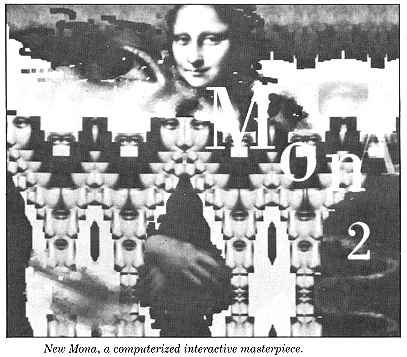
1984. Illustrating for Bob de Marrais‘ article on Computer Graphics,
published in Digital Deli: The Comprehensive, User-Lovable Menu
of Computer Lore, Culture, Lifestyles and Fancy, ed. Steve Ditlea.
**
My late friend Bob de Marrais wrote a five-part short-book-length essay, Catastrophes, Kaleidoscopes, String Quartets: Deploying the Glass Bead Game, which is so wide-ranging in its scholarship that no single journal had peers sufficient to review it, so witty, subtle, enchanting, and generally impossible that its continued existence on the web and in the time-worn hard drives of a scattering of computers has made of it a sort of samizdat — a secret publication passsed from hand to hand, or in this case memory to memory, and in this post I wish to memorialize both the essay and Bob himself.
Here are five sips, to give you a sense of the work.
**
Catastrophes, Kaleidoscopes, String Quartets:
Part I: Ministrations Concerning Silliness, or: Is “Interdisciplinary Thought” an Oxymoron?
We seek deep concepts by silly means. Think of this, for openers at least, as a cerebral equivalent of a well-known Monty Python skit: welcome to the Ministry of Silly Thoughts. [ … ]
Essential to easy generation of the “silliness effect” – as in the frivolous juxtaposing of Kings Arthur and Elvis in the last paragraph – is production of collisions between disparate things, which context makes us associate unexpectedly. No one not on drugs or writing late-night standup material would be likely to seek a link between the latest news from robotic interplanetary exploratory vehicles and political upheaval in the Hispanic community in the general vicinity of Miami. But when Elian Gonzales’ mom fled Castro’s regime on a flimsy makeshift boat and died at sea while getting her son to (what she thought would be his) freedom, Jay Leno noted how scientists had just discovered water on the Red Planet, “and in an unrelated story, a boat of Cuban refugees washed up on Mars this morning.”
Aside from late-night comedic unwinding from the day’s events, there is only one other area where such juxtapositions are hunted down and put to use. (No, not dreams: that’s involuntary; and besides, many people today no longer have any.) This area is largely deemed, regardless of lip services paid, “absurd; trifling; frivolous” in academia – when not, that is, subjected to sober attempts at its production which typically display all these three aspects in spite of themselves. This is the domain of what often passes for an oxymoron in our supremely specialized research establishment: interdisciplinary thought. And this, of course, is what we’re here to talk about.
Compare “the silliness effect .. is production of collisions between disparate things, which context makes us associate unexpectedly” with, from this morning’s diggings:
Brecht:
He [Darko Suvin] cites Brecht as follows: “A representation which estranges is one which allows us to recognize its subject, but at the same time make it seem unfamiliar.” This permits a new cognition of the now and creates a moment which is potentially liberating. Placing familiar objects (or subjects) in unfamiliar settings allows us to see differently. Our old and tired perceptions can thus be revitalized and transformed. — Lucy Sargisson, Fool’s Gold?: Utopianism in the Twenty-First Century
Boulez:
For Boulez, the challenge was to present the borrowed ideas in a new light that could lead to results far removed from the original, which had provided only a single solution. — The Gramophone
Both quotes via JustKnecht, another Glass Bead Game-player of note, discussing his Rattlesnake Games.
**
Part II: Canonical Collage-oscopes, or: Claude in Jacques’ Trap? Not What It Sounds Like!
For this section of Bob’s work, I’ll just post a snippet referencing the Catastrophe Theory of René Thom:
Of the many, many ways to frame the two-control Cusp, the most interesting for us is the predator-prey chain, due to Thom himself. Let us frame it mythically: in the Vedic lore of pre-Hindu India, the great god Indra – the Zeus of the Aryan invaders – had (or was trapped in) a magical net. Depending on the story told, and teller’s point of view, Indra is the hunter and the hunted too. According to the mathematics of Catastrophe Theory, this is fundamental, not unusual. The theory’s creator typically focuses on the single Cusp as the basis of all richer models .. Its stable “splits and mergers” mode of yoyo-ing between the Two and the One, he tells us, is “the most fundamental regulatory process” in nonlinear dynamics: not only in the abstract, but, under the guise of the “predation loop,” in the ultimate concreteness of animal feeding. At least since the emerging of the amoeba, this is, simply, merging: “fundamentally, engulfing a prey into the organism” … and herein resides an enigma.
It’s a rich broth, you see — connecting perhaps to Ali Minai‘s comment tweeted today:
Polyphony, in an abstract sense, applies not just to human complex systems but to all complex systems. .. One of the most unappreciated facts about natural complexity is that it emerges from interaction of simpler processes, and not from some prior complexity.
**
Part III: Grooving on the Sly with Klein Groups
No one knows that this tale is a part of an immense poem: myths communicate with each other by means of men and without men knowing it. … The situation which Le Cru et le cuit describes is analogous to that of musicians performing a symphony while kept incommunicado and separated from each other in time and space: each one would play his fragment as if it were the complete work. No one among them would be able to hear the concert because in order to hear it one must be outside the circle, far from the orchestra. In the case of American mythology, that concert began millennia ago, and today some few scattered and moribund communities are running through the last chords.
That’s Octavio Paz writing on Claude Lévi-Strauss, and Bob uses it as the epigraph to section III. Just today I was writing of the various friends of mind who are making profound contributions as islands in an archipelago — and how I long for the richness that will emerge when the connections between them are strong, the transmission of ideas between them fluid..
Further, from section III:
Somebody calls you, you answer: “In theory, a twirl of kaleidoscopes” – why?
If you were called to provide a summary of the first two installments preceding this, to someone who’s only just joined us, the perpetual revolution of Sir David Brewster’s famous tube should certainly be the very first image to pop from that jack-in-the-box you keep in your head. For Jacques Derrida, as we saw, lopped off this capstone of Lévi-Strauss’s extended metaphor of how the mythic mind operates: the workings of “bricolage” were like those of a kaleidoscope, as the anthropologist summed it up; but Derrida’s demolition job didn’t so much as footnote, much less explicitly point to, this motif. [ … ]
… Beatles’ paean to “the girl with kaleidoscope eyes.” …
Leary and Ralph Metzner meanwhile wrote about, and advocated, the use of low-tech kaleidoscopes, imported from the East, for inner exploration as well: I refer, of course, to mandalas. Mixing scientific and New Age styles, they managed to synthesize, in brief compass and without the “depth psychology,” the gist of what Jung’s approach toward such sacred objects (about which, more in the next installment) is taken to be by those who’d worn bell-bottoms and “love beads” while reading such things:
… [As] the mandala is a depiction of the structure of the eye, the center of the mandala corresponds to the foveal “blind spot.” Since the “blind spot” is the exit from the eye to the visual system of the brain, by going “out” through the center, you are going in to the brain. The Yogin finds the mandala in his own body. The mandala is an instrument for transcending the world of visually perceived phenomena by first centering them and turning them inward.
Note that Leary’s reading of the foveal blind spot is markedly at odds with Derrida’s
**
Part IV: Claude’s Kaleidoscope . . . and Carl’s
As before, note that the epigraps to this section contain doors intonwhat is within:
All the creative power that modern man pours into science and technics the man of antiquity devoted to his myths. This creative urge explains the bewildering confusion, the kaleidoscopic changes and syncretistic regroupings, the continual rejuvenation, of myths in Greek culture.
That’s Carl Jung, in Symbols of Transformation
Here he goes:
For those who’ve tuned in late to this mini-series, the first episode performed a sort of sitcom setup of the main conundrum: Derrida’s deconstruction launched itself using Lévi-Strauss’ structuralism – as epitomized in his Mr. Fixit figure of the “bricoleur” – as thrust-block . . . the irony being that the latter “failed” analytics of myth proved a harbinger of advanced mathematical toolkits whose utility in linguistic and cultural studies has been burgeoning, while the former “success story” has shown itself to be ever more hollow – intellectually, morally, and spiritually.
In Part Deux, we blowfished the argument, treating the core event – the 1966 Johns Hopkins conference where Derrida struck his “deal with the Devil” – as itself a sort of myth requiring structural analysis, inspecting it through the lens of Derrida’s 1987 reminiscences about the postmodernist “quotation market” and his own role in fomenting it . . . and then beefed up our discussion of Lévi-Strauss’ own “canonical law of myths” with Catastrophe Theory mathematics and the tasteful injection of celebrity quotes, movie reviews, and pornographic movie ads to, um, “flesh out” the argument.
Strike three, though, was where the ubiquitous form-language of the so-called “A,D,E Problem” and its lowly instancing as a new sort of Timaeus-style creation myth – based on kaleidoscopes instead of an odd lot of triangles and things whose names rhyme with Tipi Hedron[1] but don’t look half as fetching – was taken much too seriously, with the limitations in Husserl’s phenomenology shamelessly contrasted (unfavorably) with the concentric run-out groove at the end of the Beatles’ Sgt. Pepper album. The point being, naturally, that the Madhyamika Buddhism of Nagarjuna’s “full void” was allowed to underwrite the superposition principal of quantum mechanics in spite of its looking like something Derrida liked to mutter about, while all the while all of this was subsumed in some mare’s nest of comparisons between the structures of mythical argument, their “reincarnation” in the forms of classical music, and the Glass Beads that Hermann Hesse’s Magister Ludi was known to like to play with when he thought no one was watching.
Of course, if we’re going to keep a load like that down without providing our readers free Pepto-Bismol, it would behoove us to make the people reading this think the linchpins of the argument were somehow intrinsic. Put another way (which is our specialty here), we could say that it’s all very nice that this “A,D,E Problem” gives us kaleidoscopes as the Meaning of Life and like that there, but wouldn’t it be so much better if we got the same basic mishmash without all the abstraction – if the kaleidoscope could legitimately be seen as some kind of “archetype” in its own right, which “just happened” to bring in Catastrophe-type “shock waves” into the argument without all the hand-waving … and all without losing all the rest of our baggage, once the argument has landed?
**
Part V: Spelling the Tree, from Aleph to Tav (While Not Forgetting to Shin)
I didn’t even know there was a fifth part — quint-esseence? — until a couple of days ago, and am very grateful to Steven H. Cullinane for conserving all five for us.
One of the epigraphs for this fifth section comes from Gregory Bateson, Steps to an Ecology of Mind:
“The heart has its reasons which the reason does not at all perceive.” Among Anglo-Saxons, it is rather usual to think of the “reasons” of the heart or of the unconscious as the inchoate forces or pushes or heavings – what Freud called Trieben. To Pascal, a Frenchman, the matter was rather different, and he no doubt thought of the reasons of the heart as a body of logic or computation as precise and complex as the reasons of consciousness. (I have noticed that Anglo-Saxon anthropologists sometimes misunderstand the writings of Claude Lévi-Strauss for precisely this reason. They say he emphasizes too much the intellect and ignores the “feelings.” The truth is that he assumes that the heart has precise algorithms.)
WHat can I tell you? We haven’t delved in any detail into Bob’s mathematical work, but this section contains a footnote — a quotation that delights us with the concept of a perfectly square ship with vertical sides, and offers enough catastrophe-cusp based math to illustrate that central aspect of the whole work:
Tim Poston and Ian Stewart, Catastrophe Theory and its Applications (Boston, London, Melbourne: Pitman, 1978): “The commonest kind of water-going vessel which is actually built with vertical sides all the way round is a floating oil-platform. These are normally fixed to the ocean floor when on site, but they float during transport. Often they are built square. This symmetry goes through to the buoyancy locus… and the buoyancy locus is a circularly symmetric paraboloid of revolution. The metacentric locus may therefore, apparently, be found by spinning the two-dimensional case, so that the geometry of the perfectly square, vertical-sided ship is remarkably simple. From a catastrophe theory viewpoint this simplicity is thoroughly deceptive, the energy function takes the form (x2 + y2)2. This is not finitely determined … and so has infinite codimension…. Physically, this means that the apparently simple geometry of the ‘ideal’ vessel .. is violently unstable.”
**
Bobert de Marrais was born Nov. 30, 1948, and died April 4, 2011 in Boston, MA. His obit notes he “had a lifelong interest in history, his French heritage, music, history of science, and multidimensional algebras.” He was a remarkable polymath, profoundly loved and deeply admired by the fortunate few who knew him.