Haaretz on the Temple Mount, pt II: axis mundi
[ by Charles Cameron — Jerusalem, and the Temple Mount in particular, as the still point in the turning world — Midrash, Haaretz, a map from 1581, M Eliade, TS Eliot, Navaho Night Way ]
.
There is tremendous poetic force to the notion of the axis mundi, the mythic center around which all else revolves.

.
In an earlier post, I quoted this saying, which exemplifies the power of the “center of the world” motif as applied to Israel and the Temple Mount:
As the navel is set in the centre of the human body,
so is the land of Israel the navel of the world…
situated in the centre of the world,
and Jerusalem in the centre of the land of Israel,
and the sanctuary in the centre of Jerusalem,
and the holy place in the centre of the sanctuary,
and the ark in the centre of the holy place,
and the foundation stone before the holy place,
because from it the world was founded.– Midrash Tanchuma, Qedoshim.
**
Let’s give that room to breathe.
**
There are those who will dismiss all such images and words as irrelevant, impractical, foolish, irrational — Jerusalem is not the center of the earth any more than the earth is the center of the solar system — but to a poet they are words in a familiar language, not of fact but of imagination and love. They are poetry.
Sadly, in my view, the members of the various movements to rebuild the Jerusalem Temple on or near the sites of the Al-Aqsa Mosque and Dome of the Rock on the Noble Sanctuary / Temple Mount take the poetry of the Mount as axis mundi literally and all too politically — as happens not infrequently with authentic poetry.
Phrased as political prose, the idea just isn’t the same, as these words from Shany Littman‘s Haaretz article addressed in the prequel to this post will demonstrate:
Rivka reminded us that over and above the sheer experience and the historical tales, the visit had a purpose: to understand the essence of the Jewish home through the Temple, as the visit revolved around a bride on her wedding day. Holding up a page containing what looks like a satellite image of planet Earth, she showed how, from a certain angle, the Land of Israel and Jerusalem appear to be at the center of the world, in its innermost circle. “I give lessons to women about modesty,” she said. “I show them this image and replace the word ‘modesty’ with the word ‘inwardness.’ The innermost circle, the most hidden, is the Land of Israel, Jerusalem, the Temple, the Holy of Holies. What is modesty, what is a modest, inward place? It is hidden, the place least visible to the eye.”
But the bride was contentious: “You could take that photograph from a different angle and then Jerusalem will not be in the center.” “True,” Rivka replied, “but here we see that the State of Israel is at the heart of the world. If the world knew how much it would gain from us building the Temple, they would heap good stones on us, because they will profit from it. The most prosperous countries in the world are the Western ones; China, Africa and Asia are poor.”
A questioning eyebrow was raised. “Don’t look at the industry,” Rivka said. “Look at the miserable people, who are not allowed to have more than one child and don’t have proper housing and suffer from tsunamis and earthquakes. Look at the suffering they are undergoing. And why? Because the Jewish people resides close to the Temple, the world on this side gains; where we do not reside [i.e., the East] the world loses. This is the place that coordinates and pinpoints all the prayers and the connection with the Master of the Universe. If we are not here, they lose. And we lose, too.”
and, in the words of Prof. Weiss from the same article:
I want to take the movements to a place that is more sensible: a Temple-based state, where the state’s entire content revolves around the Temple.”
**
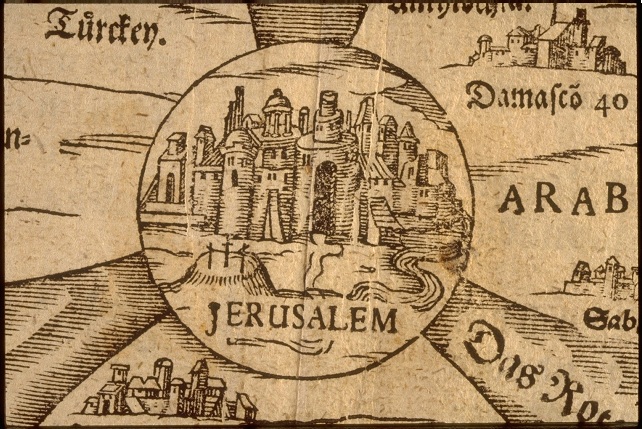
Map (above) by Heinrich Bunting from a copy of Itinerarium Sacrae Scripturae (1581) in the Jerusalem as the center of the world exhibition at the University of Southern Maine’s Osher Map Library, detail below:
**
For more on the symbolism of the axis mundi, see Mircea Eliade‘s essay Symbolism of the Centre in his book Images and Symbols — or consider these lines from TS Eliot‘s poem-series, Four Quartets:
At the still point of the turning world. Neither flesh nor fleshless;
Neither from nor towards; at the still point, there the dance is,
But neither arrest nor movement. And do not call it fixity,
Where past and future are gathered. Neither movement from nor towards,
Neither ascent nor decline. Except for the point, the still point,
There would be no dance, and there is only the dance.
I can only say, there we have been: but I cannot say where.
And I cannot say, how long, for that is to place it in time.
The inner freedom from the practical desire,
The release from action and suffering, release from the inner
And the outer compulsion, yet surrounded
By a grace of sense, a white light still and moving…
**
In many ways, both Eliot’s words and those of the Midrash remind me of the beauty found in the prayers of the Navaho Night Chant:
In beauty may I walk.
All day long may I walk.
Through the returning seasons may I walk.
On the trail marked with pollen may I walk.
With grasshoppers about my feet may I walk.
With dew about my feet may I walk.
With beauty may I walk.
With beauty before me, may I walk.
With beauty behind me, may I walk.
With beauty above me, may I walk.
With beauty below me, may I walk.
With beauty all around me, may I walk.
In old age wandering on a trail of beauty, lively, may I walk.
In old age wandering on a trail of beauty, living again, may I walk.
It is finished in beauty.
It is finished in beauty.
To my reading eye as a poet, these are all expressions of the same kind — invocations of the human spirit by rhythm and imagery — true poems, visions. They offer us a form of nourishment and insight not easily found today — nourishment and insight which shrivel and die when reduced to politics or prose.
**
For more on the Navaho chantways, and the balance called “sa’a naghai bik’e hózhó” which this prayer embodies, see John Farella, The Main Stalk: A Synthesis of Navajo Philosophy.



October 8th, 2012 at 1:11 am
wasn’t the entire theme of the Olympics opening ceremony riffed off the poem ’till we have built Jerusalem / amidst these dark, satanic mills’…which caused concerns given the history and power of Masonic Lodges in London that the whole thing was one giant Illuminati joke?
October 12th, 2012 at 7:33 pm
A post that has just appeared on the BBC “Why modern maps put everyone at the centre of the world”
.
” … But these days we are all really at the centre of our maps, which is both a useful and egocentric thing. A thousand years ago Jerusalem stood at the centre of the Christian world view, or if you lived in China it was Youzhou. But now it is us, a throbbing green dot on our handhelds. We no longer travel from A to B but from Me to B, and we spread out maps on the floor or on our laps in a car only with wistful nostalgia.
.
It is quite possible to walk, phones in our palms, from one end of a city to another without looking up. The loss is historical, social and monumental (as one inspired tweeter observed, I wouldn’t change my Apple Maps for all the tea in Cuba). In our cars, GPS may guide us quite merrily from one country to another, and we may arrive at our destination without any idea of how we got there. En route from London to Cornwall, drivers may listen to a radio documentary about Stonehenge without realising that they have passed it on the right, for it is not on the sat nav. We now tend to look just a few yards ahead, which is a shorter distance than our ancestors used to gaze when they lived in caves. …”
.
And much more …
October 12th, 2012 at 10:37 pm
Mr. X:
.
Aha, I have a Jerusalem post waiting in the wings. I hope it will find an opening in time, one of these days, and actually get completed and posted,
.
Michael:
.
I suspect that we stand still, while we “travel” B towards us until it reaches us. But that requires making “travel” a transitive verb, which at the moment it isn’t: I just suspect it should be!