About today, a normal and highly significant Thursday
I’ve quoted this before, I know: it’s the account given by the man I know who, more than any other, prayed, lived, worked, and saw his great dream and hope accomplished in his lifetime — the overturning of the apartheid regime in S. Africa. For myself, it’s the heart of what he taught me: here, in his own words, Fr Trevor Huddleston CR describes how his own role in that drama began:
On Maundy Thursday, in the Liturgy of the Catholic Church, when the Mass of the day is ended, the priest takes a towel and girds himself with it; he takes a basin in his hands, and kneeling in front of those who have been chosen, he washes their feet and wipes them, kissing them also one by one. So he takes, momentarily, the place of his Master. The centuries are swept away, the Upper Room in the stillness of the night is all around him: “If I, your Lord and Master, have washed your feet, ye ought also to wash one another’s feet.” I have knelt in the sanctuary of our lovely church in Rosettenville and washed the feet of African students, stooping to kiss them. In this also I have known the meaning of identification. The difficulty is to carry the truth out into Johannesberg, into South Africa, into the world.
**
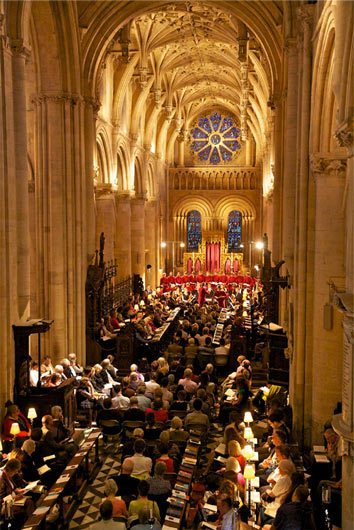
Earlier today, Queen Elizabeth II will have celebrated “the Royal Maundy” in the chapel of my old College and that of my mentor, Trevor Huddleston, at Oxford, Christ Church — our college chapel is also the cathedral of that great city.
The current Dean Of Christ Church, the Very Reverend Christopher Lewis, gave the BBC this historical detail:
The last time it happened here was in 1644 when Charles I was thrown out of London and welcomed in Oxford.
Here’s the glorious building where the ceremony will have taken place:
**
The Royal Maundy is celebrated by the monarch giving two purses to local pensioners — 83 men and 83 women this year since HM is 83 years old — a white purse containing sterling silver 1p, 2p, 3p and 4p pieces, and a red purse contained a £5 and a 50p coin commemorating the 60th anniversary of the Queen’s coronation in 1953.
Maundy Thursday commemorates the day of the Last Supper of Jesus Christ with the Apostles. The word ‘Maundy’ comes from the command or ‘mandatum’ by Christ at the Last Supper, to love one another.
The tradition of the Sovereign giving money to the poor dates from the thirteenth century. The Sovereign also used to give food and clothing, and even washed the recipients’ feet. The last monarch to do so was James II.
The recently retired Archbishop of Canterbury, Dr Rowan Williams, gives us a sense of the rich symbolism of the occasion:
It’s a curious survival, the Royal Maundy, but a touching one, looking back to the days when the monarch really was expected to be a bit like a priest for the nation – acting out the great symbols of faith on behalf of everyone. …
And that’s very much what the Royal Maundy is about. What we see today is only a shadow of what used to be done hundreds of years ago, when the monarch would actually do what Jesus did at the Last Supper and wash the feet of a number of poor people. Back in the Middle Ages, this meant that the King was just doing what priests and bishops often did, not only on Maundy Thursday but on many other occasions.
They didn’t all do it because they were lovely humble people – some were, and some definitely weren’t – but because they accepted one great truth that needed repeating over and over again, the one big thing that Christianity had brought into the world of human imagination.
Page 2 of 3 | Previous page | Next page