Hysteria about Afghan schoolgirl hysteria
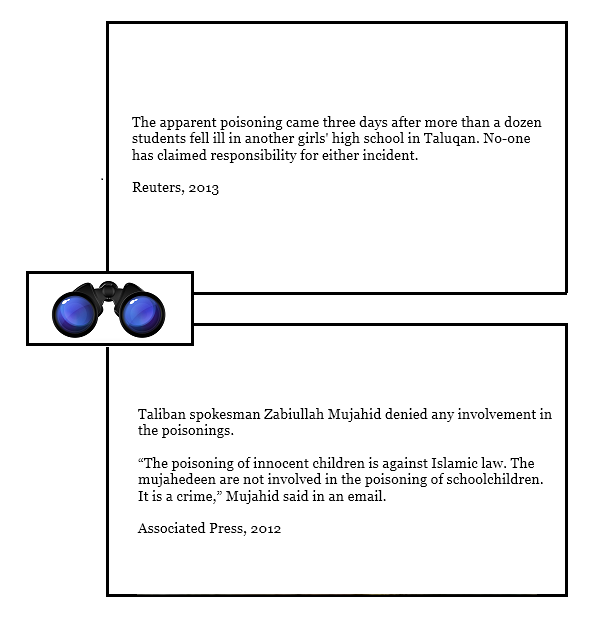
Of course, the Taliban spokesman was addressing a 2012 outbreak of the same hysteria story, and the “no claim of responsibility” report is from one of this year’s versions.
But why would anyone claim responsibility in any case, if the actual cause is mass hysteria rather than poisoning? There’s history to these things — they didn’t begin in Afghanistan:
The cases the Afghanistan incidents most resemble are the Tanganyika laughter epidemic of 1962, in which hundreds of people, mostly schoolgirls, were overcome by fits of mirthless, extended laughter, in what is now known as Tanzania, and the West Bank fainting epidemic of 1983.
The similarities between the heavily studied epidemic in the occupied West Bank and Afghanistan are particularly striking. Both places are in a state of conflict, where political violence is a fact of life, and both have powerful local rumor mills. The incidents follow a similar pattern: First a single report of a bad smell, then a small number of girls come down with symptoms, then it spreads. Local media fueled the rumors and the incidents spread in Afghanistan, just as they did in Israel and Palestine.
Albert Hefez, Israel’s lead psychiatric investigator of the incident, wrote in his 1985 study “The Role of the Press and the Medical Community in the epidemic of ‘Mysterious Gas Poisoning’ in the Jordan West Bank” that Israeli newspaper reports of “poisoning” at the start of the epidemic added fuel to the flames. A front page article in Haaretz on March 28, 1983 even claimed that Israeli military investigators had found traces of nerve gas and quoted “army sources” as saying they suspected Palestinian militants were poisoning their own people in order to blame Israel and provoke an uprising. Palestinian leaders followed up with accusations that Israel had poisoned them in an attempt to drive them from the West Bank.
And such things don’t only happen “abroad” — as detailed in that same NYT blog post I quoted above:
The phenomenon of groups of people falling ill for psychological, rather than physical, reasons is not unknown, nor is it limited to Afghanistan. Moreover, the typical victims are school-age girls. In late 2011, when a group of girls in Le Roy, New York, fell victim to a mysterious twitching illness, medical authorities eventually concluded it was psychogenic.
Page 2 of 2 | Previous page
Suzanne Schroeder:
May 9th, 2013 at 1:34 am
I found Matt Aikens report to be excellent; but I would even go a step further in attempting to come up with a speculative cause. While I think the situation of women and girls in Afghan society does indeed result in deep anxieties,in this case, with the age of the girls involved, it’s more tied to fears about the absence of security. That’s how children’s brains process fear. I was terrified as a kid of being stung to death by bees. As an adult, I realize that unless I knock a nest out of a tree, the chances are…unlikely. That element of control in one’s own safety just is not that developed in pre-adolescent brains. Also, as horrible as it sounds, poisonings without any fatalities, or serious health issues, is sort of a red flag that should have raised some questions.
Charles Cameron:
May 9th, 2013 at 1:46 am
Hi Suzanne:
.
Yes, I suspect you’re right about the girls and Afghanistan — but i think there’s also an interesting epidemiology issue, having to do with how gales of laughter, fainting, yawning, etc spread. That may be outside your remit on this occasion, but it’s an interesting tangent to consider.
.
I’ve been in some pretty ecstatic crowds in my time, and came to the (provisional, verbal) conclusion that it wasn’t a matter of my loving, or others loving, but of love loving, and a great many of us feeling it. Perhaps something of the same kind could be true of fear?
Suzanne Schroeder:
May 9th, 2013 at 2:01 am
Hmmm…I wonder if ecstasy spreads more quickly than fear? But of course, people on trampled by crowds because panic takes over, rather than more deliberate, reasoned responses. On a less analytical level, the story is interesting just in how it’s sort of appropriated to support a variety of idealogical/political positions. It then extends to, would the insurgency go to such effort in opposition to female education, when if you *really* hate that ISAF-built school, you could just blow it up.
Charles Cameron:
May 19th, 2013 at 6:19 pm
Excellent piece today by Waslat Hasrat-Nazimi titled The Afghan girl’s cry for help, which concludes: