On two, one, seven plus or minus, and ten – towards infinity
When I specified above “the simplest form of graph — the dyad — populated with rich nodes and optimally rich associations between them” I was offering a Castoriades-style reversal of approach, in which our choice of nodes is determined not by their abstraction — as single data points — but by their humanly intuited significance and rich complexity. Hence: anecdotes, quotes, emblems, graphics, snapshots, statistics — leaning to the qualitative side of things, but not omitting the quantitative. And their connection, intuited for the richness of the parallelisms and oppositions between them.
Often the first rich node will be present in the back of the mind — aviators wanting to learn how to fly a plane, but uninterested in how to land it — when the second falls into place — when a student asks a diving instructor to teach the diving technique, with no interest in learning to avoid the bends while coming back up. And bingo — the thing us understood, the pattern recognized, and an abstraction to “one way tasks” — including “one way tickets” established.
Let’s call that first node a “fly in the subconscious”. I’d love to have been a fly in the subconscious when SecDef Rumsfeld told a Town hall meeting in Baghdad, April 2003:
And unlike many armies in the world, you came not to conquer, not to occupy, but to liberate and the Iraqi people know this.
Because I could have chimed in cheerfully in the very British voice of General Sir Frederick Stanley Maude, in that different yet same Baghdad in 1917:
Our armies do not come into your cities and lands as conquerors or enemies, but as liberators…
Oh, the echo — the reverb!
**
The ideal number of nodes in the kind of graph I’m thinking of is found in terms of the human capacity to hold “seven plus or minus two” items in mind at the same time — thus, with a slight scanning of the eyes, a graph with eight to twelve nodes and twenty or so edges is about the limit of what can be comprehended.
The Kabbalistic Tree of Life, infinitely rich in meaning and instruction, has ten nodes and twenty-two edges. Once taken into the mature human mind, there is no end to it.

The value of a graph composed of such rich nodes and edges lies in the contemplation it affords our human minds and hearts.
**
Two, being the simplest number, will probably give you the richest graphs of all…
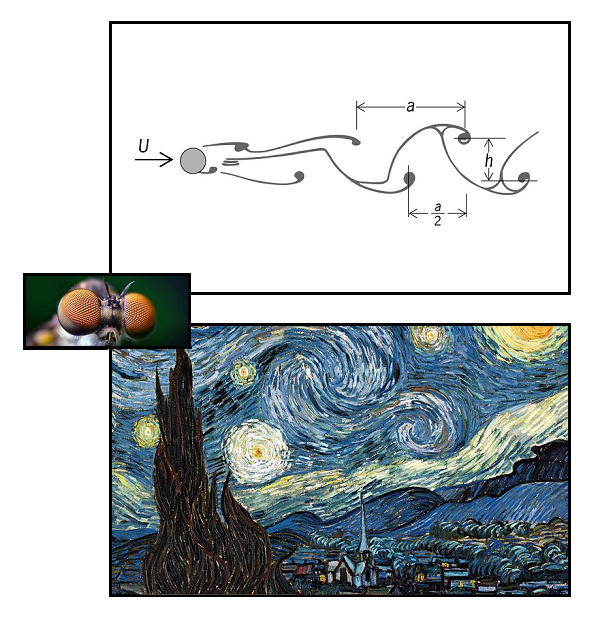
Art, in the person of Vincent Van Gogh, meet science, in the person of Theodore von Kármán.
Page 2 of 2 | Previous page
Mr. X:
July 29th, 2013 at 1:17 am
David P. Goldman aka Spengler’s been hammering Gerehct of late on Egypt here:
http://pjmedia.com/spengler/2013/07/26/dumb-dumber-dumberer-in-washington/
At its worst, so-called rationalist political philosophy turns into the old materialist assertion that being determines consciousness: put people into democratic institutions and they will turn into democrats, just as the Communists asserted that collectivizing the means of production would produce a “new man.” Perhaps something good will come out of all of this: Max Boot and Reuel Marc Gerecht are as close as living writers can come to an embodiment of reductio ad absurdum.
Mr. X:
July 29th, 2013 at 1:19 am
But I agree with the Gerecht quote above. CIA looks foolish in the wave of insider jailbreaks freeing Takfiris from Tunisia to Abu Gharib. The inability to think like a criminal/jihadi and excessive, lazy reliance on SIGINT as opposed to HUMINT has led to many failures. You couldn’t stop the Benghazi attack, for example, if the participants took the simple expedient of conspiring offline with their cell phones left at home.