The virtual museum is not simply a museum in virtual space
[ by Charles Cameron — cross-posted from Sembl — on the infinite possibilities of juxtaposition in gallery & museum, catalog & library — creativity & the Sembl game ]
.
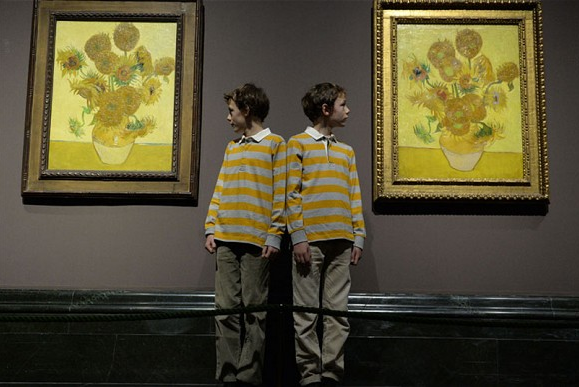
Van Gogh's Sunflowers: the Amsterdam and National Gallery Sunflowers side by side, Jan 2014. Photo credit: Julian Simmonds, Telegraph UK
Please note that what I term here the “virtual museum” is intended to cover both a physical museum or gallery space with available or built in digital affordances and the museum as a completely portable function of the digital network and its devices alone.
I originally wrote this set of notes on February 10, 1997, and have made only tiny changes in the text as presented here — removing one paragraph that was left incomplete, switching the last two bullet points, and placing one “spare” sentence in a suitable context.
As I look back to those days of the Magister Ludi list, and forward to Cath Styles‘s progress with Sembl, I have a sense that this document was prescient, the seed of much that is coming into being now, as we speak. Like all such visions, the manifestation has developed over time, but the idea of the ready, multiple comparison of museum or gallery objects, together with supporting documentation, is still fresh: over time the invisible becomes cutting-edge.
To set the scene, here is a quote from Sven Birkerts that had long inspired me:
There are tremendous opportunities, and we are probably on the brink of the birth of whole new genres of art which will work through electronic systems. These genres will likely be multi-media in ways we can’t imagine. Digitalization, the idea that the same string of digits can bring image, music, or text, is a huge revolution in and of itself. When artists begin to grasp the creative possibilities of works that are neither literary, visual, or musical, but exist using all three forms in a synthetic collage fashion, an enormous artistic boom will occur.
With that insight in mind, here’s a glimpse of my early thoughts about the glass bead game and the museum:
———————————————————————————
That’s right — the virtual museum is not simply a museum in virtual space
I
What’s going on here is that we’re dealing with a multidimensional space rather than the flat space of a wall or the three dimensional space of a room.
- Walk-through “real-life” museums necessarily organize their collections in such a way that one work of art is sequentially related to the next. The visitor walks up a corridor, or through a room, and takes in each work in sequence, carrying a little of the previous work trailing in memory — and on occasion stepping back to view two works placed next to one another in a comparative way.
- In her hand or in his ear, a textual commentary is available: the catalogue. And this is typically consulted in a one-to-one relation, such that picture 63 is viewed and the text for picture 63 heard or read.
The museum is a collection of physical objects with stories which explain them: virtual space is a space of virtual objects with linkages between them.
Page 1 of 3 | Next page