On fire: issues in theology and politics – i
[ by Charles Cameron — suicide, protest, martyrdom, the self-immolation of Buddhist monastics ]
.
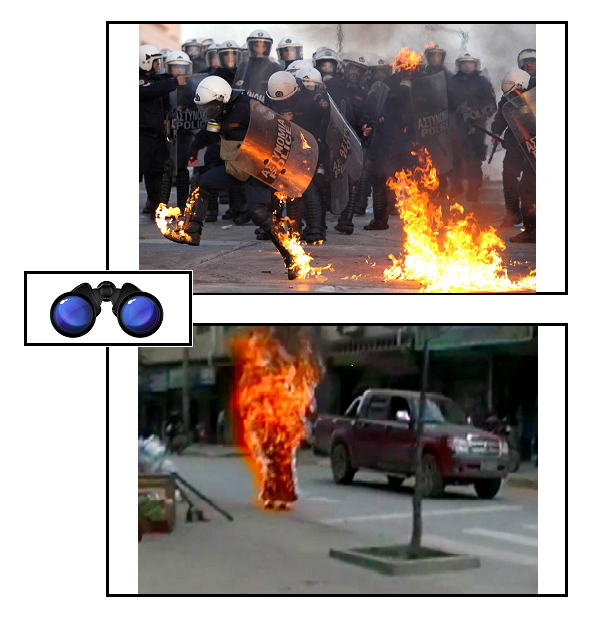 Q&A with Lobsang Sangay, the prime minister of the Tibetan government-in-exile caught my eye:
Q: Does Buddhism allow self-immolation?
A: It’s a complex issue. One could refer to Jataka tales, which concern the previous births of the Buddha. In one story, the Buddha, in a previous incarnation, gives up his body to feed a starving tigress and her four cubs. Some other stories also talk about self-sacrifice by the Buddha.
Although suicide is violent and prohibited in Buddhism, some Buddhists believe it depends on the motivation. If you do it out of hatred and anger, then it is negative. But if you do it for a pure cause … it’s such a complex theological issue. You can’t go either way or have a definitive answer. But the action is tragic, so painful.
That’s a start: it’s a theologically complex issue…
The young Karmapa Lama, second in influence only to the Dalai Lama himself, is quoted in a Guardian report as discouraging this form of protest:
These desperate acts … are a cry against the injustice and repression under which they live. But I request the people of Tibet to preserve their lives and find other, constructive ways to work for the cause of Tibet.
In Buddhist teaching life is precious. To achieve anything worthwhile we need to preserve our lives.
It should be noted, however, that a number of monks in exile from China are depicted in the same article, bearing posters that call the self-immolators “burning martyrs”.
Robert Thurman, Je Tsongkhapa Professor of Indo-Tibetan Buddhist Studies at Columbia and president of New York’s Tibet House, provides his own justification for such acts:
When you destroy your body, you violate your own life, the lives of what Buddhists call “the 84,000 cells” that constitute it. This does seem violent. Yet in this case, the individual sacrifices herself to appeal to her enemy, to convey the perhaps all-too-subliminal message that they have nothing to fear from her, that she will resist their relationship of fear and harm by removing herself from being the target of their ultimately self-destructive, evil behavior. That is true non-harming—perfect resistance by complete surrender. If your victim prevents you from harming her by harming herself and taking herself out of your reach, then why were you afraid of her and wanting to harm her in the first place? Since she won’t harm you, she must love you. She wants you to stop fearing and hating; she wants you to be happy! Indeed, she cries out to you with her very life to wake up and behold the power of love—how it does not fear death, how it gives itself away to reality, how it overwhelms hatred.
And we should remember that even within Buddhism, self-immolation is not an exclusively Tibetan phenomenon. Here’s the celebrated Vietnamese zen monk and poet Thich Nhat Nanh, hearkening back to the days of the Vietnam War in his open letter “In Search of the Enemy of Man” (addressed to Martin Luther King):
Page 1 of 3 | Next page