Metaphors, more iv, featuring Oliver Roeder & Chris Cillizza
[ by Charles Cameron — others besides david ronfeldt who find game & sports metaphors valuable — or should that be invaluable? ]
.
I’m making this post a “special” because Ron Hale-Evans pointed me to a trove of articles variously about or touching on game metaphors for politics, geo or otherwise.
**
This was the start:
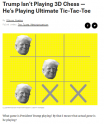
What game is President Trump playing? By that I mean what actual game is he playing?
Trump’s political performance, in seriousness and in jest, has often been likened to chess. Even to three-, four-, eight-, 10- and 12-dimensional chess. His proponents argue he’s a grandmaster,1 and his detractors argue he’s a patzer. CNN’s Chris Cillizza has written two different articles accusing Trump of playing “zero-dimensional chess,” whatever that means. Even Garry Kasparov, probably the greatest actual chess player of all time, has weighed in, inveighing against the use of this gaming cliche via Politico.
In my job here at FiveThirtyEight, I spend a lot of time thinking about games — board games, video games, chess tournaments, math puzzles, the game theory of international affairs. So I understand that “playing chess” is easy shorthand for “doing strategy” or “being smart” or whatever. But I think we can do better. I humbly propose to you that Trump is not playing chess (of any dimension), but rather something called “ultimate tic-tac-toe.” It’s time to update your tropes.
It’s a good day when I find an entire article dedicated to game or sports metaphors for politics, but this one had some great links..
Instances:
**
The second thing this Corker episode makes clear is that, strategically speaking, Trump is playing zero-dimensional chess. As in, the only strategy is that there is no strategy.
In the wake of Trump’s absolutely stunning 2016 victory, the conventional wisdom — in political circles — was that Trump was a strategic genius, always seeing five moves ahead. He was playing three-dimensional chess while the media was still trying to figure out which way pawns could move. The reason no one thought Trump could win was because “we” didn’t see the whole board the way he did. No one else saw it that way. Trump was a genius. An unconventional genius but a genius nonetheless.
There, incidentally, is the definition of zero-dimensional chess:
Trump is playing zero-dimensional chess. As in, the only strategy is that there is no strategy.
And:
**
The key part is when he concludes Flake will be a “no” on the tax reform package in the Senate because, well, his political career is “toast” — or something.
I submit this as yet another piece of evidence that Trump is playing zero-dimensional chess.
What do I mean? Simply this: When Trump won the White House — against all odds — the working assumption was that he had executed a plan so brilliant and so complex that only he (and the few advisers he let in on the plan) could see it. He was playing three-dimensional chess while the media, the Clinton campaign and virtually everyone else was still playing checkers.
But as his first year in the White House has progressed, there’s mounting evidence that Trump may not be playing three-dimensional chess. In fact, he might just be playing zero-dimensional chess. As in, the only strategy Trump is pursuing is no strategy at all.
From a game-policy metaphor angle, this doesn’t take us much further, although you can read the whole post for details of the Trump-Flake business..
And..
**

Chess? That’s not what Garry Kasparov sees Donald Trump or Vladimir Putin playing—three-dimensional or any other kind. But if they did sit down for a game, the former grandmaster believes the Russian president would obviously win.
“Both of them despise playing by the rules, so it’s who will cheat first,” Kasparov told me in an interview for POLITICO’s Off Message podcast. “But in any game of wits, I would bet on Putin, unfortunately.”
Page 1 of 3 | Next page