Metaphors, more iv, featuring Oliver Roeder & Chris Cillizza
Kasparov gets into some interesting details, not entirely uncritical of Obama, and even GW Bush, but flicking Trump off the board with a flick of his cultivated fingernail..
I think I’vetheis referenced the Kasparov article once before, but hey, this is a rich harvest..
Next:
**
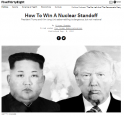
Shall we play a game?
Imagine that a crisp $100 bill lies on a table between us. We both want it, of course, but there’s no chance of splitting it — our wallets are empty. So we vie for it according to a few simple rules. We’ll each write down a secret number — between 0 and 100 — and stick that number in an envelope. When we’re both done, we’ll open the envelopes. Whichever of us wrote down the higher number pockets the $100. But here’s the catch: There’s a percentage chance that we’ll each have to burn $10,000 of our own money, and that chance is equal to the lower of the two numbers.
So, for example, if you wrote down 10 and I wrote down 20, I’d win the $100 … but then we’d both run a 10 percent risk of losing $10,000. This is a competition in which, no matter what, we both end up paying a price — the risk of disaster.
What number would you write down?
In the 538 post, the game’s available for interactive play.. And later in the same piece, too..
Now imagine that you’re playing the same game, but for much more than $100. You’re a head of state facing off against another, and the risk you run is a small chance of nuclear war
That was instructive, I think, though my mind is artificially dimmed at present..
And finally:
**
This one revolved around a tweet in which Trump had said
:When a country (USA) is losing many billions of dollars on trade with virtually every country it does business with, trade wars are good, and easy to win. Example, when we are down $100 billion with a certain country and they get cute, don’t trade anymore-we win big. It’s easy!
How easy? was this post’s response:
But how easy? And how exactly do you win them? (Also, what’s a trade war?)
Let’s find out. You (Yes, you!) have just been elected president of your very own country. Congratulations! Now it’s time to get to work. There is another country out there that has goods you can buy, and you have goods it may want to buy. Your job is to choose your foreign economic policy — which you’ll do in the little game we’ve prepared for you below.
The rules go like this: You can cooperate with the other country, allowing the free flow of its goods into your country. Or you can defect, imposing tariffs on the foreign goods. And because you will trade with the same country over and over again, you have to decide whether to stick with a single strategy no matter what or whether to change course in response to your opponent. The other country faces the same choice, but you can’t know in advance what plan they’ve chosen. Free trade helps both countries, generating big windfalls for both sides. But it’s possible for a single country to improve its own situation at the other’s expense — you both have a selfish incentive to defect, taxing the imports from the other country and helping only yourself. However, if you both defect, you both wind up isolated, cutting yourselves off from the market and reducing earnings on both sides.
Again, the game is available for interactive play.
We’ve simplified trade dramatically: You’re engaging in 100 rounds of trade with a randomly chosen FiveThirtyEight reader. In each round, you and your trade partner can either cooperate (allow free trade) or defect (impose a tariff). Your goal is to pick a strategy that earns you as much as possible.
The game mechanics here were interesting (and “gave the game away” where the game is game theory a la Prisoners Dilemma):
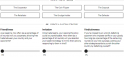
Well..
Was there a trade war? Was it good? Did you win it?
Tariffs are the weapons of a trade war
The game you just played took a little game theory — the formal, mathematical study of strategy — and retrofitted it to the world of international relations. (Of course, our simulation is extremely simplified, and it runs in a very controlled little world that ignores alliances, trade deals, political histories, other countries, and hundreds of other factors.)
**
Page 2 of 3 | Previous page | Next page