The martyr Soleimani embraced by Imam Hussein

So shall it be; for I will burn my tents,

And quit the host, and bear thee hence with me,

And carry thee away to Seistan,

And place thee on a bed, and mourn for thee,

With the snow-headed Zal, and all my friends.

And I will lay thee in the lovely earth,

And heap a stately mound above thy bones,

And plant a far-seen pillar over all,

And men shall not forget thee in thy grave.

Soleimani, then, is drawn into an embrace by Huseyn, viewed as another Rustum, heroic Iranian icon — and on today’s Middle Eastern battlefields from Lebanon to Iraq a brilliant strategist and warrior..

**

Reflect, then, on this 2009 quote from Soleimani, to get a sense of the man as he regards his own role:

The war-front is mankind’s lost paradise. One type of paradise that is portrayed for mankind is streams, beautiful nymphs and greeneries. But there is another kind of paradise. … The war-front was the lost paradise of the human beings, indeed.

Isaac Chotiner describes him thus in the New Yorker:

If he had described himself, it would probably have been as the commander of Iran’s equivalent of CENTCOM, the regional commander of all of Iran’s operations — security, intelligence, military– outside of the Iranian border.

And to return to martyrdom:

The main [Iranian] news channels showed a live gathering at a mosque in Gilan Province, where the preacher reassured worshippers that “the best death is martyrdom for God” and that “great men prefer martyrdom to death by natural causes, cancer, accidents or old age”.

**

Recommended tweeting:

  • Vali Nasr, until recently dean of SAIS
  • Narges Bajoghli, SAIS Assistant Professor
  • Mohammad Ali Shabani, PhD Researcher at SOAS
  • Page 2 of 2 | Previous page

    1. Charles Cameron:

      My friend Ali Minai wrote me:

      This was one of the first thoughts that occurred to me. The Shi’a response cannot be understood without appreciating the centrality and glorifying power of martyrdom in Shi’ism. Western analyses that overlook this are going to be very wrong.

    2. Charles Cameron:

      Soleimani’s reach:Avi Melamed: The Killing of Major General Qassem Soleimani – Initial Observations:

      Soleimani was the spearhead, the lead strategist – in charge of designing, leading, and implementing Iran’s hegemonic vision in the Middle East. His role was to spread Iran’s reach and influence and make Iran the superpower in the region. And he did so primarily by creating, supporting, and nurturing a network of militias throughout the Middle East including Hezbollah in Lebanon, Hamas, and Islamic Jihad in Gaza, Iraqi Shi’ite militias, Yemeni Houthi forces, Afghan and Pakistani Shi’ites militias, etc. Under Soleimani’s command, Iran deepened its hold in Lebanon, Syria, Iraq, Yemen, and the Gaza Strip.

    3. Sally Benzon:

      Thanks for this, Charles. I appreciate also what your friend Ali Minai writes.

    4. Charles Cameron:

      Sen. Chris Murphy:

      Iran is full of malevolent evildoers, and Soleimani was the worst of them. But Iran is also a nation state. And the reason the U.S. doesn’t kill leaders of other countries is because once you normalize assassinations, it’s hard to put the genie back in the bottle.

    5. Charles Cameron:

      You’re most welcome, Sally.
      .
      FWIW: In my post, I covered matters that seem important to me, but that are largely ignored by our [largely secular, skeptical] press. I’m using the comments section to drop in a few select pieces on the natsec angle, generally known materials, but succinctly stated.

    6. Charles Cameron:

      Studies in deterrence: Why killing Iran’s Qasem Soleimani doesn’t do it

      Soleimani has been t the helm of the elite Quds Force since 1998, and it’s difficult to overstate his importance. In the Atlantic, Andrew Exum, former US deputy assistant secretary of defense for Middle East policy, wrote that “from a military and diplomatic perspective, Soleimani was Iran’s David Petraeus and Stan McChrystal and Brett McGurk all rolled into one”—referring to two former US military generals and a former special presidential envoy.

      Andrew Exum = Abu Muqawama.

    7. Charles Cameron:

      WATCH: Iran unveils red flag of revenge against America at mosque

      A blood-red flag symbolizing vengeance unfurled Saturday above the dome of Jamarkaran Mosque in Qom, Iran, a day after the United States killed Iranian Gen. Qassem Soleimani and Iraqi militia leader Abu Mahdi al Muhandis.
      .
      The flag, inscribed with the words “Those who want to avenge the blood of Hussein,” was hoisted above the mosque’s shrine for what local reports claimed was the first time in history, according to the Daily Mail.

      .
      **
      .
      For those of you who read the whole article, Tim Furnish comments:

      Hussein’s death was NOT “met with bloody retaliation.” He was killed by the (Sunni) Umayyads & the Shi`is were forced to hide & practice taqiyya (pretending not to be Shi`is). So the “red flag of revenge” is much ado about little.”

      Nonetheless, retaliation is supposedly mentioned on the flag — and Tim Furnish of all people, having “written the book” on Mahdism and visited Jamkaran, knows how significant a place that mosque has in Shia theology, Tim.
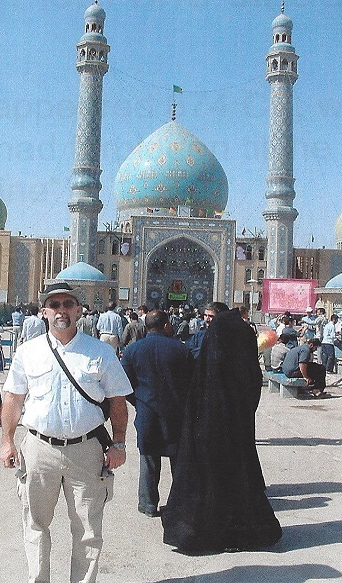
      .
      Here’s Tim Furnish at Jamkaran:
      .
      null
      .

      .
      **
      .
      Watch the flag go up:
      .

    8. Charles Cameron:

      Vali Nasr, until recently Dean of the Johns Hopkins School of Advanced International Studies, tweeted a link to the article below with the comment:

      This is a particularly insightful analysis of why Iranians have reacted with so much emotion to the killing of #Soleimani, and where #Iran goes from here. A must read.

      The Day After War Begins in Iran by Azadeh Moaveni — commenting on the death of Soleimani:

      Many consider him responsible for the deaths of thousands, for his intervention in salvaging Bashar al-Assad’s rule in Syria. But to many Iranians, Iraqis, Kurds and others, he was a pivotal figure in vanquishing the Islamic State, helping repel its rapid march across Iraq in 2014.

    9. Charles Cameron:

      Robin Wright in the New Yorker, The Breathtaking Unravelling of the Middle East After Qassem Suleimani’s Death

      Iran has not seen such an outpouring of emotion on the streets since the death of the revolutionary leader Ayatollah Ruhollah Khomeini, in 1989. His successor, Ayatollah Ali Khamenei, wept openly—as did other political leaders and military officers—as he prayed over the casket. Esmail Gha’ani, Suleimani’s successor as head of the Quds Force, the élite wing of the Revolutionary Guards, vowed to confront the United States. “We promise to continue down martyr Soleimani’s path as firmly as before, with the help of God, and, in return for his martyrdom, we aim to get rid of America from the region,” Gha’ani said at the funeral.

    10. Charles Cameron:

      TRUMP AND IRANIAN MILITARY LEADER RATTLE SABERS VIA INTERVIEWS AND SOCIAL MEDIA

      There were many critiques about this statement, specifically about Trump’s threat to target “the Iranian culture,” but the most striking reply came from Maj. Gen. Hossein Dehghan in an interview with to CNN.
      .
      “If he says 52 we say 300 — and they are accessible to us,” he said, directly addressing the President’s tweet. “No American military staff, no American political center, no American military base, no American vessel will be safe.”