zenpundit.com » Taliban

Archive for the ‘Taliban’ Category

A recurrent fashion in explosive headgear?

Thursday, December 6th, 2012

[ by Charles Cameron — two Taliban “peace” envoys who blow themselves up, and two bombs in two turbans ]
.

I didn’t catch this at the time, but there’s a curious echo of the most celebrated of the Jyllands-Posten cartoons

in the killing of Burhanuddin Rabbani, head of the Afghan High Peace Council.

I picked up on this detail today because I was checking back on Rabbani’s killing in light of today’s assassination attempt on Asadullah Khalid, head of the Afghan National Directorate of Security by a “Taliban suicide bomber posing as a peace envoy” — the same MO used in the Rabbani assassination.

Taliban “peace envoys” intent on destroying their partners in negotiation — that’s one recurrent pattern here.

**

And the other…

Is it just that there are only so many pieces of clothing in which a bomb can be hidden, and a turban is one of them — or is there some deliberate irony at work here, taking the cartoon’s metaphorical bomb, making it real and pointing it back ?

Parallelisms are always worth a little extra consideration.

Thanksgiving and Kasab: pardon and penalty

Thursday, November 22nd, 2012

[ by Charles Cameron — i suppose this is about the state’s claim to a monopoly of violence, seen from both ends ]
.

I don’t want to go too far with this one, and I’ll start with the turkey and pardon, because pardon and forgiveness and thanksgiving all fit together and might as well be celebrated at this season — but as you’ll see, pardon has its dark side, even if it takes an anthropologist named Magnus Fiskesjö and his pamphlet titled The Thanksgiving Turkey Pardon, the Death of Teddy’s Bear, and the Sovereign Exception of Guantánamo to point it out:
.

But around the same time a turkey gets a reprieve in the US, a terrorist in India gets the death penalty.

I think it’s important to remember the Mumbai atrocities of 2008,and of which Ajmal Kasab (depicted below, and recently deceased) was the sole surviving perpetrator — if for no other reason than because he’s considered a martyr by some, and will be avenged.

But first, let me wish a Happy Thanksgiving! to all Zenpundit’s American readers, and good wishes to all others.

**

The problem with martyrdom… is that it’s a force-multiplier. Okay when the force is purely spiritual, not so much when it runs to violence and terror…

photo credit: Outlook India

Retired Indian intelligence chief Bahukutumbi Raman, whose tweets I often follow to articles on his Raman’s strategic analysis blog, warned us all:

Before the execution of Ajmal Kasab, the Pakistani terrorist of the Lashkar-e-Toiba (LET), who had participated in the 26/11 terrorist strikes in Mumbai, at Pune on the morning of November 21, 2012, our security agencies must have examined the likelihood of retaliation by jihadi terrorists in Pakistan and India and strengthened security precautions to prevent retaliatory attacks.

The LET and the organisations associated with it would want a quick retaliation.

And then he went into detail

Sure enough, Reuters then tells us:

Pakistan’s Taliban movement threatened on Thursday to attack Indian targets to avenge the country’s execution of Mohammad Ajmal Kasab, the lone survivor of the militant squad responsible for a rampage through Mumbai that killed 166 people in 2008. Kasab was hanged on Wednesday amid great secrecy, underscoring the political sensitivity of the November 26, 2008, massacre, which still casts a pall over relations between nuclear-armed rivals Pakistan and India.

“We have decided to target Indians to avenge the killing of Ajmal Kasab,” said Taliban spokesman Ehsanullah Ehsan by telephone from an undisclosed location.

**

In the course of the coronation liturgy for Queen Elizabeth II, the words justice and mercy crop up quite often — justly and justice 8 times, and merciful and mercy 28. It appears to be a sovereign’s right and obligation to administer both, and during the ceremonial they are brought together as a symbolic pair.

The Sceptre with the Cross is given into her right hand, with the words:

Receive the Royal Sceptre, the ensign of kingly power and justice

while the Rod with the Dove is given into her left hand, with the words:

Receive the Rod of equity and mercy.
Be so merciful that you be not too remiss,
so execute justice that you forget not mercy.
Punish the wicked, protect and cherish the just,
and lead your people in the way wherein they should go.

Justice is only fair: it seems, however, that it should be tempered with mercy.

**

Let me simply add that my own preference would be to have remitted the death penalty in Kasab’s case, and given him a life term in which to think about the lives he took. As for the turkey — happy stuffings!

I remember too, today, my friend and mentor Wallace Black Elk, and his wife, Grace Spotted Eagle. It was Wallace who — at least once — said:

They called us “Indians” when they came, so we have a nickname. But we are Earth people, we are original. When they come here, I welcome them with open arms, give them a turkey dinner, corn, and all the vegetables, all the greens.

Because this is a land of abundance…

Strategy, Power and Diffusion

Monday, November 19th, 2012

“….and therefore, two kinds of reactions are possible on the defending side, depending whether the attacker is to perish by the sword or by his own exertions.

                                                               – Carl von Clausewitz,  On War

 “Again, if the campaign is protracted, the resources of the State will not be equal to the strain.”

                                                                 – Sun Tzu,  The Art of War 

A recent estimate for the cost of the war in Afghanistan by the Congressional Research Office is $443 billion dollars to occupy and fight a Pakistani-supported insurgency in a primitive country whose annual GDP is a mere $ 27 billion. A  figure that itself inflated by $ 3-4 billion is remittances, $ 4 billion in NGO aid and $14 billion in direct US aid (2010 figure); when you then subtract opium smuggling ($ 4 billion), Afghanistan’s legitimate economic activity may only be a miniscule GDP of  $ 2 – 3 billion.

This does not, of course, include the cost of ten years of lavish bribes for Pakistan, a portion of which was used by the ISI to support the Taliban  killing American and ISAF  soldiers  and Afghan civilians.

This is not a cost-effective or strategic way to run a war. In fact, even for a nation as wealthy as the United States there is nothing in Afghanistan worth such an expenditure of blood and treasure, especially when the bulk of our enemies appear to be based in Pakistan, not Afghanistan. You can approach a strategic problem directly or indirectly but to do so indirectly in the most expensive way logistically possible makes little sense. For example:

….Since the ‘war to end all wars’, however, war has not exactly stood still.  Although the US Defense Logistics Agency rather quaintly describes its mission in terms of a supply chain extending ‘from factory to foxhole’, it is, above all, the mobility of military violence that is central to the conduct of late modern war.  But Creveld is adamant that since 1945 the operational freedom of modern ground forces has not markedly increased, not least because their prized mobility is absolutely dependent on supplies of petrol and gasoline.  Since the end of the Second World War the use of petroleum-based fuels by the US military has soared, and as its stripped-down forces have been expected to do more with less (through technological change and outsourcing) so the fuel expended per soldier has increased by 175 per cent to an average of 22 gallons (83 litres) per day. [viii]  As Obama had US forces ‘surge’ into Afghanistan in 2009 so ISAF’s daily fuel consumption rocketed from two million to over four million litres a day. Given these volumes, it is scarcely surprising that the death-dealing capacities of the US military and its allies should have been tied in knots by ‘umbilical cords’ far more convoluted than Creveld could ever have imagined.

There are three main supply networks to be disentangled in turn.  All of them are ground lines of communication.  Air transportation is extremely, usually prohibitively expensive, and only four airports in Afghanistan are accessible to non-military aircraft, so that until 2011 only 20 per cent of cargo was flown in.  Similarly, onward delivery to combat outposts and forward operating bases has usually only involved airdrops if other options are too dangerous. Still, by the start of 2010 around 30-40 per cent of bases were being supplied by air because the Taliban controlled much of Highway 1, the ring road that loops between Afghanistan’s major cities, and its IED attacks on NATO and Afghan forces were increasingly effective.  The high cost of airdropping pallets of fuel, ammunition, water and supplies has imposed all sorts of fuel economies on the military as it attempts to reduce its carbon footprint – ‘troops have learned to sip, not guzzle’ – but it is still the case that, as one US pilot put it, ‘we’re going to burn a lot of gas to drop a lot of gas’.  According to some estimates it can cost up to $400 a gallon to deliver fuel by air. [ix] 

Neither war nor strategy are a hard science like physics. That said, there are fields of study and investigation that while not being a science are, like physics, inherently about systems or systemic relationships. Economics  and engineering are two such examples, strategy is another.  Because of this similarity, it is often profitable to employ metaphors or analogies from physics to illustrate strategic problems, as Clausewitz famously did in On War with “friction” and “center of gravity“.

Diffusion” might be another analogy for statesmen and soldiers to keep in mind.

Military force, or more broadly, national power marshaled and employed toward a vital objective represents a potent concentration of energy like a red hot iron bar. Thrust deeply into a trough of ice water, the surface of the water yields to the mass and heat of the iron bar in a furious burst of steam and boiling turbulence. Keep the bar submerged and every erg of heat will be sapped out of it by the water and the iron will emerge cold, tempered by the experience and inert. Keep the bar submerged long enough and the water will begin to rust the iron away until nothing is left.

Vast spaces, hostile populaces and deeply impoverished environments are like ice water to the molten heat of an invading power, as we have discovered in Afghanistan.

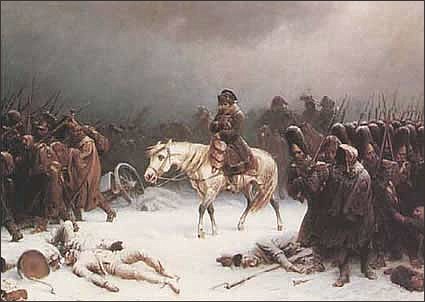
There are already old military maxims that express a warning about the risks of diffusion, notably “Don’t get into a land war in Asia” or “Don’t invade Russia in winter”.  Napoleon Bonaparte marched his vast and fabled Grand Armee of 600,000 men into the endless steppes of Tsar Alexander’s Russia. Everything gave way before Napoleon’s legions, but the Russians were not the Austrians or Prussians, they retreated, savagely burning and destroying as they went:

….Alexander’s proclamation to his people, issued at the time of the French invasion, appealed to these deep seated feelings: Napoleon had come to destroy Russia; the entire nation must rise against ‘this Moloch’ and his ‘legions of slaves’. ‘Let us drive this plague of locusts out! Let us carry the Cross in our hearts and steel in our hands!’ The proclamation was read in all the churches, and the priests supplemented it with embellishments of their own. The Comte de Segur, at this time an aide-de-camp to Napoleon, wrote: ‘They convinced these peasants we were a legion of devils commanded by the Antichrist, infernal spirits, horrible to look upon, and whose very touch defiled”

In Moscow, the city in flames, even Napoleon the Conqueror, the master of Europe, did not have enough men, or material or speed of movement to either digest and rule the immense spaces of Russia or compel Alexander to come to terms:

….Throughout the fall of 1812, Napoleon waited in vain for Alexander’s peace proposals to arrive in the Kremlin. When none came, he made overtures of his own, but Alexander sent no reply. As the days stretched into weeks, Napoleon came to see that he, not Alexander, faced a truly desperate situation, for Russia’s armies grew stronger by the day while his own dwindled from desertions and the ravages of disease. He faced the hopeless prospect of wintering in Russia without adequate food, shelter, or supplies, surrounded by a people so hostile that they burned their grain rather than sell it for French gold. As winter approached, and as the Russian partisans stepped up their attacks on his rear, Napoleon saw that his line of communications, which relied upon a perilously vulnerable corps of couriers who raced from Paris to Moscow in fourteen days, must soon collapse.

Of the Grand Armee, only five thousand returned home from the snowy wastes of Russia alive.

The Wehrmacht did little better. Hitler’s imagined drive to the Urals without a surrender and territorial concession by Stalin was a fantastical ambition. The far-flung distance, roadless mud and icy snow alone were too much for panzer armies and Luftwaffe air wings that proceeded to break down with statistical certainty. Supply lines were too long; gasoline and replacement parts were too few, as were replacements for the men for whom the Eastern Front was a grave. To the dogged resistance of the Red Army, the Germans needlessly added the people’s rage of the Russian partisans by demonstrating to the peasantry that the NKVD held no monopoly on atrocity.  Imperial Japan’s coterminous war in China tells exactly the same unhappy tale.

William Lind and the 4GW school used to like to make the point, regarding your moral and political legitimacy, that ” If you fight the weak, you become weak”. The corollary to that is economic: “If you fight the poor, you become poor”.

Grinding poverty itself  is a tax upon the invading force. There are no resources for your army to comandeer or buy, no skilled manpower to requisition or hire, no infrastructure for them to use. All of that must be imported and built at great expense by the invader whose troops are accustomed to far less spartan environs. The local population is usually malnourished, illiterate, ignorant, suspicious of outsiders and  rife with disease; their living habits and water sources unsanitary and endanger the troops. Caring for the locals, even minimal administration of humanitarian aid, becomes a bureaucratic and logistical burden consuming time and diverting resources away from urgent military needs.

The United States under George Bush the Elder, entered into Somalia, a land beset by violent anarchy and it’s people in the grip of a terrible famine and was driven out shortly thereafter under Bill Clinton. The last scenes there being the emaciated Somali followers of  a two-bit warlord,Mohammed Farah Aidid, gleefully swarming over and looting our military’s former…. garbage dump.

When the enemy has a land so poor that he treasures and makes use of the crap you throw away, the economic spillover of your logistical supply lines will fund his war against you. Used to surviving on bare subsistence, the invader’s presence becomes an economic bonanza for resistance and collaborator alike. Sort of a highly kinetic form of military Keynesianism. The war itself and the occupation become an irreplaceable cornerstone of their economy. They hate you being there, but can’t afford to defeat you and drive you out either – making a “quagmire” irregular conflict their ideal economic equilibrium to maintain.

What lessons can we draw here?

  • Keep your national power concentrated – don’t diffuse it with unmanageable, ill-defined, tasks of unlimited scope
  • Military power is to be used for a clear and articulated policy end with a defined political settlement in mind
  • If a political settlement is impossible because the problem is intractable, avoid involvement.
  • If you cannot avoid getting involved (i.e. -you were attacked) your best option is to engage in a punitive expedition to destroy the war-making capacity of the enemy and impose  ruinous costs and then immediately leave.
  • Keep campaigns short. In operation, military power is a terrible, swift sword and you should sheathe it just as quickly. 
  • Ruling over enemy population is a wasteful, thankless, burden not to be undertaken except in extremis (Reconstruction and occupation of Germany and Japan were in extremis cases).
  • Maximum gains accrue from the most effective use of the smallest possible force in the shortest period of time.
  • Make an army large enough and the enemy will become a secondary or tertiary concern of its leaders.


Wei Wu Wei, or the inactionable option

Tuesday, November 13th, 2012

[ by Charles Cameron — the excellence of today’s piece by Joshua Foust and the importance of intelligence that is not actionable, with illustrations from Zenpundit, Dickens and Shakespeare ]
.

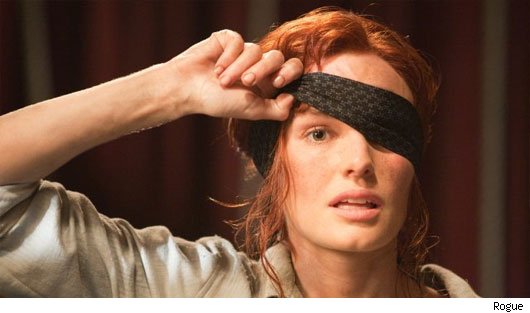
Kate Bosworth peers out from under a blindfold in the 2010 movie, Warrior's Way

**

Josh Foust just posted an important piece in his Atlantic column and on his American Security Project blog titled Myopia: How Counter-Terrorism Has Blinded Our Intelligence Community, with the subtitle:

The United States’ overriding interest in “actionable” information on terrorists has produced a dangerous form of tunnel vision.

Bingo.

This is important, and I’ll circle back to it. But first, please follow the full arc of the circle…

**

I post little headers at the top of all my Zenpundit posts these days, to let people know where on the irrelevance scale my latest offering should be placed — I guess the idea came from the 19th century practice of offering “synoptic chapter headings” to titillate the reader of novels, as when Mr Dickens titles one chapter of The Pickwick Papers:

Chapter XVIII. Briefly illustrative of two points; first, the power of hysterics, and, secondly, the force of circumstances

I digress.

Some while back, I posted a piece called The Haqqani come to high Dunsinane here on Zenpundit, and gave it the header:

why is non-actionable (useless) intelligence sometimes the most intelligent (useful)? – importance of multiple frames for complex vision

The piece was about the Haqqani network, but obliquely so — I was leaping from an image in a video where a cluster of Haqqani-guys in training were running around dressed as trees, to a similar image in Shakespeare‘s Macbeth:

Macbeth shall never vanquish’d be until
Great Birnam wood to high Dunsinane hill
Shall come against him.

Well, that was the prophecy, and Macbeth took it to mean he’d never be defeated in battle:

That will never be.
Who can impress the forest, bid the tree
Unfix his earthbound root? Sweet bodements! Good!

Prophecies and portents are notorious for their double meanings, however, and this one’s fulfillment comes when Malcolm gives the order to his men:

Let every soldier hew him down a bough
And bear’t before him. Thereby shall we shadow
The numbers of our host and make discovery
Err in report of us.

Heh — “discovery” here means what today we’d call “intelligence” — and notice the importance here of reading multiple meanings out of a single sign.

A while later, a messenger arrives, and declaims:

As I did stand my watch upon the hill,
I look’d toward Birnam, and anon, methought,
The wood began to move.

This turns out to be true enough, for in the next scene Malcolm, now before Dunsinane, gives the order:

Now near enough: your leafy screens throw down.
And show like those you are.

and:

Make all our trumpets speak; give them all breath,
Those clamorous harbingers of blood and death.

And so it goes.

**

Let me emphasize, this is not, definitively not, actionable intelligence that I am in any way attempting to offer as such to anyone engaging in close-quarters combat with the Haqqanis.

Our arc is almost complete at this point, so let’s take a closer look at Josh Foust’s piece:

Large areas of the IC have move away from their traditional role of analyzing a broad range of current events for policymakers and toward supporting the global counterterrorism mission. News stories about this shift suggest the counterterrorism mission has become the overarching concern of the national security staff.

This shift in focus can create blind spots that pose unique challenges for the president. If branch chiefs and the policymakers they support value “exploitable” information over deep understanding, they might be ignoring potentially vital information that doesn’t seem immediately of interest.

Imagine an analyst finding reports of a growing discontent in a Middle Eastern country’s politics; if that does not provide immediate benefit for a decision-making process for targeting suspected terrorists, it can easily be ignored in the avalanche of targeting information.

Blind spots, eh?

Those would be “the dots” in the “larger picture” that you can’t “connect” until it’s too late. And where are they found? In “information that doesn’t seem immediately of interest” — intelligence that’s not “actionable” in other words.

Or to put that another way, what Josh calls “tunnel vision” comes from staring at what’s “actionable” — whereas vision that’s “out of the tunnel” comes from noticing what’s in peripheral vision.

**

Wei wu wei? It’s a Taoist motto: literally, it means “action without action” though it can also be translated “effortless action”.

I know, I know, this is a useless post. But you know what Hui Tzu said to Chuang Tzu?

I have a big tree of the kind men call shu. Its trunk is too gnarled and bumpy to apply a measuring line to, its branches too bent and twisty to match up to a compass or square. You could stand it by the road and no carpenter would look at it twice. Your words, too, are big and useless, and so everyone alike spurns them!

And you know what Chuang Tzu said in response?

Graphical footnotes, 1: Iwo Jima and the Muj

Thursday, November 8th, 2012

[ by Charles Cameron — another insight into mujahideen ethos via their graphics, this time from their Soviet era campaign ]
.

First, a current graphic which I’ve already shown you in a recent post on jihadist imagery — then a version of the same visual idea from earlier days:

credits: above, Ibn Siqilli, below, Mathew Trevithick for Foreign Policy

.

Ibn Siqilli‘s image is contemporary, Trevithick‘s is drawn from his fascinating series of images titled The Not-So-Funny Papers, which I missed myself when it first came out, and warmly recommend. The legend the flag in Trevithick’s piece carries is “Jihad”.

This post is intended as a footnote to my earlier post, Iwo Jihad? — the muj have clearly been at this business of graphical borrowing for a while…


Switch to our mobile site