Time for a Grand Strategy Board?
The President of the United States, of course has a number of bodies that could, should but do not always provide strategic advice. There’s the Defense Policy Advisory Board, an Intelligence Advisory Board, the National Intelligence Council, the State Department’s Policy Planning Staff, the Office of Net Assessment and not least, the NSC itself and the Joint Chiefs of Staff, whose Chairman, by act of Congress, is the military advisor to the President and Secretary of Defense. While strategic thinking does percolate from these entities, many have very specific mandates or, conversely, wide ranging briefs on matters other than strategy. Some operate many levels below the Oval Office, are filled with superannuated politicians or have personnel who, while intellectually brilliant, are excessively political and untrained in matters of strategy. The Joint Chiefs, the professionals of strategy, are highly cognizant of the Constitutional deference they are required to give to civilian officials and are very leery of overstepping their bounds into the more political realms of policy and grand strategy.
What the President could use is a high level group just focused on getting strategy right – or making sure we have one at all.
I’m envisioning a relatively small group composed of a core of pure strategists leavened with the most strategically oriented of our elder statesmen, flag officers, spooks and thinkers from cognate fields. A grand strategy board would be most active at the start of an administration and help in the crafting of the national strategy documents and return periodically when requested to give advice. Like the Spartan Gerousia, most of the members ( but not all) would be older and freer of the restraint of institutional imperatives and career ambitions. Like the Anglo-American joint chiefs and international conferences of WWII and the immediate postwar era, they would keep their eye on the panoramic view.
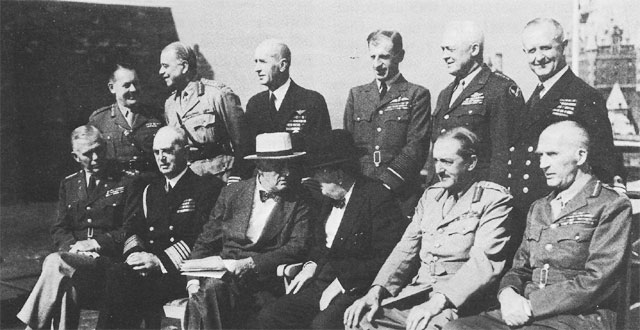
The Octagon Conference – FDR, Churchill and the Combined Chiefs of Staff
Here’s my grand strategy board in a hypothetical perfect world, unlike the one that prevails inside the beltway. I’m sure people will quibble with particular names or will suggest others. I freely admit, for example, that I do not have the best grasp of who our leading intellectual powerhouses are in the Navy, Air Force or the closed world of intelligence analysis and this impairs my ability to put together the list. Nevertheless, I’m trying anyway:
Let’s start with a group of acclaimed and eminent strategic thinkers who have demonstrated over a long tenure, their ability to consider matters of war, peace and statecraft as well as the nuances of strategic theory:
Thomas Schelling -Chairman
Andrew Marshall
Edward Luttwak
Colin Gray
Joseph Nye
Next, some senior statesmen:
Henry Kissinger
George Schultz
Zbigniew Brzezinski
Madeleine Albright
General officers and one colonel with a demonstrated talent for challenging conventional assumptions:
Lieutenant General Paul van Riper
General James Mattis
General Jack Keane
Colonel John Warden
Two economists:
Alan Greenspan
Nouriel Roubini
Two scientists:
Freeman Dyson
E.O. Wilson
Mixed group of strategists, historians, practitioners and theorists:
David Kilcullen
John Robb
John Negroponte
Barry Posen
Antulio Echevarria
Chet Richards
Micheal Vlahos
Thomas P.M. Barnett
Stephen Biddle
Robert Conquest
Duane Clairridge
Jack Matlock
Martin van Creveld
Visionaries and Contrarians:
Nicholas Nassim Taleb
William Gibson
Ray Kurzweill
Andrew Bacevich
What are the problems with my grand strategy board (aside from having zero chance of coming into being)?
Page 2 of 3 | Previous page | Next page