Chet on TEMPO….Rao on OODA
Guilty as charged. I didn’t spend enough time exploring how OODA gets beyond merely “faster tempo” to “inside the adversary’s tempo.” That’s something I hope to explore in a more nuanced way in a future edition. Over the last 6-8 months, I think I’ve come to understand the subtleties a lot better, and the challenge is to now spend more time thinking through clear definitions and examples….
I think everyone who has explored the OODA Loop concept, including John Boyd himself, initially gravitated to the aspect of cycling “faster” than one’s oponent because it is a natural assumption that resonates with our own experiences. We have all seen competitions where one player or athlete was “quicker” in reading situations and arriving at the right intuitive decision – usually most of us have been both the faster as well as the slower and more hesitant person. It’s the first scenario that springs to mind and being “faster” gives an obvious comparative advantages. Obvious does not mean “only” though.
What made the “faster” interpretation of OODA Loop really stick in the culture though, IMHO, was this unfortunate but easily understood graphic:
NOT THE REAL OODA LOOP

As a result, we get critical arguments that the OODA Loop is really something germane only to binary situations similar to the high pressure aerial combat that Boyd experienced in the Korean War or as a tactical fighter pilot instructor (or Musashi’s sword fighting) and not something generally useful in military strategy. An odd argument, given that Clausewitz liked to use binary metaphors to describe the nature of war.
The next graphic, which better illustrates the simultanaeity and dynamic nature of the OODA Loop, with other potential avenues of exploitation than just going “faster” (which will swiftly hit diminishing returns in any event) does not lend itself as easily to nearly instant comprehension:
THE ‘OFFICIAL” OODA LOOP:
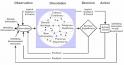
With these cognitive relationships operating continuously, mostly subconsciously with automaticity and in an iterative fashion, a different set of meanings to the phrase “inside your oponent’s OODA Loop” than just going “faster”, like a formula one race car zooming around a track.
Page 2 of 2 | Previous page
Matt:
July 26th, 2011 at 5:15 am
Yeah, I see that too with OODA. A lot of guys in my industry throw around the concept to impress others, but they really do not take the time to dig into the heart of the concept or really understand it.
Also, I liked Chet’s reference to snowmobiles. It is a theme that is extremely inspirational and useful to me, and I am a big fan of analysis and synthesis.
zen:
July 26th, 2011 at 9:39 pm
Hi Matt,
.
Me too. Most of the material I have read on creativity in education, psychology and neuroscience point to three different cognitive avenues for creative thinking – insight, synthesis and lateral/horizontal/divergent thinking exercises. The first we can’t typically control (though there is *some* evidence that we can precipitate it or make insight more likely) and the other two are fundamentally different approaches, at least initially ( horizontal thinking can lead to synthesis or insight but you usually have to have pretty good competency in one field first to see profound analogues elsewhere)
Ed Beakley:
July 26th, 2011 at 11:20 pm
Fred Leland also did a review on TEMPO (http://www.lesc.net/blog/book-review-tempo-timing-tactics-and-strategy-narrative-driven-decision-making-venkatesh-rao) and also started a discussion on the Linkedin "Disciplies of Boyd Strategy" group page. Chet made an interesting comment related to the U.S. Women’s Soccer coach:
"Everyone always talks about increasing the tempo," (Pia) Sundhage said Thursday. "We needed to decrease the tempo and control the rhythm." [Sundhage is the coach of the US women’s soccer team — watch them play the Japanese for the World Championship Sunday, July 17 at 2 pm ET on ESPN. Quote is from "Pure Brawn and Horsepower As Soccer Gets More Technical, the U.S. Women Still Thrive on Physical Play," by Matthew Futterman in the 15 July 2011 Wall St. Journal.]
I commented that I don’t have a clue what "decreaasing the tempo and controling the rhythm" means. No one decided to decipher. I am a long time reader, studier and even user of OODA as an analysis synthesis tool, but some recent writing leaves me wondering. Chet’s other comments on Fred’s post plus his comments in the book review about tempo and being "inside the opponents loop" and what Boyd said about the two raise some issues that word definition could help.
What do we mean by speed, pace, tempo, rhythm in regard to OODA? And what is inside? One flaw in the process even if you O-O-D-A well and who’s out of sync with who?
Since reading TEMPO, I have been exchanging e-mails with Rao on my ongoing work on analysis of the Battle of Midway through the lens of O,O,D,A centering around the destruction of Nagumo’s ability to command control – in effect complete inability to reestablish tempo once lost. All of this was in spite of poor observation and ability to orient on both sides, yet Spruance given Nimitz direction for both aggressiveness AND prudence acted so as to afford the best possibility and flexibility of outcome. This most certainly includes the one decision he was most criticized for – the withdrawal on the night of 4 June.
Venkatesh’s comment is most telling:
“What you are describing in the Midway case as Spruance’s reasoning is actually classic tempo/OODA thinking in my opinion. I think of the idea of “getting inside the opponent’s tempo” as having more to do with making more information-dense moves than your opponent, not necessarily moving at a faster raw tempo. i.e. it’s about how much information each “move” processes rather than the raw ratio of your moves to mine. So an experienced martial artist, for instance, may be only making 1 move for every 3 by his opponent, but his moves may have 4 times the “information processing.”
"In this case, it appears that in a symmetric case of equally poor information on both sides, Spruance moved in ways that opened up his action to more information saturation, by amplifying feedback. In my technical field of control theory, there is even a rigorous mathematical idea called “persistence of excitation” which loosely translates to ‘if you don’t have enough information about the system, any action, even random action, will help you identify the system properly and will be better than operating using bad information.’ “
Could one conjecture that "rhythym" is indicative of what is intrinsic to the organization and technology one owns/uses and "tempo" is a function of the mission application?
zen:
July 27th, 2011 at 2:09 am
Hi Ed,
.
You don’t ask small questions 🙂 I can’t speak for Chet, nor do I have your historical grasp of the Battle of Midway but here is how I would answer/define in terms of OODA with additional comments:
.
SPEED: The velocity of mental processing; how long it takes to neurocognitively move through the Loop to arrive at a decision-based action
.
Pre-Freud, Pre-James, neurological processing speed was a major area of investigation for the budding field of psychology in the mid 19th C. because they could set up observable, falsifiable, quantifiable experiments. Helmholtz discovered a time discrepancy with reality and neuroscientists today can find discrepancies not only between ppl but within the same brain depending on the task, the complexity, a person’s genetic predisposition and experience
.
PACE: the speed at which an entity is operating in a continuous series of complete OODA Loops which can be reactive (to environmental stimuli) or pro-active ( deliberately setting a pace that confounds the advantages of an opponent)
.
Organizations and people have a pace which represents maximum efficiency over a given unit of time. At the extremes of pace we become less efficient, dysfunctional or even risk harm (note: the messenger who died at Marathon).
.
TEMPO: [ clarification required]
.
In normal English "pace" and "tempo" are synonyms. "OPTEMPO" in military parlance relates to the pace of equipment/supply/whatever usage. Suspect Boyd would have used tempo and pace interchangeably but I am not sure when OPTEMPO entered the military vocabulary and could conceivably have entered into Boyd’s thinking. This is a Dr. Chet question I can’t answer.
.
CONTROLLING THE RYTHM: Having the initiative in setting an advantageous action-reaction pattern with an opponent
.
You are "inside their Loop" when you are creating patterns of behavior to which they are responding without themselves gaining the initiative.
.
On Venkat’s comment:
.
"“getting inside the opponent’s tempo” as having more to do with making more information-dense moves than your opponent, not necessarily moving at a faster raw tempo. i.e. it’s about how much information each “move” processes rather than the raw ratio of your moves to mine."
.
I am inclined to agree. This gets to cognitive efficiency in the sense of both speed and complexity (handling multiple variables). A simple word to use might be "deeper" instead of "faster". More of the potential moves derived from the information are recognized, considered, evaluated and more information in an absolute sense.
.
Anyone who wants to jump in this discussion is welcome. I am parsing possibilities here.
Ed Beakley:
July 28th, 2011 at 5:51 pm
Mark,
Thanks for "taking on the "not small question." I read TEMPO at the same time I read "Shattered Sword" which is a take on the Battle of Midway from the Japanese side. I find it hard to believe that if one is aquainted with OODA, they would not see how badly the Japanese executed the individual pieces on 4 June 1942. The question is why and I think worthy of some investigation with lessons learned possible for today’s environment in regard to how decisions are made in crisis.
Boyd’s work is all based on competition and to "getting inside" the opponent’s loop, but the decision process of O-O-D-A can be applied and is observable in many activities including response to disasters like Katrina or Deepwater Horizon. I would venture that looking at how OODA is done irrespective of the other side’s attempt or process can be valuable, and indeed hurricane’s don’t do OODA.
What struck me with the Japanese at Midway (sparked by Rao’s thoughts) is they had "commander’s intent," they had the "eastern mindset" in terms of deception and subtletness of plan, and they in fact established a "tempo" of what was to happen and when – dismantle Midway by air attack, carriers then await US carrier response while the ground fgorces take the island. Their initial "action" of "observation" was weak based on the "plan" and not on what might be possible.
Spruance with also minimal "observation" launched under the premise developed out of the "battle experiments" of the 30s which said the carrier that strikes first will win. The resultant battle was all over the place, but completely destryed the Japanese tempo of operation based on rigid compliance with commanders intent. Even after devastating losses their decision process of trying to observe and orient to what was happening was based on original mission rather than truely getting oriented to reality.
I’ll close here to say that here that there’s a lot of stuff written on Boyd and OODA, most talks "intent" and concept of "getting inside" and always makes the point its not just speed through the loop. The ideal is the folding one’s adversary back in on himself, sneakily if possible. I think there’s a need for a lot more thinking on the OODA parts and how to do them better. Dueling loops maybe possible, but reality to me says you can’t really observe that or mesasure the cause-effect in most cases. Time might be better spent insuring you do your side correctly and as Rao stated make best informed decisions to be in place to adapt.
Thanks again,
Ed