Striking Iran: Two Games and a World – Pt 2
[ by Charles Cameron – board game and board-room simulation of an Israeli strike on Iran ]
.
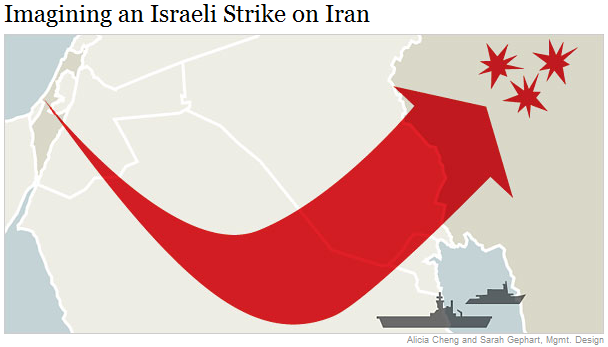
[graphic & headline from the New York Times]
[continuing from part I]
5.
Osiraq Redux
Karim Sadjadpour described a very different style of game in Foreign Policy just one day after Michael Peck’s description of Persian Incursion. It was conducted by the Brookings Saban Center, and also written up by Kenneth Pollack in the Center’s Middle East Memo of February 2010, and by David Sanger at the New York Times.
Here is Pollack’s description of the structure of the Brookings game:
The simulation was conducted as a three-move game with three separate country teams. One team represented a hypothetical American National Security Council, a second team represented a hypothetical Israeli cabinet, and a third team represented a hypothetical Iranian Supreme National Security Council.
As a scholar of religion, I would be tempted to add, after the manner of the Athanasian Creed, “Yet there are not three hypotheticals but one hypothetical.”
More:
The U.S. team consisted of approximately ten members, all of whom had served in senior positions in the U.S. government and U.S. military. The Israel team consisted of a half dozen American experts on Israel with close ties to Israeli decision-makers, and who, in some cases, had spent considerable time in Israel. Some members of the Israel team had also served in the U.S. government. The Iran team consisted of a half-dozen American experts on Iran, some of whom had lived and/or traveled extensively in Iran, are of Iranian extraction, and/or had served in the U.S. government with responsibility for Iran.
This game begins with an Israeli strike – that is to say, the strike itself is not what is gamed here: the game is designed to be “a day-long simulation of the diplomatic and military fallout that could result from an Israeli military strike against the Iranian nuclear program.” Again, I will not rehearse nor comment in much detail on what has been reported of play, both in Pollack’s official Brookings report on the game and in Sadjadpour’s account, noting only that the Brookings game features a response from Hizbollah which (as Michael Peck noted) was lacking in the board game.
6.
Differences of style
What interests me is the difference in style between the two games, the two approaches:
- The emphasis on the initial strike in Persian Incursion focuses that game more tightly on questions of materiel and logistics, while the Brookings game naturally puts greater emphasis on the responses of individuals and groups. And I’d suggest that the structures of the two games in some sense parallels that distinction:
- The board game is played by two players, typically experienced grognards, wargame hobbyists or designers, often with military backgrounds. Their skill is in decision-making in the context of such games, and Larry Bond has provided them with an exhaustively-researched briefing on the issues he considered salient.
- The board-room sim is played by a couple of dozen players, each of them already possessing their own highly detailed “takes” on the specific aspects of the game their voices will “represent”.
One might say that Persian Incursion is an entertainment and the Brookings game a high-level albeit informal strategic deliberation — but that comparison fails to account for the detailed research that has gone into PI — and the Harpoon gaming system which underlies it. Both games are serious attempts, at the limit of human imagination, to figure out — to “game” — one specific, now perhaps looming, future.
Page 1 of 3 | Next page