On form and beauty

And that’s only a fraction of what the whole series of a hundred photos offers us. Each of these, I’d submit, is what I’d term a DoubleQuote in the Wild.

One final shot, color against grey — perhaps the loveliest of all:
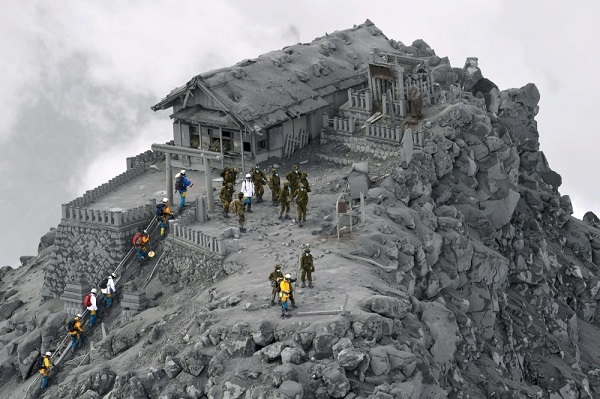
A temple covered in ash from the  /></a></p><p>A temple covered in ash from the Ontake volcanic eruption, Japan</p><p>So much humanity, so much pathos there.</p><p>**</p><p>Brilliant minds in both the arts and sciences focus as much on form as on content — on patterns, repetitions, symmetries for their own sakes, as much as on the particulars of the fields they study and in which they find them. At heart, this is a matter of aesthetic cognition.</p><p>We would do well to cultivate this kind of double vision — the awareness of form as well as content — across the board, from education and the arts to the sciences and strategy.</p><p>The moment we become polarized, however, in terms of a political or other form of partisanship, content becomes all we see (and agree or disagree with), and form effectively evaporates. In terms of the images above, we see earth or sky, summer or autumn, town or country — left or right — <strong>but not — but no longer — the whole</strong>.</p><p>Page 3 of 3 | <a href='/?p=47934&wpmp_switcher=mobile&wpmp_tp=1'>Previous page</a></p></div><p class=Posted in aesthetics, art, Charles Cameron, cognition, cognitive dissonance, Doublequotes, form, metacognition, photography, science, symmetry, Uncategorized | 2 comments

  1. Dreamtimer:

    The picture of the volcanic temple looks like an Escher painting.

  2. Charles Cameron:

    You recall that first image, titled “A toothy sea”?

    DoubleQuote it with this one: