Iconic: compare and contrast
So among other things, we’re up against the phenomenon I call “sibling pea rivalry” — where two things, places, institutions, whatever, that are about as similar as two peas in a pod, have intense antagonism between them, real or playful — Oxford and Cambridge, say, and I’m thinking here of the Boat Race, or West Point and Annapolis in the US, and the Army-Navy game.
Oxford is far more “like” Cambridge than it is “like” a mechanic’s wrench, more like Cambridge than it is a Volkswagen or even a high school, more like it even than Harvard, Yale, Princeton or Stanford — more like it than any of the so-called “redbrick universities” in the UK — so like it, in fact, that the term “Oxbridge” has been coined to refer to the two of them together, in contrast to any other schools or colleges.
And yet on the day of the Boat Race, feelings run high — and the two places couldn’t seem more different. Or let me put that another way — an individual might be ill-advised to walk into a pub overflowing with partisans of the “dark blue” of Oxford wearing the “light blue” of Cambridge, or vice versa. Not quite at the level of the Zetas and the Gulf Cartel, perhaps, but getting there…
4.
So one of the things I’ve thought a bunch about is the kind of analogy that says a : A :: b : B.
As in: Egyptian cop is to Egyptian protester as UC Davis cop is to UC Davis protester.
Which you may think is absolutely right — or cause for impeachment — or just plain old kufr!
And I’ve figured out that the reason people often have different “takes” on that kind of analogy — takes so different that they can get extremely steamed about it, and whistle like kettles and bubble over like pots — has to do with the perceptual phenomenon of parallax, whereby some distances get foreshortened in a way that others don’t.
5.
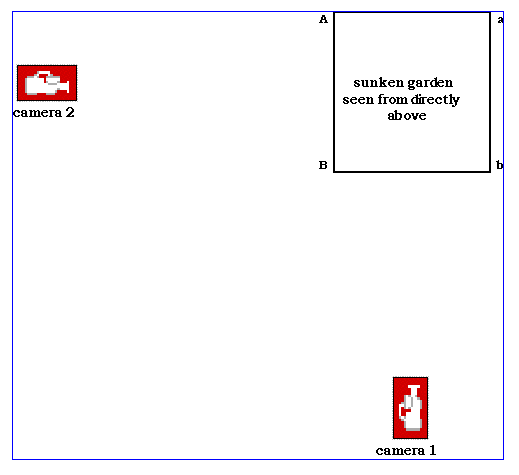
So my thought experiment sets up a sunken garden — always a pleasure, with two video cameras observing it, as in this diagram:
And from the two cameras, the respective views look like this: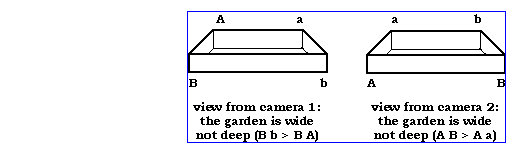
In this scheme of things, Aa (Oxford) seems very close to Bb (Cambridge) seen from the viewpoint of camera 1 — but from camera 2’s standpoint, Aa (Oxford) and Bb (Cambridge) are at opposite ends of the garden, and simply couldn’t be father apart.
6.
Now, my thinking here is either so obvious and simple as to be a platitude verging on tautology — or one of those subtle places where the closer examination of what looks tautological and obvious leads to the emergence of a new insight, a new “difference that makes a difference” in Bateson’s classic phrase.
And clearly, I hope that the latter will prove to be the case here.
7.
What can we learn from juxtapositions? What can we learn from our agreements about specific juxtapositions — and what can we learn from our specific disagreements?
Because it’s my sense that samenesses and differences both jump out at us, as Cath Styles suggested — and that both have a part to play in understanding a given juxtaposition or proposed likeness.
Each juxtaposition will, in my view, suggest both a “sameness” and a “difference” — in much the same way that an arithmetic division of integers, a = qd + r, gives both quotient and dividend.
Page 2 of 3 | Previous page | Next page