Of Boxes and Worldviews
One might say that the physical seem little more than the wooden hilt, while the moral factors are the precious metal, the real weapons, the finely honed blade.
I suggested above that we need to get out of the Matrioshka-nested boxes of our current thinking, and if I can put that another way, we need to get to the heart of creativity.
**
From the point of view of pure creativity, as diagnosed by Arthur Koestler in his classic book, The Act of Creation, the aha! or eureka! of the creative breakthrough is in fact a “creative leap” — from one frame of reference to another, as shown in this diagram based on those in his book:
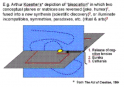
From the point of view of cognitive science, as Gilles Fauconnier & Mark Turner illustrate and confirm with neuro-scientific precision in their book on “conceptual blending”, The Way We Think, the tide has now turned from a more literal to a more analogical understanding of mental processing, at the most basic levels, and across all disciplines:
We will focus especially on the nature of integration, and we will see it at work as a basic mental operation in language, art, action, planning, reason, choice, judgment, decision, humor, mathematics, science, magic and ritual, and the simplest mental events in everyday life. Because conceptual integration presents so many different appearances in different domains, its unity as a general capacity had been missed. Now, however, the new disposition of cognitive scientists to find connections across fields has revived interest in the basic mental powers underlying dramatically different products in different walks of life.
From the point of view of Marshall McLuhan, writing to the poet Ezra Pound back in the 1940s, the issue is that following the rational enlightenment of the eighteenth century, which brought us today’s scientific and technological breakthroughs but has left us a wasteland in terms of values, threatening our planetary home with our weapons, our eager overpopulation, our fierce tribalisms, and excessive energy requirements, we have lost one central ingredient in human thought: the ability to think analogically rather than logically, in terms of relationships rather than linear causality.
McLuhan wrote, presciently,
The American mind is not even close to being amenable to the ideogram principle as yet. The reason is simply this. America is 100% 18th Century. The 18th century had chucked out the principle of metaphor and analogy.
And computer scientist and Pulitzer prize-winner Douglas Hofstadter has aptly subtitled his book Surfaces and Essences, co-authored with cognitive scientist Emmanuel Sander, “Analogy as the Fuel and Fire of Thinking”.
The analogical leap is the leap out of the box.
**
Thus far I’ve de-emphasized the “Coast Guardness” of my thinking. But let’s view some Coast Guard related issues in light of the above:
Let’s take a simple lateral comparison first – how does the Chinese Coast Guard compare with our own, what are the physical overlaps and differences, strengths and weaknesses, of theirs and ours?
Please note that this question cross-cuts, to a greater or lesser degree, with any and all other questions involving the USCG. It also leaps from ours to theirs, responds to Sun Tzu’s “know your enemy”, works by comparison and contrast, invites us into detail – and is far more easily answered in physical terms than in terms of morale. SIGINT is better at locating ships than at reading the mind and heart.
Budgeting.
If ever there was a tangled knot, the US system for allocating budgetary items would be it. Not only do the federal services each have a series of individual pulls and pushes, but the fifty states, their senators and congresspeople do too. And then there’s the lame-duck president and the president soon to be elect. Until November, there’s the two party scramble, with voters on both sides of the aisle drifting to and fro between partisanship, frustration, and independence. And there are undertows and swells of popular emotion influencing these other factors.
The Coast Guard, arriving at its wish list for the next budget, must be single minded as to its objectives, flexible as to its willingness to negotiate – to a point – but balancing its clearly understood urgencies against the shifting tides of political wills in concert and in conflict, in a multi-vectorial tug-o-war, one against many. And there are no doubt similar tussles within the USCG, doctrinal purists and innovators, old hands and new, with their own mixed agendas, their temporary victories and defeats.
Page 2 of 5 | Previous page | Next page